
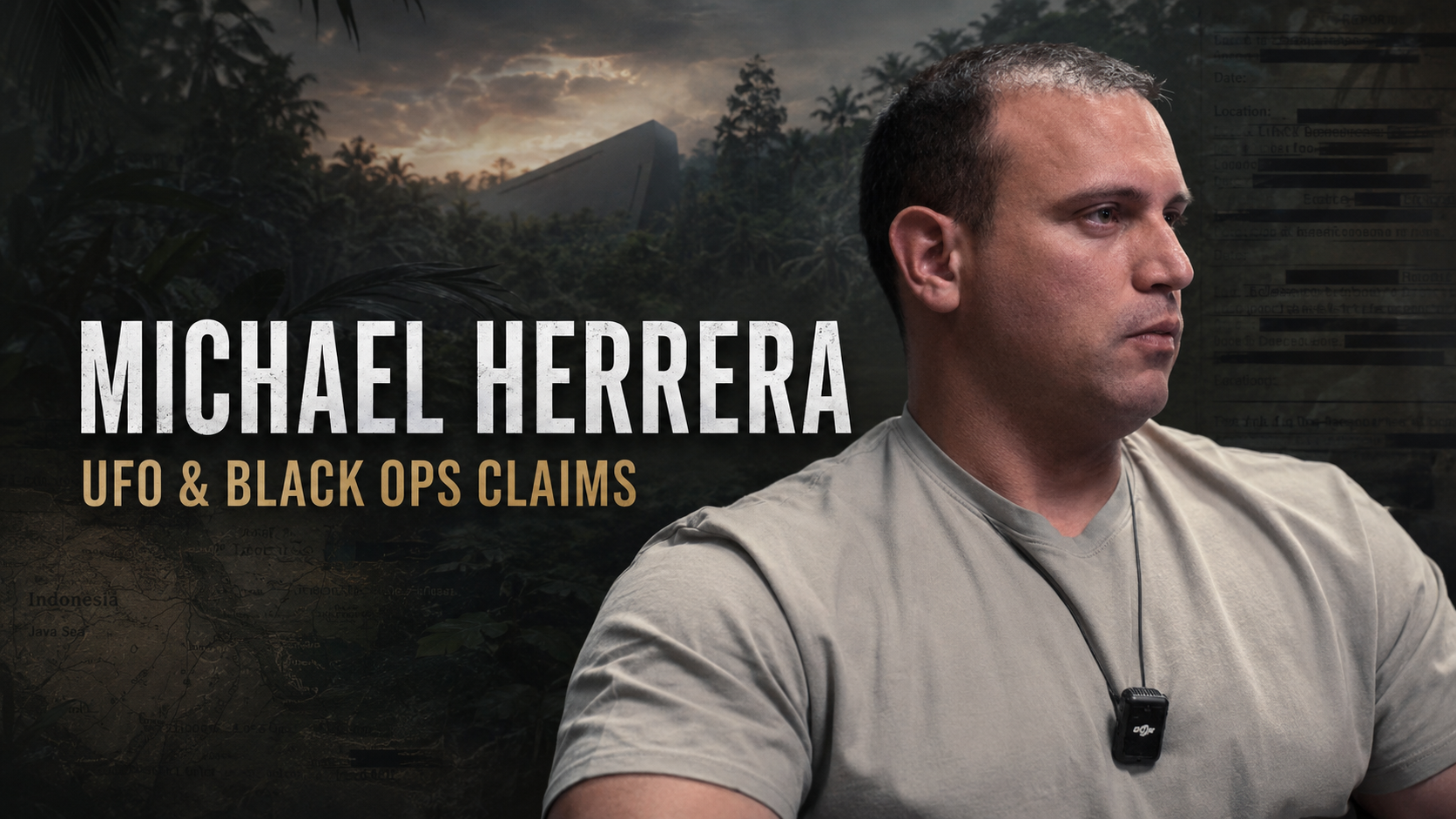
A single interview can move from an unidentified object to secret military operations and allegations of human trafficking within minutes. For readers, the challenge is to keep track of which statements describe an observation, which repeat information from other people, and which draw a conclusion.
Michael Herrera’s Shawn Ryan Show interview brings those questions together. This first article in Taming Gravity’s three-part series offers a method for evaluating the account fairly: preserve the testimony, identify what can be checked, compare competing explanations, and let confidence change with the evidence.
Watch Michael Herrera’s interview
In this Shawn Ryan Show conversation, former Marine Michael Herrera presents his account of an unusual encounter in Indonesia and the conclusions he draws about the people and activity involved. Watch the interview as the primary source for his account. As you listen, distinguish what he says he observed, what he says he learned from others, and what he concludes those details mean.
Watch directly on YouTube · Official Shawn Ryan Show episode page
The episode’s title presents serious allegations. Including that title and embedding the interview identifies the source; it does not establish that the allegations are true. The analysis below evaluates how such claims can be investigated, rather than claiming to authenticate the encounter or summarize every later development.
What is being claimed?
The show’s episode description places Herrera’s story in an Indonesian disaster-response setting and describes an alleged encounter with an unidentified craft and armed personnel. The interview also connects the account to an alleged human-trafficking operation.
Those elements involve separate questions. Was Herrera present in the relevant setting? What did he encounter? What capabilities did the object display? Who were the personnel? What supports the allegation about the operation’s purpose? Evidence that answers one question may leave the others unresolved.
For example, a record confirming a deployment would support the background chronology. It would not, by itself, authenticate an extraordinary craft. Similarly, evidence of armed security would not establish the personnel’s employer or prove a criminal purpose.
Separate observation, testimony, and interpretation
A useful reading begins by sorting statements according to how the speaker knows them. These categories should remain distinct even when they appear in the same sentence.
- Reported firsthand observation: what Herrera says he personally saw, heard, or experienced. Readers receive this through his testimony, rather than directly observing the original event.
- Information from other people: what he says someone later told him. Its value depends on that person’s access, reliability, and supporting evidence.
- Interpretation: conclusions about ownership, purpose, authority, or technology drawn from those observations and reports.
- Independent corroboration: separately obtained records, observations, or physical evidence that support a particular part of the account.
A detailed recollection can provide useful investigative leads. Detail alone does not establish accuracy, just as a witness’s uncertainty about a minor point does not automatically invalidate everything else. The task is to identify which statements can be tested and how much confidence each test warrants.
This also prevents an unfair choice between accepting the entire story and accusing the witness of deception. An account may combine accurate background facts, uncertain recollections, and conclusions that go beyond what the available evidence supports.
Start with a timeline that can be checked
Before debating the craft’s origin, build the clearest possible account of when, where, and under what circumstances the encounter allegedly occurred. A useful timeline records:
- Date and location: the narrowest time range and geographic area the witness can support, with uncertainty stated.
- Assignment and purpose: the unit, mission, and reason the group was in that area.
- Participants: who was present and which portions each person could have observed.
- Sequence: what happened before, during, and after the encounter, without filling gaps with assumptions.
- Early disclosure: when the witness first described it to someone else or recorded it in a message, photograph, diary, or report.
These details suggest specific checks: deployment records, mission logs, maps, weather observations, photographs with provenance, or people who can independently describe the same circumstances. Such records may be incomplete or inaccessible. Their availability should be investigated, not assumed.
Corroboration is strongest when sources have an independent basis for their knowledge. Several people repeating the same podcast account do not provide several independent observations. Even matching witness accounts require questions about what each person saw and whether they discussed the event before giving their accounts.
A contradiction should be examined at the same level of precision. An impossible location or an incompatible deployment date could matter substantially. A difference in an estimated distance may be less decisive, particularly if neither estimate was measured.
What would establish an extraordinary technology claim?
A description of something unfamiliar raises a question about the object. It does not identify the physical mechanism that made it move or remain suspended. Capability, mechanism, and ownership are different investigative problems.
For a claimed hovering or rapidly moving object, useful questions include viewing distance, duration, lighting, reference points, visible supports, and whether the observation was recorded. A technical assessment should ask which quantities were measured and which were estimated.
For instance, a description of rapid movement becomes more informative if investigators can establish distance and elapsed time. Without those quantities, a dramatic impression cannot simply be converted into a reliable speed or acceleration. Likewise, failing to see a propulsion system does not establish gravity control.
A stronger case would combine independently assessed observations with instrument records, authenticated imagery, or physical evidence. Each would need its own checks: sensor limitations, original files, handling history, uncertainty, and plausible alternative explanations.
This keeps established physics separate from a proposed explanation. If a gravity-control mechanism is suggested, the question becomes what distinctive, measurable effects that mechanism predicts and whether the evidence demonstrates them. Naming a technology is not the same as demonstrating it.
For the broader distinction between physical theory and a working device, see Taming Gravity’s Science & Engineering guide.
Test the strongest competing explanations
A fair inquiry asks what each explanation accounts for, what it struggles with, and what would count against it. The following are possibilities to evaluate, not findings about Herrera.
Misidentification or incomplete observation
The strongest conventional explanation would identify equipment or circumstances that fit the reported setting and observable features. Simply saying that the witness must have been confused leaves the details unexplained. Conversely, an unfamiliar appearance does not eliminate ordinary explanations.
Classified terrestrial activity
A restricted operation could explain secrecy or limited information, but it would not automatically explain an extraordinary performance claim. Nor would secrecy establish trafficking. This explanation needs specific support for access, logistics, equipment, personnel, and authority.
Unusual technology with an unresolved origin
If reliable evidence demonstrated capabilities that conventional explanations could not account for, the technological question would deserve closer investigation. Even then, the evidence would need to distinguish an unexplained capability from a demonstrated mechanism, and an unknown operator from an identified institution or nonhuman origin.
A covert network operating outside lawful oversight
This hypothesis concerns organization and conduct. It would need evidence connecting people, decisions, resources, and actions: authenticated communications, financial records, contracting relationships, or independently corroborated accounts. Similar themes across interviews cannot supply those connections on their own.
Different parts of the story could ultimately have different explanations. An inquiry should remain open to a mixed outcome instead of requiring every detail to support one sweeping theory.
Handle the trafficking allegation with precision
The allegation of human trafficking deserves careful attention because it concerns potential harm to people. Its seriousness makes accurate attribution and corroboration especially important. Concern for possible victims does not require presenting an unverified accusation as an established finding.
The key question is how the conclusion was reached. What does Herrera describe as directly observed? What does he attribute to later information? What is his own interpretation? Those distinctions should remain visible whenever the allegation is summarized.
An investigation would need evidence relevant to the alleged harm itself, rather than relying only on the unusual nature of the surrounding story. Depending on the specific allegation, useful material might include independently obtained witness accounts, authenticated communications, or records connecting people and movements to the alleged conduct.
Even a verified unusual craft would not, by itself, verify trafficking. Evidence of criminal conduct would likewise not determine the craft’s origin. The two claims must be tested separately.
Readers should avoid publicly identifying supposed perpetrators or victims from resemblance, rumor, or speculative connections. A productive contribution is a precise, attributable source that can be assessed without exposing uninvolved people to accusations.
A practical method for evaluating the interview
Choose one important claim and follow it carefully. This is more manageable than trying to settle the entire account at once.
- Record the exact statement and timestamp. Preserve enough context to distinguish the guest’s words from the host’s question or a later paraphrase.
- Identify its basis. Mark it as a reported observation, information from another person, interpretation, or an independently supported fact.
- List the best available check. Name the record, witness, measurement, or original file that could support or contradict it.
- Check independence and provenance. Establish where the material came from and whether it adds evidence beyond repeating the original account.
- Write down what would change your assessment. Apply that standard to evidence that weakens your preferred explanation as well as evidence that strengthens it.
For example, an authenticated record placing a witness in the relevant area would strengthen the opportunity-to-observe part of the case. It would leave the object’s capabilities and the trafficking allegation as separate questions. An independently documented mismatch in the central timeline could weaken the account without requiring speculation about the witness’s motives.
Avoid treating every missing record as evidence of suppression. Ask whether the proposed event would reasonably have generated that record, who would retain it, and whether the search was capable of finding it. Equally, a lack of public records should not be described as proof that nothing occurred.
The UAP Investigation guide provides the wider framework. Our close-encounter overview explains descriptive categories; using a category does not authenticate an event or establish its cause.
How the three accounts fit together
This series compares the questions raised by three accounts while preserving the evidence boundaries of each:
- Part 1: Michael Herrera examines an alleged encounter in Indonesia and how to separate observations from conclusions about technology, operators, and criminal purpose.
- Part 2: DC Long examines his Range 19 underground-facility account and the records that could help test its chronology and associated allegations.
- Part 3: Eric Hecker examines his Antarctic claims involving Raytheon, directed energy, and earthquakes, alongside the distinction between documented infrastructure and alleged capabilities.
Shared themes can suggest useful questions, but they do not establish a shared program. Corroboration requires a specific connection supported by evidence independent of the similarity itself. One account’s unresolved details cannot fill another account’s evidentiary gaps.
That approach reflects the Taming Gravity manifesto: investigate unusual possibilities while keeping observations, testimony, physical theory, and interpretation distinct.
Three takeaways and the next useful question
Herrera’s interview offers a starting point for questions about unusual observations, secrecy, and accountability. The useful next question is: which specific piece of independent evidence would most clearly distinguish the competing explanations?
If you contribute to the discussion, bring a timestamp, an original source, or a clearly stated question. Explain what that material establishes and what remains unresolved. That is how this conversation can develop into an inquiry readers can evaluate for themselves.
Reader Q&A
Does this article accuse Michael Herrera of lying?
No. It evaluates the relationship between testimony and supporting evidence. Questions about accuracy or interpretation do not establish deliberate deception.
What would count as meaningful corroboration?
Material that independently supports a specific claim: an authenticated contemporaneous record, a witness with direct relevant knowledge, or assessable imagery or measurements. Its significance depends on what it actually establishes, not simply on the number of people sharing it.
Does an unidentified craft imply nonhuman intelligence?
No. An unresolved identification leaves the origin open. Establishing a particular origin requires evidence that distinguishes it from competing possibilities.
Can something be classified without being unlawful?
Secrecy and alleged wrongdoing are separate questions. Restricted access alone does not establish criminal conduct, and it does not excuse conduct if independent evidence establishes wrongdoing.
Do the other two interviews confirm Herrera’s account?
Similarity alone does not provide confirmation. The DC Long and Eric Hecker articles examine distinct accounts; a connection between them would need specific, independently supported evidence.














Leave a Reply