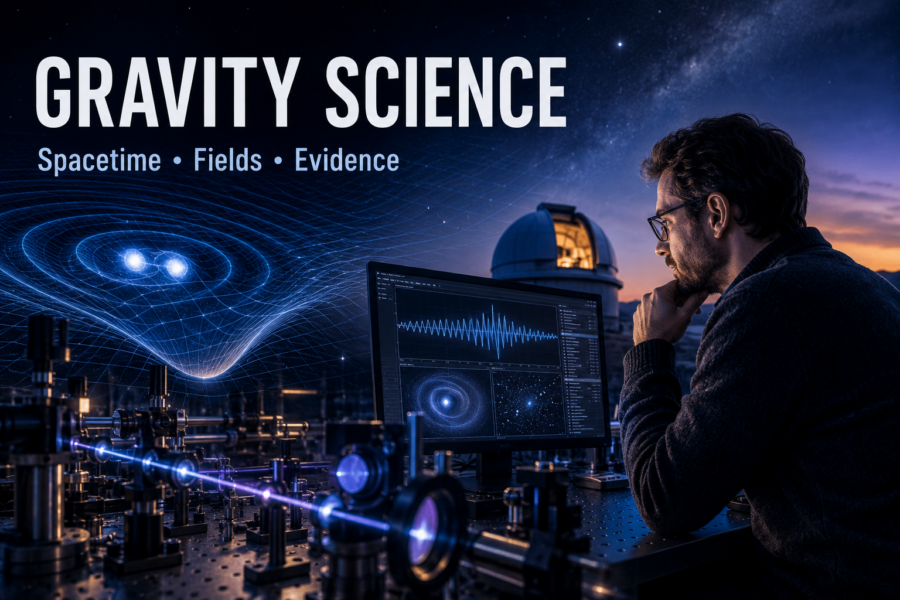
Taming Gravity foundational guide
From established gravity physics to testable ideas for advanced propulsion
Humanity already knows how to predict gravity with extraordinary precision, detect ripples in spacetime, navigate spacecraft, and simulate gravity through rotation or acceleration. What we do not yet possess is verified technology that can shield, reverse, amplify, or engineer gravity on demand. This section examines both realities together: the science that has earned confidence through measurement and the frontier proposals that must still earn it through transparent, repeatable evidence.
Three key takeaways
- Gravity science and gravity engineering are not the same stage of knowledge. A valid equation, mathematical spacetime, patent, laboratory anomaly, and working propulsion system are different achievements.
- Open-minded inquiry requires stronger testing—not weaker standards. Unconventional proposals deserve fair examination, while extraordinary performance claims require reproducible measurements and independent confirmation.
- Taming Gravity follows evidence across institutional boundaries. Universities, government laboratories, independent researchers, witnesses, archives, and unconventional investigators can all contribute information, but each contribution must be identified according to what it actually establishes.
The Purpose of Science & Engineering
Taming Gravity begins with a question that is both imaginative and technically demanding: could humanity ever move from understanding gravity to deliberately shaping gravitational or spacetime effects?
The honest answer is that we do not yet know. General relativity demonstrates that mass-energy and spacetime geometry are intimately related. Modern astronomy has confirmed many of the theory’s predictions, including gravitational waves and frame-dragging. Yet those achievements do not automatically provide an engineering method for producing useful spacetime curvature in a laboratory or propelling a vehicle without conventional reaction mass.
This hub therefore joins two complementary areas:
Gravity Science
The established theories, observations, experiments, unresolved questions, and proposed quantum descriptions that shape our present understanding of gravity.
Propulsion & Engineering
The process of turning physical principles and hypotheses into measurable effects, controlled experiments, reproducible devices, and—only if the evidence supports it—usable propulsion.
Science before certainty
The purpose of this section is neither to defend conventional opinion automatically nor to declare unconventional technology real prematurely. It is to identify what has been observed, what has been calculated, what has been claimed, what remains disputed, and what experiment could distinguish among the possibilities.
The Taming Gravity Evidence Ladder
The old version of this page divided ideas into “conservative” and “fringe.” That language can obscure the real issue. A proposal should not be judged simply by whether it is institutionally popular or culturally unconventional. It should be judged by the kind and quality of evidence supporting it.
| Level | What it means | Examples | What it does not prove |
|---|---|---|---|
| 1. Established | Repeatedly tested theory or observation with strong independent agreement. | Orbital dynamics, relativistic time corrections, gravitational waves, frame-dragging. | That gravity can be engineered into a propulsion field. |
| 2. Active research | Serious unresolved scientific work with recognized methods and open questions. | Quantum gravity, dark matter, dark energy, precision tests of relativity. | That any particular proposed unification or mechanism is correct. |
| 3. Theoretical possibility | A mathematical model or solution consistent with specified assumptions. | Warp-drive metrics, wormhole geometries, some emergent-gravity models. | That required matter, energy, control systems, or construction methods exist. |
| 4. Preliminary or disputed evidence | A reported anomaly, limited experiment, patent, instrument result, or effect lacking robust independent replication. | Some superconducting gravity claims, anomalous thrust reports, electrogravitic interpretations. | That the effect is gravitational, scalable, independently verified, or useful for propulsion. |
| 5. Interpretive or speculative claim | Testimony, reconstruction, inference, historical allegation, or explanatory hypothesis. | Claims that observed UAP use metric engineering or gravity control. | The origin, mechanism, ownership, or even physical nature of an unexplained observation. |
A mathematical solution is not yet a machine
Physics can describe possible geometries or relationships without showing that nature supplies the required conditions—or that engineers can create, stabilize, control, and safely use them. Mathematics establishes consequences under assumptions. Engineering must establish materials, energy, control, measurement, scalability, reliability, and safety.
Gravity Science: What We Know
Newtonian gravity remains extraordinarily useful
Newton’s law of universal gravitation accurately describes a vast range of ordinary situations, from falling objects to planetary and spacecraft trajectories. It is not the final description of gravity, but it remains an exceptionally effective approximation when gravitational fields are not extreme and velocities are well below the speed of light.
General relativity describes gravity as spacetime geometry
Einstein’s general relativity goes deeper. Matter and energy influence spacetime geometry, and that geometry influences how matter and light move. The theory accounts for phenomena that Newtonian gravity cannot fully describe, including gravitational time dilation, the detailed motion of Mercury, light deflection, black holes, gravitational waves, and frame-dragging around rotating masses.
The direct detection of gravitational waves by LIGO transformed spacetime dynamics from a prediction into a new observational science. These waves demonstrate that changing distributions of mass-energy can produce propagating disturbances in spacetime. They do not, by themselves, show that a compact device can produce a controllable gravitational field strong enough for propulsion.
Gravitomagnetism is real—but normally extremely weak
General relativity predicts effects loosely analogous to magnetism when mass-energy moves or rotates. Frame-dragging is one such effect and has observational support. This provides a legitimate scientific basis for studying gravitomagnetic phenomena. It does not validate every claim that an electromagnetic or superconducting apparatus produces an amplified gravitational field.
Quantum gravity remains unfinished
General relativity describes gravity successfully on large scales, while quantum theory describes matter and the other interactions with extraordinary precision. A complete experimentally verified quantum theory of gravity has not yet emerged. String theory, loop quantum gravity, emergent-gravity approaches, and other frameworks investigate parts of this problem, but no single proposal has achieved decisive empirical confirmation.
Where possibility genuinely remains open
An unfinished theory of quantum gravity means our understanding is incomplete. It does not mean that every proposed gravity-control mechanism is equally plausible. The productive position lies between premature dismissal and premature confirmation: identify a mechanism, derive predictions, design discriminating experiments, disclose methods, and invite independent replication.
Artificial Gravity Already Within Engineering
“Artificial gravity” can refer to very different things. Engineers already understand methods that reproduce some of gravity’s felt effects without creating a new gravitational field.
Rotation
A rotating habitat can press occupants toward its outer wall, producing a gravity-like experience through centripetal acceleration. Radius and rotation rate determine the effective acceleration, while Coriolis effects, motion sickness, structural loads, and human adaptation shape the design. NASA continues to study rotating systems and human centrifugation for long-duration missions.
Linear acceleration
A spacecraft under sustained acceleration would create a gravity-like environment in the direction opposite its acceleration. This follows the equivalence between local acceleration and gravitational experience, but maintaining Earth-like acceleration over long periods would require propulsion and energy capabilities far beyond present spacecraft.
Magnetic levitation is not gravity control
Magnetic systems can lift or suspend appropriate materials and can counteract weight in particular experimental conditions. The force is electromagnetic, not evidence that gravity has been shielded or reversed. Distinguishing an effect from its interpretation is essential throughout frontier research.
| Method | Present status | Underlying effect |
|---|---|---|
| Rotating habitat | Established physics; significant engineering and human-factors work remains | Centripetal acceleration |
| Continuous linear acceleration | Established principle; presently impractical for sustained high acceleration | Inertial acceleration |
| Magnetic levitation | Demonstrated for suitable systems | Electromagnetism |
| Generated gravity-like field | No independently verified propulsion-capable system | Proposed gravitational or effective-field mechanism |
Frontier Gravity and Propulsion Concepts
Metric engineering
Metric engineering is a useful umbrella term for attempts to deliberately influence spacetime geometry rather than merely move through an unchanged background. General relativity mathematically relates geometry to stress-energy. The unresolved engineering question is whether any physically attainable distribution of matter, energy, pressure, fields, or quantum states can create a useful, controllable geometry without impossible requirements or destructive side effects.
Explore metric engineering research and commentary →
The Alcubierre metric
Miguel Alcubierre showed that Einstein’s equations admit a spacetime in which a localized region could, mathematically, be transported through expansion behind it and contraction ahead of it. The original model requires negative energy density and raises major issues involving energy conditions, formation, stability, causality, radiation, and control. It is therefore a theoretical laboratory—not a blueprint for an existing warp engine.
Explore Alcubierre warp-drive analysis →
Ning Li and A/C gravity
Physicist Ning Li published theoretical work involving gravitomagnetic effects in rotating superconductors and later became associated with proposed “A/C gravity” concepts. Her work deserves accurate historical and technical examination. However, the existence of papers, patents, contracts, or reported experiments does not establish that a propulsion-capable gravity field was successfully demonstrated. The central questions remain measurement quality, experimental controls, documentation, independent replication, and the distinction between electromagnetic artifacts and genuinely gravitational effects.
Gravitomagnetic field proposals
Because gravitomagnetism is part of general relativity, exploring whether unusual matter configurations could enhance measurable effects is a legitimate theoretical question. But moving from astronomical frame-dragging to a strong laboratory field requires a quantitatively credible mechanism. Any claimed enhancement must survive tests for vibration, thermal gradients, ion wind, magnetic coupling, electrostatic forces, sensor drift, data selection, and ordinary thrust.
Explore gravitomagnetic field effects →
Electrogravitics and anomalous propulsion
High-voltage systems can produce striking motion, but many apparent “electrogravitic” effects can arise from ion wind, corona discharge, asymmetric electrostatic forces, or interactions with the experimental environment. A credible claim must demonstrate performance under controlled vacuum conditions, isolate electromagnetic coupling, quantify momentum transfer, and permit independent teams to reproduce the result.
Claims that require special caution
A patent is not proof that a device works. A government contract proves that work was funded, not that its hypothesis succeeded. A classified context can explain missing information, but it cannot substitute for public evidence. Testimony may identify a question worth investigating, but it does not independently verify the mechanism being described.
From an Interesting Effect to Real Technology
Transformative technologies do not emerge from labels. They emerge through a chain of increasingly demanding achievements:
- Define the claimed effect. What measurable quantity changes, by how much, under what conditions?
- Specify the mechanism. What theory predicts the effect, and what competing explanations exist?
- Control ordinary causes. Eliminate thermal, mechanical, aerodynamic, electrostatic, magnetic, software, and human-selection artifacts.
- Pre-register decisive tests. State success and failure criteria before examining the final data.
- Replicate independently. Researchers without a stake in the original claim must reproduce the effect.
- Establish scaling. Show how the measured effect changes with energy, mass, geometry, frequency, temperature, or field strength.
- Demonstrate controlled operation. Turn the effect on and off, vary it predictably, and maintain stability.
- Measure the full energy and momentum balance. Account for inputs, outputs, waste heat, radiation, and environmental coupling.
- Evaluate safety and ethics. Consider failure modes, ecological consequences, weaponization, access, and governance.
The decisive question
The most useful question is not “Is this mainstream or fringe?” It is: What observation would distinguish this proposed mechanism from error, artifact, or a conventional explanation? A theory becomes scientifically productive when it risks being wrong in a clear and testable way.
What UAP Observations Can—and Cannot—Contribute
Some UAP reports describe apparent acceleration, hovering, unusual trajectories, low observability, or movement across different environments. Such observations can motivate technical questions. They may also reflect incomplete data, perspective effects, sensor behavior, atmospheric phenomena, conventional systems, data-processing limitations, or inaccurate interpretation.
A reported performance characteristic is not automatically a measurement of propulsion. Even a genuinely anomalous trajectory would not, by itself, reveal whether the cause was gravitational, electromagnetic, aerodynamic, inertial, perceptual, computational, classified, natural, or something not yet considered.
| Evidence | What it can contribute | Primary limitation |
|---|---|---|
| Witness testimony | Timing, appearance, experience, direction, behavior, context | Memory, perception, viewing conditions, later reconstruction |
| Video or photography | Recorded angular motion, brightness, shape constraints, sequence | Distance, scale, sensor processing, provenance and metadata |
| Radar or multisensor data | Potential range, velocity, track correlation, independent channels | Calibration, access, classification, clutter, correlation errors |
| Physical traces | Materials, environmental changes, biological or electromagnetic effects | Chain of custody, contamination, controls, alternative causes |
| Official documents | Institutional actions, reported incidents, programs and historical context | An official record documents a claim or action; it does not necessarily verify the claim’s interpretation |
The appropriate bridge between UAP investigation and engineering is therefore not assumption—it is measurement. If an observation suggests unusual performance, researchers should ask what data would be needed to calculate distance, velocity, acceleration, energy, environmental interaction, and uncertainty.
Unexplained is a finding, not an origin
“Unexplained” can be an honest and important conclusion. It means the available evidence has not established an adequate explanation. It does not, by itself, establish extraterrestrial technology, gravity control, psychological error, secret military hardware, or any other specific origin.
A Better Research Culture
Scientific institutions can become cautious, political, competitive, or slow to engage stigmatized subjects. Independent communities can become vulnerable to weak controls, confirmation bias, commercial incentives, charismatic authority, or claims that cannot be checked. Neither institutional status nor outsider status guarantees truth.
Taming Gravity’s approach is to take the strongest contribution from each side:
- From established science: mathematical precision, calibrated instruments, peer criticism, replication, and cumulative knowledge.
- From frontier inquiry: willingness to examine anomalies, cross disciplinary boundaries, revisit assumptions, and ask questions institutions may avoid.
- From historical and traditional inquiry: long-range perspective on human experience and meaning—without treating philosophical correspondence as laboratory proof.
- From engineering: operational definitions, tolerances, failure analysis, energy accounting, and demonstrations that other people can reproduce.
This is consistent with the larger purpose expressed in the Taming Gravity Manifesto: human understanding evolves when curiosity and responsibility develop together. Our models must remain open to revision while staying answerable to reality.
Our editorial commitment
We will not dismiss a claim solely because it challenges convention. We will not accept it solely because it inspires us, opposes powerful institutions, appears in an official document, or comes from a trusted personality. We will identify the evidence, represent competing explanations fairly, disclose uncertainty, correct errors, and keep asking what better data would resolve the question.
Explore Science & Engineering
Gravity Science
General relativity, quantum gravity, gravitational waves, frame-dragging, measurement, and the boundaries of established knowledge.
Enter Gravity Science →
Propulsion & Engineering
Metric engineering, experimental design, propulsion concepts, energy requirements, patents, replication, and the path from theory to technology.
Enter Propulsion & Engineering →
How Taming Gravity Works
Explore the site’s larger framework for investigating gravitational manipulation, anomalous observations, and future implications.
Read the framework →
News & Archive
Follow new developments and revisit the historical record with modern context and source-aware analysis.
Explore the record →
Frequently Asked Questions
Has science proven that gravity can be controlled?
No. Science can predict gravitational behavior with great precision, and engineers can simulate gravity-like acceleration through rotation or linear acceleration. No publicly verified device has demonstrated controllable gravity shielding, amplification, reversal, or propulsion.
Does general relativity permit warp drive?
General relativity admits mathematical spacetime geometries such as the Alcubierre metric. That does not establish that the required energy conditions can exist, that the geometry can be created and controlled, or that a safe engineering implementation is possible.
Is gravitomagnetism only a theory?
Gravitomagnetic effects such as frame-dragging are genuine predictions of general relativity with observational support. The unsettled question is whether any attainable laboratory configuration could amplify or engineer such effects to a technologically useful strength.
Did Ning Li demonstrate A/C gravity?
Ning Li developed theoretical proposals involving superconductors and gravitomagnetism and became associated with experimental gravity-control claims. Publicly available evidence has not established an independently replicated, propulsion-capable A/C gravity device. Her work remains historically important and worthy of careful source-based review.
Could UAP be evidence of advanced propulsion?
Some reports may justify investigating unusual performance, especially when supported by reliable multisensor data. An unexplained observation does not reveal its origin or propulsion mechanism. Distance, velocity, acceleration, sensor behavior, uncertainty, and conventional alternatives must be established before technical conclusions can follow.
Why examine unconventional ideas at all?
Science advances by testing questions, including difficult or unpopular ones. The safeguard is not to ban unconventional ideas; it is to require clear predictions, transparent methods, appropriate controls, independent replication, and conclusions proportional to the evidence.
Selected References and Starting Points
- Einstein Online — Max Planck Institute explanations of general relativity, spacetime, and frame-dragging.
- LIGO Scientific Collaboration: Gravitational-Wave Science — observations and explanations of gravitational waves.
- NASA: Artificial Gravity — rotational artificial gravity and human health during long-duration spaceflight.
- NASA Technical Reports Server: Evidence Report—Artificial Gravity — research assessment of artificial-gravity approaches.
- Miguel Alcubierre, “The Warp Drive: Hyper-Fast Travel Within General Relativity” — the original 1994 spacetime proposal.
- arXiv General Relativity and Quantum Cosmology — current preprints; inclusion is not equivalent to peer review or validation.
A living hub
Science & Engineering will evolve as experiments improve, records emerge, claims are tested, and theories change. When evidence strengthens, weakens, or overturns an interpretation, this page and its supporting articles should change with it.
Continue exploring: Begin with Gravity Science, move into Propulsion & Engineering, or read the Taming Gravity Manifesto for the larger purpose behind the inquiry.