Unveiling the Mysteries: Real-Life Examples of Close Encounters of the Second Kind (CE2)
The fascination surrounding Unidentified Flying Objects (UFOs) has found a place in human imagination and scientific curiosity alike. This interest gained substantial scholarly structure thanks to Dr. J. Allen Hynek’s comprehensive classification system for UFO encounters. Among these classifications, “Close Encounters of the Second Kind” (CE2) occupies a particularly intriguing niche. Defined as UFO sightings that leave behind physical evidence or have a tangible effect on the environment or living beings, CE2 experiences serve as the linchpin between mere sightings and the more controversial claims of direct contact with extraterrestrial life.
These encounters often produce material evidence—ranging from physical markings on the ground to electromagnetic disturbances—that invites rigorous scientific scrutiny. In this exploration, we delve into seven real-life cases of CE2 that have confounded skeptics, puzzled scientists, and captivated the imaginations of UFO enthusiasts around the world. These cases often feature compelling and, at times, disturbing, physical effects, offering what many consider to be tangible proof that we may not be alone in the universe.
The study of UFOs has captivated the world for decades. A subset of this intrigue lies in the classification system devised by Dr. J. Allen Hynek, which organizes UFO encounters based on their intensity and interaction with our environment. “Close Encounters of the Second Kind” (CE2), wherein the UFO sighting has an observable effect on the immediate environment or the beings within it, presents some of the most compelling and often controversial evidence for UFO phenomena. Over the years, numerous cases have claimed to belong to this category, offering physical proof of unexplained aerial phenomena.
CE-2 Main Points:
- Hynek’s Classification and CE2’s Unique Position: Dr. J. Allen Hynek’s comprehensive classification system for UFO encounters has provided a scholarly framework for studying these phenomena. Within this system, “Close Encounters of the Second Kind” (CE2) hold a unique position. They are defined by their tangible, physical effects on the environment or living beings, serving as an intermediate category between mere sightings and the more extreme claims of direct contact with extraterrestrial entities.
- Physical Evidence and Scientific Scrutiny: CE2 encounters often present material evidence, ranging from ground markings to electromagnetic disturbances. This physical evidence invites rigorous scientific investigation and often serves as compelling data for those arguing for the existence of unexplained aerial phenomena.
- Captivating and Controversial Cases: Over the years, numerous real-life cases falling under the CE2 category have captured global attention. These instances have confounded skeptics, intrigued scientists, and captivated the imagination of UFO enthusiasts. They often provide what many consider to be concrete proof that unexplained phenomena may be interacting with our world in ways we do not yet understand.
These main points serve as a roadmap for the in-depth exploration of seven intriguing historical examples of CE2 that follow.
Historic Examples:
- Socorro, New Mexico (1964): Police officer Lonnie Zamora reported seeing an oval-shaped craft landing in the desert. Upon approaching the site, he noticed four leg marks in the ground where the object had apparently landed and a patch of smoldering brush underneath where the object had been.
- Delphos, Kansas (1971): A teenager named Ronald Johnson claimed to see a luminous, mushroom-shaped object hovering close to the ground. After the object left, he found a glowing ring on the ground where the object had hovered, and the soil within that ring was found to be impermeable to water for some time after the incident.
- Maury Island, Washington (1947): Harold Dahl reported seeing six doughnut-shaped objects near Maury Island. Debris from one of the objects fell onto his boat, damaging it and injuring his son. Dahl collected some of the debris as evidence.
- Colares, Brazil (1977): Over a period of months, numerous residents reported seeing strange lights and objects in the sky. Many claimed these objects emitted beams of light that left burn marks on their skin. The Brazilian government initiated “Operation Saucer” to investigate these events.
- Rendlesham Forest, England (1980): US Air Force personnel from RAF Bentwaters reported seeing strange lights over the forest. Upon investigation, they found three depressions in the ground and increased radiation levels. These events happened over multiple nights.
- Trans-en-Provence, France (1981): Renato Nicolai, a farmer, claimed to see a saucer-shaped object land in his field briefly and then fly away. An investigation found that the plants in the area had undergone rapid aging and other cellular changes.
- Cash-Landrum Incident, Texas (1980): Betty Cash, Vickie Landrum, and Colby Landrum experienced an intense encounter with a diamond-shaped UFO on a road in Texas. Following the incident, they suffered from symptoms resembling radiation poisoning, and their car had damages reportedly from the encounter.
The enigma surrounding UFOs and extraterrestrial encounters has long been a subject of intense debate and speculation. Yet, among the various classifications that Dr. J. Allen Hynek proposed, Close Encounters of the Second Kind stand as a special category that teases the line between skepticism and belief. The cases we’ve explored here provide us with tantalizing hints of a reality that is far more complex than what we understand, underscored by the physical evidence or physiological effects left behind.
While skeptics may still hold ground by suggesting alternative explanations—be they natural phenomena, military experiments, or even hoaxes—the tangible data connected with these CE2 instances offer an unparalleled opportunity for scientific investigation. Even if these events could be conclusively explained by earthly means, they would still represent remarkable phenomena worthy of study in fields as diverse as physics, environmental science, and psychology.
Thus, whether one approaches the subject of UFOs with credulity or skepticism, it’s hard to deny the value of examining CE2 encounters closely. They challenge our fundamental understanding of what is possible, calling into question established scientific principles and asking us to extend the boundaries of our knowledge and methodologies. As we continue to probe into the mysteries of our universe—through telescopes pointed at far-off galaxies or through microscopes focused on cellular structures—the questions raised by these CE2 encounters remind us that some of the greatest mysteries may be much closer to home. And, as we dare to venture further—both out into space and into the depths of scientific research—it’s encounters of this kind that fuel the imagination and drive discovery, beckoning us toward an ever-expanding frontier of understanding.
Frequently Asked Questions About Close Encounters of the Second Kind (CE2)
Close Encounters of the Second Kind (CE2) occupy a unique position in Dr. J. Allen Hynek’s classification system because they involve reported physical effects associated with an unidentified aerial phenomenon. The following questions explore what distinguishes CE2 cases, how they are investigated, and why they continue to generate scientific interest and debate.
What is a Close Encounter of the Second Kind (CE2)?
A Close Encounter of the Second Kind (CE2) is a reported UFO encounter that includes alleged physical effects on the environment, technology, animals, or people. Unlike a simple sighting, CE2 cases involve claims of measurable changes or trace evidence that investigators may be able to examine.
How does CE2 differ from a Close Encounter of the First Kind?
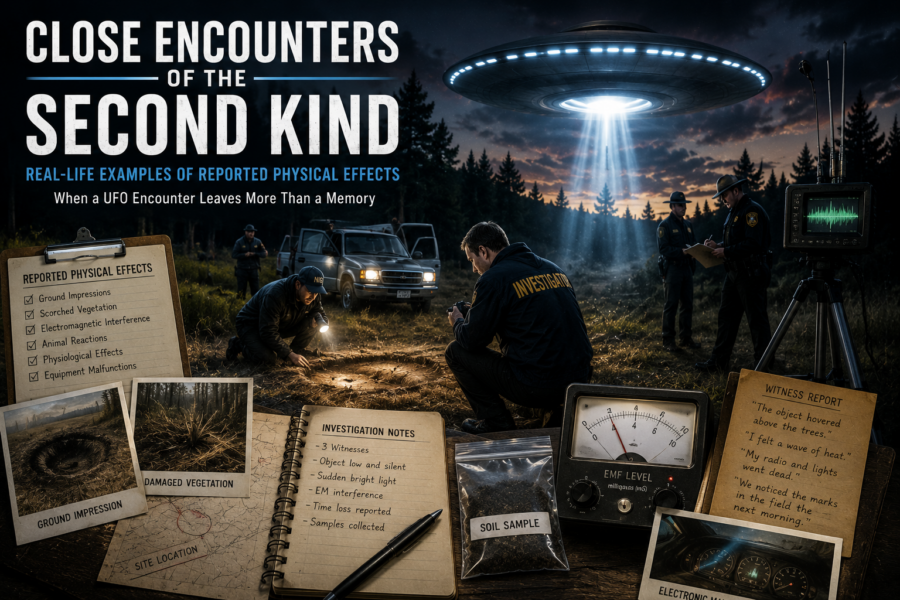
A Close Encounter of the First Kind (CE1) involves observing an unidentified aerial object at close range without any reported physical interaction. CE2 includes a similar sighting but adds alleged physical evidence such as ground impressions, damaged vegetation, electromagnetic interference, physiological effects, or unusual animal behavior.
What types of physical evidence are commonly reported in CE2 cases?
Witnesses have reported ground depressions, scorched vegetation, electromagnetic interference affecting vehicles or electronics, unusual animal reactions, temporary physiological symptoms, and other environmental changes. Each claim must be evaluated individually because similar effects can also result from natural or human-made causes.
Does physical evidence prove that a UFO was extraterrestrial?
No. Physical evidence may demonstrate that an unusual event occurred, but it does not by itself establish the origin of the phenomenon. Environmental traces, equipment malfunctions, or medical symptoms can have multiple possible explanations that require careful scientific investigation.
Why are CE2 cases considered especially important to investigators?
Unlike eyewitness testimony alone, CE2 reports may provide physical evidence that can potentially be measured, photographed, sampled, or analyzed in a laboratory. This makes CE2 one of the few close encounter categories that may allow independent scientific examination after the event has ended.
What are some of the best-known CE2 cases?
Frequently discussed examples include the Socorro incident (1964), Delphos, Kansas (1971), Maury Island (1947), Colares, Brazil (1977), Rendlesham Forest (1980), Trans-en-Provence (1981), and the Cash-Landrum incident (1980). These cases remain subjects of continuing debate and have not reached universal scientific agreement regarding their causes.
How do scientists investigate reported CE2 evidence?
Investigators may document witness testimony, collect soil or vegetation samples, photograph trace evidence, analyze electromagnetic effects, review medical records when appropriate, compare environmental conditions, and eliminate conventional explanations before considering more unusual possibilities.
What conventional explanations are often considered?
Researchers examine numerous possibilities, including aircraft activity, military exercises, lightning, atmospheric phenomena, geological processes, equipment failures, environmental contamination, hoaxes, and ordinary mechanical or biological causes. A thorough investigation attempts to test each explanation against the available evidence.
Can CE2 reports produce physiological effects on witnesses?
Some witnesses have reported symptoms such as heat sensations, burns, headaches, temporary paralysis, nausea, eye irritation, or fatigue. While these reports are documented in several well-known cases, none of these symptoms alone demonstrates the presence of an unidentified aerial phenomenon, as many conventional medical explanations are also possible.
How reliable is the physical evidence found in CE2 cases?
The reliability varies considerably from case to case. Some reports include photographs, laboratory analyses, or multiple independent witnesses, while others rely primarily on personal testimony. The quality, preservation, and chain of custody of any physical evidence play a major role in determining its scientific value.
Could modern technology improve future CE2 investigations?
Yes. High-resolution cameras, drones, satellite imagery, environmental sensors, forensic laboratory techniques, GPS data, artificial intelligence, and standardized reporting systems could significantly improve the documentation and analysis of future CE2 reports.
What is the most balanced scientific perspective on CE2?
CE2 reports deserve careful investigation because they involve claims of physical evidence rather than observation alone. However, no individual CE2 case has yet provided conclusive scientific proof of extraterrestrial visitation. A balanced approach remains open to new evidence while applying rigorous scientific methods and considering all plausible explanations.
Rounding It Up:
While skeptics often point to alternative explanations for such incidents, the physical evidence associated with Close Encounters of the Second Kind offers compelling data for the existence of unexplained aerial phenomena. These events, regardless of their true origins, provide crucial material for scientists, investigators, and enthusiasts to study, analyze, and debate. They also emphasize the importance of keeping an open mind while seeking evidence-based answers.
Key Takeaways:
- The physical evidence linked with CE2 cases presents a unique and often controversial dimension to UFO phenomena.
- While explanations for such encounters vary, the occurrences undeniably introduce compelling data that challenges our understanding of the known world.
- Investigating these events with a scientific lens can pave the way for new insights, irrespective of one’s stance on UFOs.
“In the vast abyss of space, these terrestrial tales of the unexplained remind us that the universe’s mysteries might just be closer than we think.”
References:
- Hynek, J. A. (1972). “The UFO Experience: A Scientific Inquiry”. Chicago: Henry Regnery Company.
- Clark, J. (1998). “The UFO Book: Encyclopedia of the Extraterrestrial”. Visible Ink Press.
- Ruppelt, E. J. (1956). “The Report on Unidentified Flying Objects”. Doubleday.
- Smithsonian Channel (YouTube Channel)
- “This blog post was generated with the assistance of GPT-3, an AI language model developed by Openai.com.”