A Little Historical Introduction to “Close Encounters of the First Kind” (CE1)
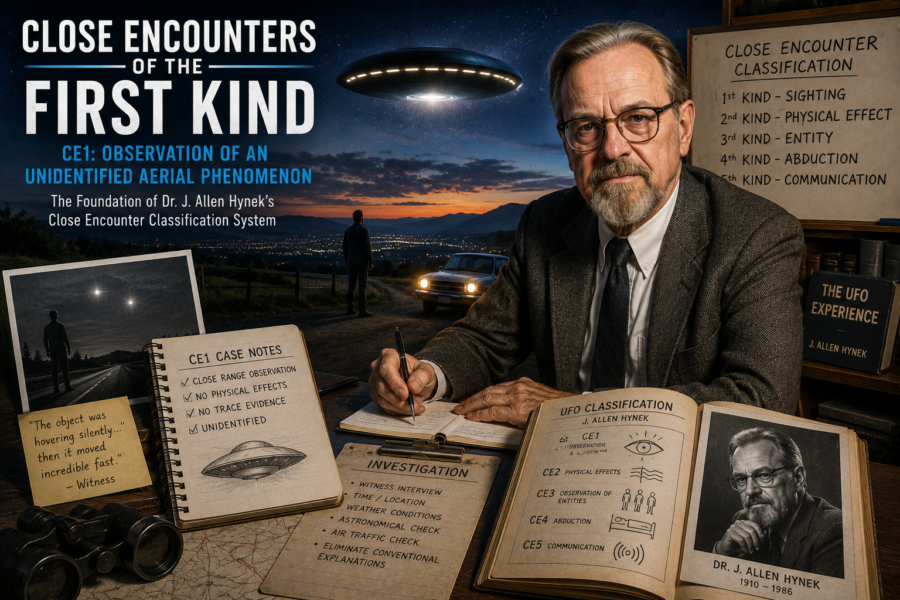
A “Close Encounter of the First Kind” refers to a classification of UFO (Unidentified Flying Object) encounters wherein a person witnesses an unidentified object in the sky at a distance of less than 500 feet (approximately 150 meters). This classification does not involve any interaction with the object or its occupants; it is merely a sighting of an unknown airborne object at relatively close range.
The Close Encounter classifications were introduced by Dr. J. Allen Hynek, an American astronomer, professor, and UFO researcher. Hynek acted as a scientific advisor to UFO studies undertaken by the U.S. Air Force under Projects Sign, Grudge, and Blue Book. Over time, he became increasingly convinced that some UFO reports represented genuine unknown phenomena.
Hynek’s classification system for UFO encounters consists of the following:
- Close Encounters of the First Kind (CE1): Sighting of a UFO, as described above.
- Close Encounters of the Second Kind (CE2): A UFO event in which a physical effect is alleged. This can be interference in the functioning of a vehicle or electronic device, animals reacting, a physiological effect such as paralysis or heat and discomfort in the witness, or some physical trace like impressions in the ground, scorched or otherwise affected vegetation, or a chemical trace.
- Close Encounters of the Third Kind (CE3): UFO encounters in which an animated entity is present. These include humanoids, robots, and humans who seem to be occupants or pilots of a UFO.
There are further classifications that have been added by other researchers beyond Hynek’s original three, but the above are the ones Hynek himself proposed.
Common Themes and Challenges in Investigating “Close Encounters of the First Kind” (CE1)
As we sift through these historical examples, several recurring themes and challenges become evident. One is the difficulty in corroborating eyewitness accounts with physical evidence. Despite advances in technology, including radar and video capture, definitive proof remains elusive. Radars sometimes fail to capture what eyewitnesses report, and photographic evidence, often grainy or indistinct, can be susceptible to manipulation or misinterpretation.
Another compelling aspect is the involvement of credible witnesses like pilots, military personnel, and law enforcement officers. These are individuals trained to observe and report, and their accounts often come with a level of detail and nuance that is hard to dismiss outright. However, even these reports can become contentious because official narratives from governmental bodies sometimes contradict the eyewitness accounts, leading to further speculation and distrust.
The geographic and temporal diversity of these sightings also poses an interesting question. Why would such phenomena appear worldwide, across different cultures and eras, if they were merely fabrications or misunderstandings of natural occurrences? This wide distribution not only adds an extra layer of complexity but also opens up various interpretations, ranging from secret military projects to atmospheric phenomena, and yes, even to the possibility of extraterrestrial origin.
Also intriguing is the reaction of the public and media to these events. The level of interest often correlates with the degree of media coverage, which in turn influences public opinion and potentially even policy. Take, for example, the Washington D.C. incident of 1952; it led to a formal inquiry and remains one of the most thoroughly investigated cases of its kind. Public and media scrutiny often forces official bodies to address the phenomena, even if the explanations provided are not universally accepted.
Finally, we must also consider the impact of cultural and social narratives on the interpretation of these sightings. UFO phenomena are often framed within the societal context in which they occur, influenced by the prevailing political climate, technological advancements, and even popular media. For instance, the “flying saucer” craze of the mid-20th century coincided with a period of intense interest in space exploration and the Cold War rivalry, factors that undoubtedly influenced public perception and interpretation of these events. Let’s delve into seven particularly intriguing examples.
Historical Examples:
- The Washington, D.C. UFO Incident (1952): Over two consecutive weekends in July 1952, unidentified flying objects were detected on radar and seen visually flying over the U.S. capital. Air traffic controllers, pilots, and even military personnel reported these sightings, leading to headline news stories and causing a nationwide sensation.
- The Phoenix Lights (1997): On March 13, 1997, thousands of people in Phoenix, Arizona, witnessed a series of stationary lights and a massive V-shaped craft that passed over the city. The military later claimed these were flares, but many witnesses remain unconvinced due to the duration and behavior of the lights.
- The Belgium Wave (1989-1990): Over several months, more than 2,000 witnesses, including police officers, reported seeing large, silent, low-flying black triangles in the skies over Belgium. Belgian Air Force F-16s even attempted to intercept these objects, capturing radar evidence of their presence.
- The Chicago O’Hare Airport Incident (2006): Employees of United Airlines and other witnesses reported seeing a saucer-shaped object hovering over the airport’s Gate C-17. After a few minutes, the object reportedly shot up through the clouds at incredible speed, leaving a clear blue hole in the cloud cover.
- The Lubbock Lights (1951): Texas Technological College professors spotted a V-shaped formation of lights flying over Lubbock, Texas. Numerous other witnesses also reported the phenomenon, and photographs were even taken, which were later published in newspapers.
- The Levelland UFO Case (1957): Near Levelland, Texas, multiple witnesses reported seeing a glowing, egg-shaped object on the ground that interfered with car engines. The interference effects led many to believe this wasn’t just a simple misidentification.
- The Kaikoura Lights (1978): Over the coast of South Island in New Zealand, a series of strange lights were spotted by an aircraft crew and captured on film. These lights seemed to move rapidly and displayed intelligent behavior, evading pursuit when followed.
Sparking Humanities Imagination and Aspirations, “Close Encounters of the First Kind” (CE1)
The vast expanse of the universe, sprinkled with countless stars and planets, has always sparked the human imagination. Are we alone, or are there other intelligent entities out there, possibly visiting our little blue planet? While the scientific consensus remains that there’s no direct evidence of extraterrestrial visitors, numerous reports suggest otherwise. “Close Encounters of the First Kind,” a classification introduced by Dr. J. Allen Hynek, refers to sightings of unidentified flying objects within 500 feet. Over the decades, there have been many such reports, some of which have defied easy explanations.
Following our exploration of these perplexing and often spine-tingling incidents of “Close Encounters of the First Kind,” it’s fascinating to delve into the story of Dr. J. Allen Hynek, the man who coined this term and laid the groundwork for the serious study of UFO phenomena. In the Smithsonian video clip titled “This Man Sparked Spielberg’s Interest in UFOs,” you’ll get an intriguing look at how Hynek’s research and theories captivated one of Hollywood’s most iconic directors, Steven Spielberg, and inspired him to bring the subject of extraterrestrial encounters into the mainstream through his legendary film “Close Encounters of the Third Kind.” Hynek’s influence not only shaped cinematic history but also helped spark a wider cultural conversation on the possibility of life beyond Earth. So, sit back and prepare to journey through the mind of a man whose work has fascinated both scientists and storytellers alike. Here is the trailer.
Frequently Asked Questions About Close Encounters of the First Kind (CE1)
Close Encounters of the First Kind (CE1) represent the foundation of Dr. J. Allen Hynek’s close encounter classification system. These reports involve the close-range observation of an unidentified aerial phenomenon without reported physical interaction. The following questions explore what defines CE1 encounters, how they are investigated, and why they continue to attract scientific and public interest.
What is a Close Encounter of the First Kind (CE1)?
A Close Encounter of the First Kind (CE1) is a reported observation of an unidentified aerial object at a distance generally less than 500 feet (approximately 150 meters). The defining characteristic is that the witness observes an unexplained object without reporting physical effects, trace evidence, or direct interaction with occupants.
Who created the Close Encounter classification system?
The Close Encounter classification system was developed by astronomer Dr. J. Allen Hynek and introduced in his 1972 book The UFO Experience: A Scientific Inquiry. His framework was intended to organize UFO reports according to the type of encounter being described, providing investigators with a more systematic approach.
Why is the distance of approximately 500 feet important?
Hynek selected this distance because an object observed at relatively close range should display sufficient detail for witnesses to describe its size, shape, movement, and other characteristics. Even so, estimating distance—especially at night—can be difficult, making careful investigation essential.
How does CE1 differ from the other Close Encounter categories?
CE1 involves only the visual observation of an unidentified object. CE2 adds reported physical effects such as ground traces or electromagnetic interference. CE3 includes the reported observation of entities, while later classifications proposed by other researchers involve increasingly direct forms of interaction.
Does a CE1 sighting prove extraterrestrial visitation?
No. A CE1 report documents that a witness observed something they could not identify. It does not establish the object’s origin. Possible explanations may include atmospheric phenomena, astronomical objects, experimental aircraft, observational error, or genuinely unidentified phenomena requiring further investigation.
Why are reports from pilots, military personnel, and law enforcement often considered significant?
These individuals are trained observers who regularly estimate distance, speed, altitude, and aircraft behavior. Their testimony can provide detailed and valuable information, although even experienced observers can misidentify unfamiliar or unusual phenomena. Their accounts deserve careful evaluation but are not, by themselves, conclusive proof.
What are some of the most well-known CE1 cases?
Frequently discussed examples include the Washington, D.C. UFO incidents of 1952, the Phoenix Lights of 1997, the Belgium UFO Wave of 1989–1990, the Chicago O’Hare Airport incident of 2006, the Lubbock Lights of 1951, the Levelland UFO case of 1957, and the Kaikōura Lights observed in New Zealand in 1978. These cases remain subjects of ongoing discussion and differing interpretations.
Why do many CE1 cases remain unexplained?
Many sightings are brief, occur under poor viewing conditions, or lack supporting physical evidence. Photographs and videos may be inconclusive, while radar and eyewitness observations do not always agree. An unexplained report simply means investigators have not reached a satisfactory conclusion based on the available evidence.
How do scientists and skeptics evaluate CE1 reports?
Investigators first attempt to eliminate conventional explanations, including aircraft, satellites, astronomical objects, weather phenomena, balloons, drones, optical effects, and observational errors. Only after ordinary possibilities have been thoroughly considered does a case remain classified as unidentified.
Could modern technology improve CE1 investigations?
Yes. High-resolution cameras, satellite tracking, radar integration, infrared imaging, smartphone metadata, environmental sensors, artificial intelligence, and standardized reporting systems can help investigators gather more objective and consistent information than was available during many historical cases.
Why are CE1 reports important even without definitive proof?
CE1 reports provide valuable observational data that may reveal patterns in unidentified aerial phenomena, human perception, atmospheric science, or aerospace technology. Even when a case is ultimately explained, it contributes to improving investigative methods and our understanding of unusual observations.
What is the most balanced scientific perspective on CE1?
Close Encounters of the First Kind remain an important category for documenting unexplained aerial observations. While no CE1 case has conclusively demonstrated extraterrestrial visitation, some reports continue to resist straightforward explanation. A balanced approach combines open-minded investigation with rigorous scientific standards, careful documentation, and consideration of all plausible explanations.
Rounding It Up
While skeptics often attribute “Close Encounters of the First Kind” to natural phenomena, atmospheric conditions, or man-made crafts, the persistent number of reports across varied locations and times makes the phenomenon hard to dismiss entirely. The compelling nature of eyewitness testimonies, especially those from trained observers like pilots and military personnel, begs for thorough, unbiased investigation. As the search for extraterrestrial life continues in the realms of astrophysics and astrobiology, these close encounters remain an enigmatic part of the broader conversation about our place in the cosmos.
Key Takeaways:
- Many “Close Encounters of the First Kind” have been reported by credible witnesses including pilots, military personnel, and even academics.
- While explanations vary from natural phenomena to man-made interventions, some reports defy easy explanations.
- These encounters, while not scientifically validated as evidence of extraterrestrial life, challenge our understanding and demand further scrutiny.
“As we explore the vastness of the universe, the mysteries it holds are not just in the distant stars but also in the unexplained phenomena closer to home.”
References:
- Hynek, J. Allen. “The UFO Experience: A Scientific Inquiry.” 1972. Chicago: Henry Regnery Company.
- Randle, Kevin D. “The UFO Dossier: 100 Years of Government Secrets, Conspiracies, and Cover-Ups.” 2015. Visible Ink Press.
- Kean, Leslie. “UFOs: Generals, Pilots, and Government Officials Go on the Record.” 2010. Harmony.
- Clark, Jerome. “The UFO Book: Encyclopedia of the Extraterrestrial.” 1998. Visible Ink Press.
- Smithsonian Channel (YouTube Channel)
- “This blog post was generated with the assistance of GPT-3, an AI language model developed by Openai.com.”