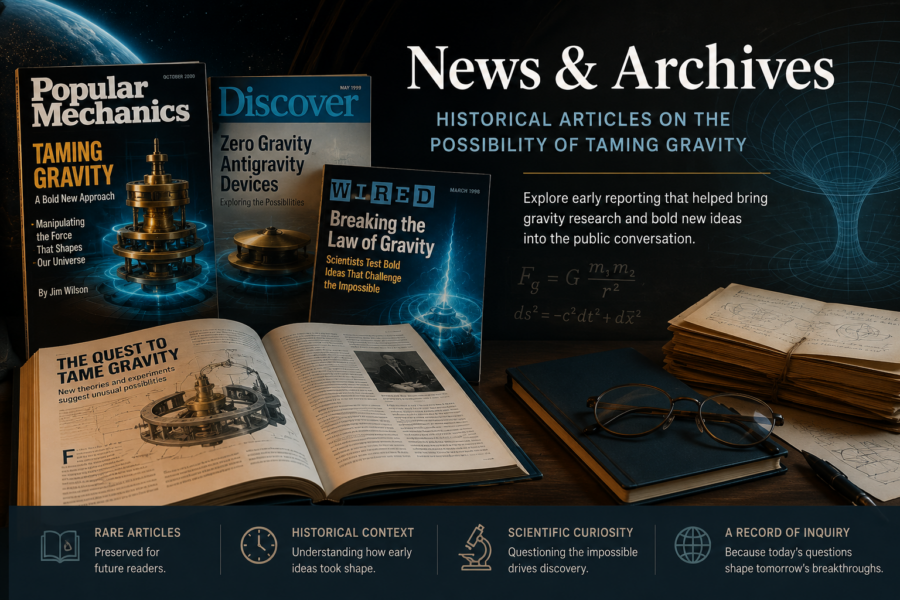
Scientific understanding develops through time. New observations revise old expectations, experimental results constrain theoretical possibilities, and historical reports reveal how ideas looked before later evidence became available. The Taming Gravity News & Archive hub brings those timelines together without confusing attention, testimony, theory, and proof.
Two Ways to Explore
This hub has two complementary branches. One follows an evolving subject in the present; the other preserves the reporting that helped shape earlier expectations.
ET in the News
Follow the changing public conversation around extraterrestrial life, UAP reports, congressional oversight, classified programs, whistleblower allegations, media influence, and the physics questions implied by reported performance.
The emphasis is evidence-aware analysis: what a source actually establishes, what remains unresolved, and where public interpretation has moved beyond the available data.
Archive
Revisit influential reporting on gravity modification, superconductors, antigravity proposals, inertia, and advanced propulsion from the late 1990s and early 2000s.
Each archived item is treated as a historical source—not as automatic confirmation—and can be compared with later experiments, improved measurements, and the present scientific consensus.
Why Context Matters
Frontier subjects are unusually vulnerable to distortion. A preliminary result may be reported as a breakthrough. A mathematical solution may be described as though it were an engineering design. A government investigation may be taken as confirmation of the explanation it was created to examine. A compelling witness may be treated as either unquestionable or worthless before the underlying evidence is assessed.
Historical distance creates another problem. Older articles preserve valuable scientific questions, but their forecasts may no longer reflect what experiments have shown. Conversely, a proposal that was once technologically inaccessible may become testable as instruments and materials improve. Responsible coverage therefore asks not only, “What was reported?” but also, “What was known then, what is known now, and what evidence changed in between?”
The Four-Level Evidence Framework
Every subject covered here should be placed within one of four levels. The levels can interact, but they should never be collapsed into a single narrative.
| Level | How It Is Used Here |
|---|---|
| 1. Established Theory and Verified Facts | Well-tested physical principles, reproducible experimental findings, authenticated public records, confirmed institutional actions, and directly documented programs. |
| 2. Experimental or Observational Signals | Measurements, sensor records, witness observations, anomalies, and unresolved cases that may be genuine but do not yet establish a cause or origin. |
| 3. Theoretical Proposals and Allegations | Mathematical models, proposed mechanisms, advanced-propulsion concepts, whistleblower claims, and interpretations that have not been publicly verified. |
| 4. Philosophical and Societal Interpretation | Questions about meaning, consciousness, ethics, governance, human evolution, and the civilizational consequences of possible discoveries. |
What Taming Gravity Follows
Gravity, Spacetime, and Fundamental Physics
Coverage includes experimental tests of gravity, General Relativity, frame dragging, gravitational waves, quantum-gravity research, vacuum structure, and careful discussion of proposals that attempt to manipulate spacetime geometry.
Advanced Propulsion and Materials
Relevant developments include electric and plasma propulsion, nuclear propulsion, beamed energy, superconductivity, metamaterials, electrogravitics, inertial concepts, and metric-engineering proposals. Established technologies and speculative mechanisms are identified separately.
Extraterrestrial Life and the Cosmos
Astrobiology, exoplanets, biosignatures, technosignatures, planetary habitability, SETI, and solar-system exploration provide the strongest scientific foundation for discussing life beyond Earth. Evidence for potentially habitable environments is not treated as evidence that extraterrestrial life—or intelligence—has been found.
UAP Observation and Investigation
Military reports, civilian cases, sensor data, official investigations, declassified records, and unresolved observations are examined as questions requiring case-specific analysis. “Unidentified” describes the limits of the available identification; it does not determine extraterrestrial origin.
Disclosure, Secrecy, and Oversight
Congressional hearings, public records, classification, Special Access Programs, whistleblower testimony, defense contracting, and allegations of hidden technology are considered with attention to documentation and lawful oversight. The confirmed existence of classified programs does not, by itself, verify claims about what any particular program contains.
How News and Claims Are Evaluated
Taming Gravity does not require every source to be correct before it can be worth examining. It does require readers to know what kind of source they are encountering and what conclusions it can reasonably support.
- Provenance: Who produced the information, when, and from what original source?
- Evidence: Is the claim supported by documents, physical samples, measurements, sensor data, or testimony alone?
- Independence: Do multiple sources provide genuinely independent confirmation?
- Reproducibility: Can the reported effect be tested and reproduced under controlled conditions?
- Alternatives: Have ordinary explanations, error, bias, misidentification, and deception been considered?
- Specificity: Does the evidence support the exact conclusion being presented, or only a narrower one?
- Updates: Has later research strengthened, constrained, or contradicted the original report?
This method allows unusual claims to be considered without giving them a credibility they have not yet earned. It also prevents premature dismissal when a question is genuinely unresolved.
Connections Across Taming Gravity
News and archival material are most useful when they lead readers toward deeper explanatory pages. A new propulsion claim should connect to the physics and engineering needed to evaluate it. A UAP report should connect to observational standards and alternative explanations. A disclosure allegation should connect to the documented structure of secrecy and oversight.
From Headline to Mechanism
Use the science hubs to examine the physical principles, energy requirements, materials, mathematical constraints, and engineering challenges behind reported breakthroughs.
From Report to Evidence
Use the UAP Investigation hub to distinguish observations, documented programs, witness claims, unresolved cases, disclosure questions, and proposed explanations.
An Ethical View of Transformative Technology
If humanity ever develops radically improved propulsion, energy systems, or some form of spacetime engineering, the achievement would not be ethically neutral. The same capabilities that could expand exploration, reduce transportation costs, and lessen planetary harm could also intensify surveillance, inequality, geopolitical instability, or weaponization.
For that reason, Taming Gravity treats governance and ethics as a legitimate fourth-level interpretation while keeping them distinct from the physics itself. A technology must first be shown to exist before its consequences become practical—but thinking ahead about stewardship is wiser than waiting until transformative power is already concentrated.
How can humanity remain open to transformative possibilities while demanding evidence strong enough to distinguish discovery from expectation?
Help Build a Better Record
Readers are welcome to suggest significant research announcements, public records, historical articles, interviews, case documentation, or corrections. Strong submissions identify the original source, explain why it matters, and distinguish what the material demonstrates from what it merely suggests.