
Can an account of unusual equipment at the South Pole establish that a scientific installation secretly operates as a directed-energy weapon? What would it take to connect that equipment to an earthquake thousands of kilometers away?
Those questions sit at the center of Eric Hecker’s appearance on The Shawn Ryan Show, episode #66. The interview combines his account of working in Antarctica with allegations about capabilities far beyond the publicly documented purposes of the facilities he discusses. It is a compelling subject for investigation, but its different claims require different kinds of evidence.
There is a substantial factual foundation to examine: Antarctic research stations, Raytheon’s historical support contract, the IceCube Neutrino Observatory, and the physics of energy transfer. Establishing those facts helps us ask better questions about the extraordinary allegations. It does not verify those allegations by association.
This final installment follows our examinations of Michael Herrera and DC Long. We begin with Hecker’s own interview, explain the relevant science, and identify the records and measurements that could meaningfully change the assessment.
Primary source: the Eric Hecker interview (Shawn Ryan Show)
Hear Eric Hecker’s account in his own words in this interview from The Shawn Ryan Show, episode #66. He discusses his reported work as a Raytheon contractor at the South Pole and presents allegations involving directed-energy technology and earthquake-related capabilities.
As you watch, distinguish between what Hecker says he personally observed, what he reports hearing from others, and the conclusions he draws about the equipment’s purpose. The interview documents his account; it does not independently establish the alleged capabilities. Our analysis below examines the scientific context, alternative explanations, and evidence needed to evaluate those claims.
Watch the interview on YouTube · Official episode page
Hecker’s background and Raytheon’s Antarctic role
The show introduces Hecker as a former Navy member and Raytheon contractor whose South Pole duties included firefighting and plumbing. It presents those duties as giving him broad access to the facility. These biographical details come from the guest and the show’s description; that description is not an employment record. [1]
Raytheon’s historical involvement in Antarctic logistics is independently documented. An NSF Antarctic Research solicitation issued in 2011 names Raytheon Polar Services Company as the program’s principal logistics contractor, responsible for coordinating research support and field operations. A contractor presence in that setting therefore does not require a hidden-program explanation. [2]
Two separate questions follow. Did Hecker perform the work and have the access he describes? If so, did he correctly identify the capabilities of the equipment he encountered? Personnel records, station rosters, training records, and colleagues could help answer the first. Technical documentation and measurements would be needed for the second.
Why access matters without settling the interpretation
A person maintaining a building may notice things that its scientific staff overlook. That makes support workers potentially valuable witnesses. Their observations should be recorded carefully, including details that seem mundane: labels, dates, room locations, instructions, and the identities of people present.
Access alone, however, does not establish an instrument’s operating principle. Seeing a cabinet, a cable, or an unusual display is different from measuring its output. A strong investigation preserves the observation and tests the proposed explanation separately. It should neither elevate every recollection into a technical conclusion nor discount it simply because the witness held a support role.
Separate the account into testable claims
The episode’s presentation connects Antarctica, a defense contractor, directed energy, and earthquakes. Those subjects should not be treated as a single claim that must be accepted or rejected as a whole. Each connection has to earn its place in the explanation.
Hecker’s central IceCube allegations are more specific than a general suspicion about secret research:
- An alleged weapon function: he says IceCube can transmit as well as detect signals and interprets it as a very large directed-energy weapon system.
- An alleged earthquake connection: he attributes the early-2011 Christchurch earthquakes to the system. He also recounts being told that the events resulted from an accidental operation, making that part of the explanation secondhand within his testimony.
These statements are allegations made in the interview, not findings established by the detector documentation or seismic records. The relevant discussion begins around five minutes into the recording. [12]
| Statement | Current category | Relevant test |
|---|---|---|
| Raytheon supported Antarctic operations. | Documented historical background. | NSF contracting and program records. |
| Hecker had the duties and access described. | Personal account requiring independent corroboration. | Employment records, access records, and witnesses. |
| Equipment had an undisclosed directed-energy purpose. | Unverified capability allegation. | Specific hardware, measured output, and operating documents. |
| An Antarctic system caused a distant earthquake. | Unverified causal allegation. | A viable mechanism, authenticated timing, and independent geophysical evidence. |
A useful interview follow-up would ask, for each detail: was this something you saw, something you measured, something someone told you, or an explanation you developed afterward? That question clarifies the evidence without prejudging the speaker’s honesty.
The distinction also helps prevent a subtle error: confirmation of an ordinary detail can make an extraordinary conclusion feel confirmed. A genuine employer, real location, and accurate description of a corridor can support a witness’s familiarity with a site. They do not, by themselves, establish what a machine inside it could do.
What IceCube and other South Pole facilities do
Established science: detecting particles through light
IceCube is a neutrino observatory near Amundsen–Scott South Pole Station. Its original deep-ice array contains 5,160 digital optical modules arranged on 86 strings. The instruments monitor roughly a cubic kilometer of ice. [3]
The sensors detect light associated with charged particles produced when neutrinos interact. Researchers use the light’s timing and spatial pattern to reconstruct properties of the event. The detector’s large size compensates for how rarely neutrinos interact; it is not a measure of a weapon’s output.
Nor is this a cubic-kilometer underground room. The sensors were lowered into drilled holes that subsequently refroze. Much of the detector is the natural ice itself, instrumented to reveal faint particle signals. The collaboration’s detector description and technical publication make the basic architecture available for scrutiny. [3] [4]
Calibration light is real—and its purpose matters
It would be inaccurate to argue that IceCube cannot emit anything because it is a detector. Its optical modules include LEDs that produce controlled light pulses for calibration. IceCube researchers use these pulses to study how light travels through the ice and improve the interpretation of recorded events. [5]
This gives us a precise question: what kind of emission is being discussed? Calibration light, electronic data signals, radio communications, and a hypothetical geophysical weapon are different things. Evidence for one does not demonstrate the others.
Restricted areas can protect sensitive measurements
The South Pole contains several research facilities with different purposes. NOAA’s Atmospheric Research Observatory samples background air. Its location beside a designated Clean Air Sector helps protect those measurements from station pollution; restrictions on access and activity serve that scientific purpose. [6]
Separately, USAP describes a Dark Sector where limits on light and radio interference protect sensitive instruments. That is a documented example of an unfamiliar-sounding restriction with a straightforward research rationale. [7]
These explanations do not authenticate every activity at every facility. They provide specific alternatives that must be considered before a restricted area, antenna, or unusual procedure is interpreted as evidence of a covert mission. Site names, buildings, experiments, and communications systems should be identified individually.
Directed energy: real technology and unsupported extensions
Directed-energy technology is a real field of engineering. The U.S. Government Accountability Office describes systems using high-energy lasers, millimeter waves, and high-power microwaves. It also documents constraints involving range, atmospheric conditions, power, and cooling. Those are measurable technologies with defined interactions and practical limitations. [8]
That background helps establish what a serious capability claim should contain. It does not establish that a named Antarctic installation contains such a system, or that an existing system could trigger a chosen earthquake.
Our engineering assessment is that the alleged mechanism must be specified before its feasibility can be evaluated. Is the proposed carrier electromagnetic radiation, a particle beam, a mechanical disturbance, or something else? What generates it? How does it propagate? How is energy transferred to the intended target?
A familiar technical word cannot substitute for these connections. “Resonance,” for example, would need an identified system, a mode of response, and a way to drive it. An assertion of undisclosed physics would require testable predictions that distinguish it from known physics. Without those details, the proposal has not yet reached the stage of a quantitative physical model.
For this reason, the appropriate category for the extraordinary capability discussed here is an unverified allegation. It should not be promoted to an experimentally supported result—or even to a developed theoretical proposal—merely because it uses scientific terminology.
The earthquake allegation and the physics of triggering
Start with geophysical measurements
An earthquake allegation should be evaluated against the event’s seismic record. For the Christchurch earthquake of February 22, 2011, GeoNet provides observations of the shallow source, faulting mechanisms, aftershock sequence, and strong ground motion. These are measurements and scientific interpretations tied to a particular event, rather than impressions about distant equipment. [9]
Those records provide a basis for testing any proposed external cause. A competing explanation would need to account for the observations and contribute evidence that the ordinary fault-rupture explanation does not supply. The existence of an unusual installation somewhere else does not establish that connection.
Human-induced earthquakes do occur
A sound assessment must acknowledge induced seismicity. USGS explains that deep wastewater injection can raise pressure within rock formations and, under suitable conditions, contribute to earthquakes. The relevant process involves physical changes in the subsurface; most injection wells are not associated with felt earthquakes. [10]
This matters because dismissing every possibility of human influence would be scientifically wrong. It also illustrates why mechanisms matter: evidence for earthquakes associated with fluid pressure does not demonstrate remote electromagnetic control of faults.
Natural remote triggering is also documented
USGS reports that seismic waves from a large earthquake can sometimes trigger earthquakes at distant, susceptible locations. This process is called dynamic triggering or dynamic stress transfer. Here the traveling disturbance is itself seismic, and the receiving location’s condition matters. [11]
That finding prevents another overstatement: distance alone does not make every triggering mechanism impossible. But a natural process affecting susceptible faults does not establish a controllable device that can select a city, initiate rupture, and determine the outcome.
What a causal case would need
A defensible investigation would have to connect several independent lines of evidence:
- A defined source: identifiable equipment and authenticated records of what it emitted.
- A physical pathway: a model explaining how the proposed influence reached the relevant fault and affected it.
- Reliable timing: operational records and seismic records aligned to a common time standard.
- A distinguishing signature: observations that favor the proposed mechanism over ordinary seismic activity or coincidence.
- Independent scrutiny: qualified analysts examining original records, uncertainties, and competing explanations.
These are standards for evaluating a causal claim, not instructions for building a weapon. They also show why a remembered sequence of events is insufficient. Even verified temporal proximity would establish that events occurred near each other in time; causation would still need to be demonstrated.
What the interview contributes and where it overreaches
What deserves serious attention
The interview preserves a public account that can be questioned, compared with records, and revisited. It gives researchers a starting point for identifying which statements concern personal experience and which concern technical interpretation. Firsthand accounts can be useful before an investigator possesses the documents needed to evaluate them.
Several background elements are real: Antarctic science involves substantial infrastructure, contractors have supported that work, and directed-energy research exists. Treating those elements accurately is essential to a fair assessment. None should be made to seem inherently implausible just because an extraordinary allegation is attached to it.
Where the conclusions outrun the evidence
The central overreach occurs when familiarity with a location or awareness of unusual hardware becomes certainty about an undisclosed capability. A further leap occurs when that proposed capability is assigned responsibility for a specific disaster without a demonstrated causal connection.
The strongest charitable interpretation is that a worker could encounter an activity whose purpose was not explained to him, and that his observations might identify a real subject for investigation. The strongest skeptical interpretation is that genuine observations could be combined with incomplete technical knowledge, secondhand explanations, or mistaken connections between separate systems.
These possibilities do not deserve equal confidence simply because both can be imagined. We can compare them by asking which accounts for the available details with fewer unsupported assumptions, and which makes predictions that records could test. A documented calibration procedure explains an observed light pulse more directly than an unspecified weapon does, unless additional evidence favors the latter.
This approach evaluates claims without diagnosing the witness or guessing at motives. Sincerity, confidence, and an engaging presentation cannot replace corroboration. Conversely, a mistaken interpretation would not automatically make every observation in the account false.
Evidence that could strengthen or weaken the case
Begin with a chronology that can be checked
The most productive next step would be a claim-by-claim record: what happened, where, approximately when, who was present, and what supporting material exists. Dates should distinguish the alleged event, the witness’s first report of it, and later interpretations. This helps prevent information learned afterward from being confused with information available at the time.
Employment and deployment records could establish opportunity to observe. A dated maintenance entry could identify an instrument. Contemporaneous correspondence could show how an event was described before the public controversy. Each item should be used only for what it actually supports.
Match evidence to the claimed capability
Useful technical material would include equipment identifiers, schematics, operating instructions, calibration records, and measurements connected to the alleged event. Photographs would need sufficient context to establish where and when they were taken. An authentic photograph of a rack verifies the rack’s appearance, not every proposed function of its contents.
Witness independence matters as well. Several people repeating one account are not several independent observations. Stronger corroboration would come from people able to describe the same event from their own roles, with compatible details and records that predate shared publicity.
Specify what would count against the claim
An investigation should be able to lower confidence as well as raise it. A securely identified instrument with documented operation inconsistent with the alleged function would weaken that interpretation. So would incompatible dates, a wrongly identified building, or an account that repeatedly changes to avoid contrary evidence.
Equally, an unavailable document is not automatically evidence of concealment. Its absence may leave a question unresolved. A refusal, a retention gap, and an authenticated record contradicting an allegation are different outcomes and should be reported as such.
The goal is an assessment that can change. If employment is corroborated, confidence in the biography should rise. If an instrument is identified, confidence in the equipment description should change. Those updates should not automatically transfer to the earthquake allegation.
How this connects to Herrera and DC Long
Part 1 examines Michael Herrera’s account. Part 2 examines DC Long’s Range 19 account. Together with Hecker’s interview, they raise questions about how witnesses interpret unfamiliar events and how outsiders can investigate claims involving restricted environments.
The common themes justify comparison, but they are not independent confirmation of a single program. Corroboration would require specific overlap: the same identifiable personnel, a shared documented operation, matching equipment, or independently supported events. Broad references to secrecy, contractors, and advanced technology are insufficient.
Each case should therefore retain its own evidence record. A strong or weak finding in one should affect another only where a demonstrated connection makes that inference reasonable.
Oversight, ethics, and responsible investigation
Ethical interpretation: the public has a legitimate interest in how scientific programs and their contractors are supervised, how concerns are reported, and how credible allegations are investigated. Those questions remain worthwhile even when the most dramatic technological claim is unverified.
Responsible oversight should protect people who report concerns while allowing their claims to be tested. It should also protect researchers and support staff from unsupported accusations. Naming a real institution or employer carries an obligation to distinguish documented responsibility from speculation.
Disasters require particular care. Their victims should not become scenery for an exciting narrative. A proposed human cause should be assessed against the strongest available evidence, with uncertainty stated plainly and corrections made when warranted.
For Taming Gravity, the constructive aim is better understanding and accountable science. Research into energy, materials, and measurement has enormous value for exploration and human welfare. Allegations of weaponization belong in a cautionary discussion about evidence and responsibility, not in a celebration of destructive power.
Three takeaways and the questions ahead
Hecker’s interview raises questions that can be investigated without treating its conclusions as settled. Which parts of his work history can be independently confirmed? Can the equipment be identified precisely? Are there contemporaneous records that connect his interpretation to measurable events?
Those are useful open questions. The next step is to seek answers capable of changing the assessment, while keeping established science, testimony, proposed mechanisms, and ethical interpretation distinct. That is how an intriguing story becomes a productive inquiry.
Continue with Taming Gravity’s UAP Investigation guide for the broader approach to evaluating unresolved observations.
Reader Q&A
Does “primary source” mean the interview is verified?
No. It means readers can examine the speaker’s own account. Verifying an underlying event requires corroboration beyond the existence of that account.
Does a detector’s ability to emit signals make it a weapon?
No. Emission must be characterized by its physical form, energy, purpose, and demonstrated effects. IceCube’s documented calibration light supports measurement; its existence does not establish the alleged weapon function.
Could a small disturbance trigger a much larger earthquake?
A fault’s existing stress matters, and triggered seismicity is documented. The unresolved issue here is the claimed source and pathway: neither the possibility of triggering nor the fault’s stored energy verifies a particular remote device.
Would testimony under oath prove the technology exists?
No. Even an authenticated sworn statement would need to be evaluated alongside supporting evidence. A description saying someone testified should also be distinguished from an identifiable official record of what was said and in which proceeding.
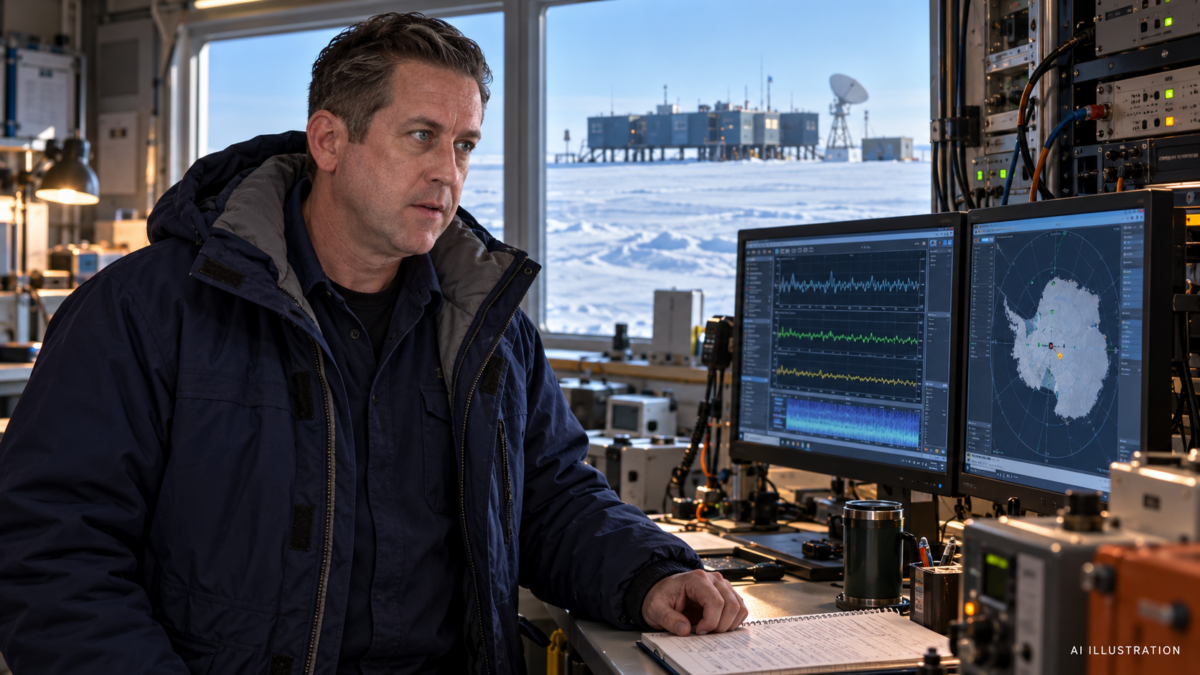
Is the featured image a photograph of Hecker at the facility?
No. The featured image is an AI-generated editorial illustration using his likeness. The depicted room and activity are imagined; the image is not evidence of the equipment or events discussed.
Sources and further reading
The interview is the source for the account under discussion. The scientific and institutional references below establish background and known mechanisms; they do not endorse Hecker’s extraordinary allegations.
- Shawn Ryan Show: official episode #66 page. The show’s presentation of the guest and interview; the full video is embedded above.
- NSF 11-532: Antarctic Research. Historical documentation of Raytheon Polar Services’ logistics and research-support role.
- IceCube: detector and construction overview. Detector geometry, operating principles, and installation in the ice.
- IceCube Collaboration: The IceCube Neutrino Observatory—Instrumentation and Online Systems. Technical reference published in Journal of Instrumentation in 2017; preprint available through arXiv.
- IceCube: optical calibration and ice-crystal research. Explains the use of LED light pulses to investigate the ice’s optical properties.
- NOAA: South Pole Atmospheric Research Observatory and Clean Air Sector information. Atmospheric monitoring and protections against local contamination.
- USAP: South Pole Station webcams and site descriptions. Includes the Dark Sector’s restrictions on light and radio interference.
- U.S. GAO: Science & Tech Spotlight—Directed Energy Weapons (2023). Technology categories and practical limitations.
- GeoNet: Christchurch earthquake, February 22, 2011. Event observations, faulting mechanisms, aftershocks, and ground-motion measurements.
- USGS: hydraulic fracturing, wastewater injection, and earthquakes. Explains a documented mechanism of human-induced seismicity.
- USGS: can earthquakes trigger other earthquakes at a distance? Explains dynamic stress transfer and susceptible locations.
- Rosetta: transcript and interview quotations. A third-party aid for locating Hecker’s statements; the original recording remains authoritative. Its automated explanatory summaries are not scientific sources.














Leave a Reply