
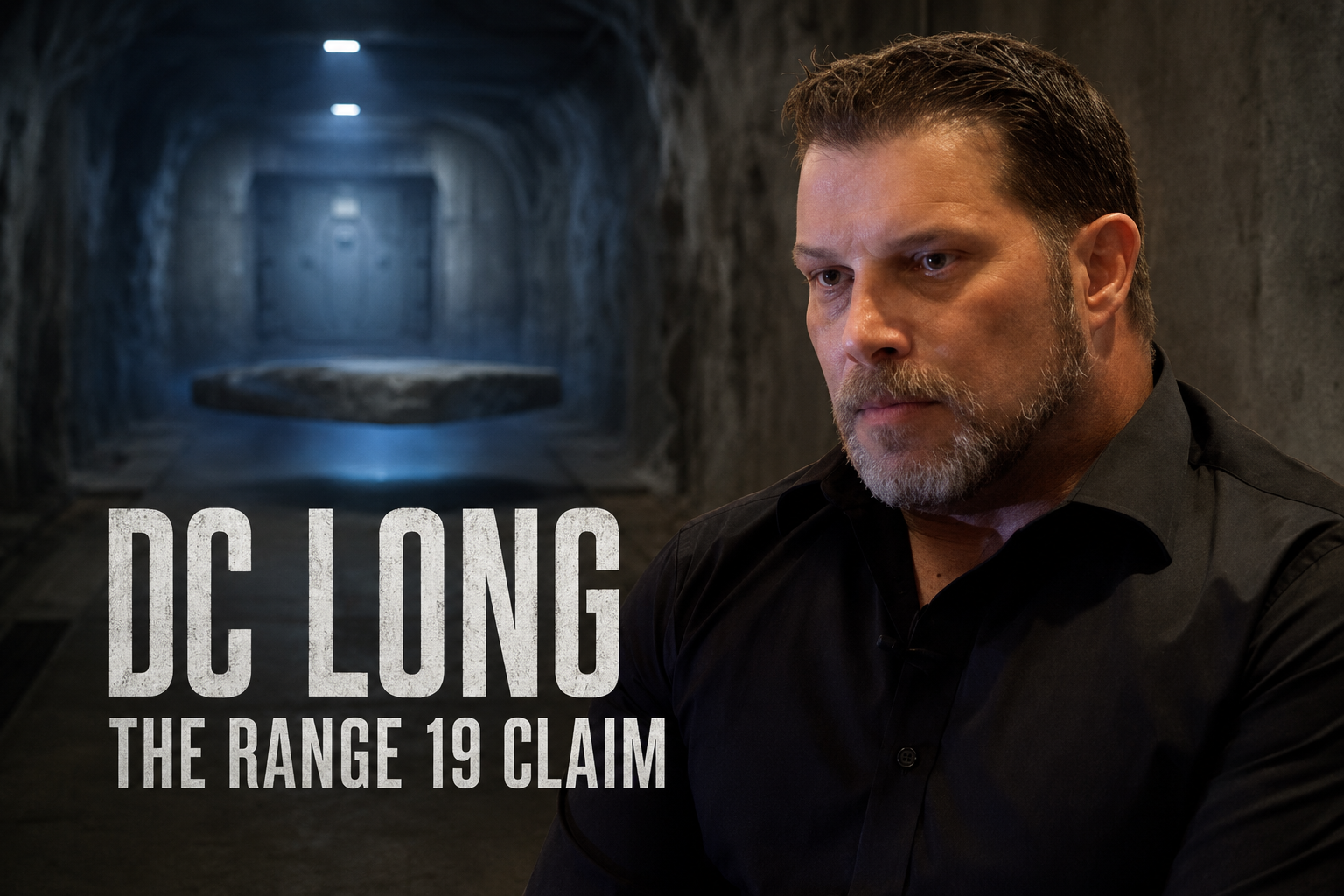
In 2011, Army combat veteran DC Long says a routine construction assessment took him and his father into an underground facility at Fort Bragg—where he encountered a massive stone-like slab hovering silently above the floor. Long’s account is extraordinary, but its importance does not depend on accepting every conclusion attached to it. The first responsibility is to preserve what he actually said, separate observation from interpretation, and identify what evidence could still be checked.
The accounts in this series raise similar questions about secrecy and unusual technology. Those similarities invite comparison, but they do not establish a shared cause or independently confirm any account. Each claim must be evaluated on its own evidence.
Who Is DC Long?
In the Shawn Ryan Show interview, Long is introduced as a U.S. Army veteran who served from 1997 to 2013 and was medically retired after injuries associated with a parachute jump. Long says his father operated a construction business that performed work connected with Fort Bragg, including projects submitted through the Army Corps of Engineers.
Long emphasizes that his alleged encounter was not part of his normal military duties. He says he was on leave and helping his father with the family construction business when the two were asked to assess work at a location called Range 19.
Primary source: DC Long’s interview on the Shawn Ryan Show. The account summarized below comes from Long’s own statements in that interview; it is not presented as independently verified fact.
What Long Says Happened at Range 19
Long places the central incident in 2011. According to his account, an escort collected him and his father near the XVIII Airborne Corps headquarters and drove them approximately 15 minutes toward the training-range area. The van had no rear windows, preventing them from seeing the route clearly.
He describes the destination as resembling a dump, with refuse surrounding a concrete entrance built into a hillside. Inside, he and his father entered a freight elevator. Long says the controls had no written labels and that their escorts warned them to keep their eyes forward or risk being shot. He initially interpreted the warning as dark humor because at least one escort was familiar to his father.
Long says he knelt as though tying his boot so he could look underneath the slab. He saw no pedestal, cable or mechanical support. He also describes the surface as somewhere between polished and translucent. These details are central because they distinguish his testimony from a vague recollection of unusual equipment: he presents a specific claim of a large object suspended above the ground.
After walking past the objects, Long and his father went one level lower to inspect an underground shoot house. They took measurements and notes for approximately 15–20 minutes. When they returned through the upper room, Long says the slab, boulders and personnel were gone. He stresses that the objects disappeared without the construction noise or heavy equipment he would have expected.
The NDA, the Business and His Father
Long says that after returning to headquarters, a man presented him and his father with nondisclosure agreements. Both allegedly refused to sign. He also says the escorts retained his father’s notes and measuring tapes.
The following day, according to Long, an employee reported that the family company’s equipment was gone and its work area had been locked. Long says he found his father’s office emptied and the door to his home damaged. When Long asked whether this was connected to Range 19, his father reacted angrily and told him never to mention the name again.
Long describes this moment as the effective end of their close relationship. He says his father largely refused contact until shortly before dying from aggressive cancer in 2021. Long does not believe the death was natural, but the interview presents no medical evidence establishing that the cancer was deliberately caused. The emotional connection is real within the testimony; the proposed cause remains unverified.
The Later Parachute-Incident Claim
Long also connects a later military parachute accident to one of the men he says escorted him underground. He recalls an unfamiliar person moving forward among a team whose membership normally did not change. Long says that as he exited the aircraft, a static line struck him, damaged his neck and contributed to a violent descent that ended his career.
He interprets this as an attempted assassination. His certainty rests partly on a later event: after his father’s funeral in 2021, Long says the same man appeared at his new residence and handed him a note expressing sympathy. Long understood the visit as a message that he could still be reached.
This is among the account’s most serious allegations. It should be reported precisely as Long’s conclusion, not converted into an established fact. A parachute accident may leave military, medical, jump-manifest and safety-investigation records. Those records could verify the injury, timing and personnel involved even if they could not by themselves establish intent.
What the Testimony Establishes—and What It Does Not
Long’s interview provides a detailed public record of his account. It includes a location, approximate date, route, participants, physical dimensions, sensory details and claimed consequences. Specificity makes a story more testable, but it does not automatically make it true.
The testimony can reasonably establish:
- what Long publicly says he remembers;
- the internal chronology and principal details of his account;
- the personal meaning and trauma he associates with the events; and
- which records or witnesses might provide independent checks.
The interview does not independently establish:
- that a hovering slab existed at Range 19;
- that the object used gravity manipulation;
- that the technology was nonhuman;
- that officials confiscated the family business;
- that the parachute incident was intentional; or
- that his father’s illness was deliberately caused.
That distinction is not a dismissal of Long. It is the boundary between preserving testimony and claiming verification.
What Could Be Corroborated?
Long’s story contains several “ordinary” details that are more practical to investigate than the technology itself:
- Military service: a DD Form 214 or appropriately redacted personnel record could confirm service dates, assignments, qualifications and medical retirement.
- The parachute accident: jump records, line-of-duty findings, medical documentation and safety reports could confirm the date, injury and official explanation.
- The family business: incorporation, licensing, tax, insurance, equipment and contracting records could establish that the company existed and performed military-related construction.
- Fort Bragg work: contract identifiers, subcontracting records, Army Corps of Engineers correspondence or a carefully framed FOIA request might establish whether the business was assigned work in the relevant area.
- Contemporaneous witnesses: employees who saw the business before and after the alleged loss could corroborate changes without needing knowledge of the underground encounter.
- Earlier disclosure: messages, letters or conversations predating the public interview would help determine when the account took its present form.
Recent military personnel files are not automatically public. The veteran can obtain and voluntarily release relevant portions, while outside requests are limited by privacy law. Fort Bragg also maintains a formal FOIA and Privacy Act process for records under the installation’s control.
How Long’s Account Connects to the Series
Part 1 examines Michael Herrera, who says he encountered a guarded craft and armed personnel while deployed in Indonesia. Long’s account differs in setting and circumstance: he describes an underground military facility in the United States, entered while assisting a contractor.
The overlap is thematic rather than evidentiary. Both men describe:
- apparently advanced objects within a human-controlled security environment;
- armed or intimidating personnel;
- pressure or consequences following the alleged encounter; and
- a belief that secret programs operate beyond meaningful public oversight.
Those parallels justify comparison, but one account cannot corroborate another merely because they resemble each other. Independent records, witnesses and physical evidence are still required. Part 3 examines Eric Hecker’s Antarctic claims using the same standard.
For the broader method behind this series, visit UAP Investigation and Disclosure & Secrecy.
Conclusion
DC Long’s account is compelling because it is concrete, personal and potentially testable. He does not merely say that secret technology exists; he identifies a time period, military setting, construction context, alleged witnesses, later injury and documentary trails that may still leave traces.
At present, however, the public case remains testimony. The reported hovering slab is not verified evidence of gravity control, and Long’s interpretations of the later events are not established conclusions. The responsible position is therefore neither automatic belief nor automatic rejection.
Preserve the testimony accurately. Seek the records that should exist. Protect the distinction between what Long observed, what he inferred and what independent evidence can support. If stronger documentation emerges, the assessment should change with it.














Leave a Reply