
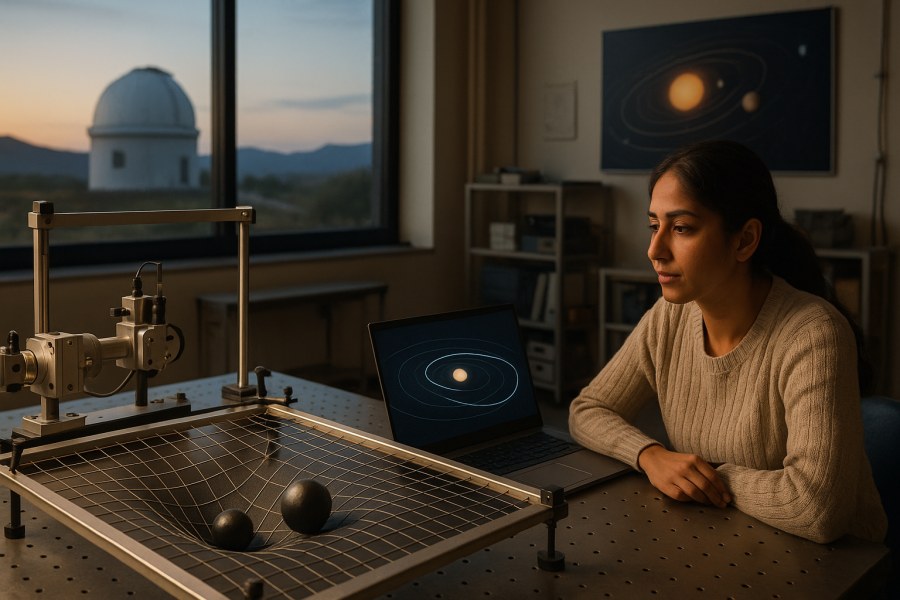
Intro physics often makes orbital motion feel clean and clockwork: one planet, one star, one elegant ellipse. That “two-body” picture is powerful because it is solvable and (for many purposes) accurate. But real planetary systems are not two-body systems. They are crowded, lopsided, and time-dependent—full of tugs from other planets, moons, rings, and the star’s own quirks.
This guide shows how and why real orbits deviate from the ideal ellipse, what kinds of effects matter at different levels of precision, and how scientists separate established physics from disputed claims. You’ll learn practical ways to reason about perturbations, stability, resonances, and long-term evolution—without pretending the Solar System is an isolated pair of masses.
1) The two-body orbit: what it gets right (and what it silently assumes)
The two-body approximation treats a planet and a star as point masses interacting only through gravity. In that idealization, the orbit is a conic section (ellipse for bound motion), characterized by a small set of parameters: semi-major axis, eccentricity, inclination, and a few angles defining orientation.
It works well when:
- One mass dominates (a star is much more massive than a planet).
- Other bodies are distant or much smaller.
- You only need modest accuracy over modest times.
But it assumes something that is almost never literally true: that nothing else exerts a significant force and nothing changes with time. The moment you add another planet, a moon, or even an extended (non-pointlike) mass distribution, the “perfect ellipse” becomes an approximation that drifts.
2) The first step beyond two bodies: perturbations as a practical workflow
A useful way to move beyond two-body physics—without jumping straight into full-blown numerical simulation—is to treat extra influences as perturbations: small corrections added to an otherwise two-body orbit.
Conceptually:
- You start with a “reference” Keplerian orbit (two-body solution).
- You compute additional accelerations from other bodies or effects.
- You track how the orbit’s elements change over time (slowly or sometimes abruptly).
This is not hand-waving; it’s a controlled approximation. It also teaches a key habit: always state what was included and what was ignored.
What typically counts as a perturbation?
- Third-body gravity: e.g., Jupiter’s pull on Mars.
- Non-sphericity: a body’s “bulge” makes its gravity field deviate from a perfect point mass or perfect sphere.
- Tides: energy dissipates and angular momentum exchanges between spins and orbits.
- Relativistic corrections: usually tiny, but measurable for close-in orbits or when you demand high precision.
- Non-gravitational forces: atmospheric drag, radiation pressure, outgassing (especially for comets), and thermal recoil forces for small bodies.
3) N-body gravity: why “everything pulls on everything” changes the story
In an N-body system, each object accelerates due to the gravitational pull of the others. Established theory (overview): unlike the two-body case, many-body gravity generally does not yield a single, simple, closed-form solution that covers all initial conditions and times in one expression. In practice, scientists rely on a mix of approximations (like perturbation methods) and numerical integration.
Three big consequences matter for planetary orbits:
- Orbital elements become time-dependent: the semi-major axis, eccentricity, and orientation can oscillate or drift.
- Resonances become possible: repeated gravitational nudges can add coherently.
- Strong sensitivity can appear: in some multi-body configurations, tiny differences in initial conditions can grow over time, limiting long-term predictability even though the underlying laws are deterministic.
What “stability” really means in multi-planet systems
Stability is not just “doesn’t crash soon.” In celestial mechanics, there are several useful notions:
- Short-term stability: no close encounters over thousands to millions of orbits.
- Long-term (secular) stability: orbital elements vary but stay bounded over very long times.
- Practical predictability: even if stable, some systems can be sensitive enough that precise positions become difficult to forecast far into the future.
For readers exploring gravity topics more broadly, Taming Gravity’s framing of evidence-first inquiry is laid out in Taming Gravity’s manifesto: find the science, not the fiction, and the broader reference hub is in Gravity Science.
4) Resonances: when small tugs add up
A resonance happens when two orbital periods form a ratio of small integers (like 2:1 or 3:2). In that case, gravitational “kicks” can repeat at nearly the same orbital phase, allowing small effects to accumulate rather than average away.
Resonances can:
- Stabilize configurations by preventing close approaches (some resonant angles “librate,” acting like a protective rhythm).
- Destabilize regions by pumping eccentricity or inclination until orbits cross.
- Open gaps in belts of small bodies (where resonant stirring clears material).
5) Secular evolution: slow changes that reshape systems
Not all orbital changes are dramatic. Many are slow, smooth trends caused by averaged gravitational interactions over many orbits—often called secular effects.
Common secular behaviors include:
- Apsidal precession: the direction of perihelion (closest approach) rotates over time.
- Nodal precession: the orbital plane’s line of nodes rotates, changing how the orbit is oriented in space.
- Eccentricity and inclination cycles: in some dynamical regimes, long-term interactions can couple eccentricity and inclination, producing slow cycles rather than fixed values.
These are among the main reasons that describing a planet as having “the” eccentricity or “the” inclination can be misleading unless you specify an epoch (a reference time) and a model.
6) Extended bodies, not point masses: bulges, rings, and lumpy gravity
Real astronomical bodies are not perfect spheres with perfectly uniform density. Rotation makes planets bulge; internal structure creates mass anomalies; rings and disks add distributed mass. These details matter most when:
- An orbit passes close to the body (low altitude spacecraft, close moons).
- You need high precision (navigation, ephemerides, tests of gravity).
- The body is strongly oblate (gas giants, fast rotators).
In practice, scientists describe these deviations using gravity-field models. The takeaway for non-specialists: the nearer you are, the more “lumpy” gravity matters, and the more the two-body ellipse becomes a rough sketch rather than a map.
7) Tides and dissipation: gravity that changes orbits by turning motion into heat
Gravity isn’t only about instantaneous pulling. In systems with deformable bodies (planets and moons), tidal stretching and internal friction convert orbital energy into heat. That dissipation can slowly change orbits and spins.
Typical consequences:
- Tidal locking: a moon’s rotation synchronizes so the same face points to its planet.
- Orbital migration: moons can spiral outward or inward depending on spin rates and dissipation.
- Circularization: eccentric orbits can become more circular over long times.
8) Relativity in planetary motion: tiny corrections with real consequences
For most everyday orbital questions, Newtonian gravity with perturbations is enough. But general relativity (GR) makes small, systematic corrections.
Established theory (background): GR predicts small deviations from Newtonian orbital motion; in high-precision regimes and/or strong-field environments, those deviations can be measurable and must be included in the force model.
Historical note (not sourced here): a widely discussed example in GR outreach is Mercury’s perihelion precession and how relativistic corrections relate to residuals after accounting for Newtonian perturbations. Because this article does not provide a primary citation for that specific historical/quantitative claim, treat it as context rather than a sourced result in this guide.
Two practical points:
- GR rarely dominates planetary dynamics in the Solar System, but it can be essential for precision modeling and for very close-in orbits.
- GR corrections can be partially absorbed into other fitted parameters if your model is incomplete—so you add them when your accuracy requires it, not as a decorative flourish.
9) A disciplined way to evaluate “orbital anomalies”
Claims of unexpected orbital behavior show up in many contexts: small-body trajectories, spacecraft navigation, exoplanet timing variations, and sometimes in more speculative discussions. A careful approach doesn’t dismiss anomalies; it classifies them.
Step A: Identify what is directly measured
- Is the observation positional (angles on the sky), range (distance), Doppler (velocity), timing (transits), or something else?
- What is the uncertainty, and does it include systematic error sources?
Step B: Audit the model inputs
- Which bodies were included? Which were approximated (e.g., as a point mass)?
- Were tides, radiation pressure, drag, or thermal recoil relevant?
- Were relativistic corrections included at the needed level?
Step C: Ask whether the anomaly is reproducible and transferable
- Does it appear in independent datasets and independent analysis codes?
- Does it show up for other objects in similar conditions?
Step D: Separate categories of explanation
Here’s a useful evidence-conscious breakdown that matches the “science, not fiction” principle:
- Physical evidence: direct measurements and their uncertainties.
- Official records: ephemerides, tracking data releases, mission navigation documentation (when available).
- Testimony: statements by investigators—valuable, but not a substitute for data.
- Inference: conclusions that follow from modeling choices.
- Disputed claims: interpretations where experts disagree about data handling or systematics.
- Speculation: ideas not yet pinned to a testable, data-verified signature.
10) Steel-manning mainstream and unconventional explanations
Because Taming Gravity aims to keep inquiry open while staying evidence-led, it helps to articulate the strongest versions of both conventional and unconventional takes.
Mainstream (conventional) explanation: “It’s perturbations and systematics”
The strongest mainstream case is that most orbital deviations are expected once you include: N-body interactions, body shape effects, tides, and non-gravitational forces; and that remaining residuals often trace to measurement biases, incomplete force models, or parameter estimation choices.
Important limitation for this guide: while this general view is consistent with how orbital dynamics is typically modeled in practice, this article does not provide external citations to quantify “success” (for example, by pointing to specific ephemeris documentation or spacecraft navigation performance reports). So treat that as background context rather than a sourced, case-closed proof.
Unconventional explanation: “There may be missing physics in some regimes”
The strongest unconventional case isn’t “we can ignore Newton and GR.” It’s the narrower claim that there could exist small, unmodeled effects in specific regimes (very weak accelerations, particular distance scales, or environments with complicated systematics) that might point to new interactions or new fields. The bar is high: such proposals must produce specific, testable signatures and survive cross-checks against established constraints.
In other words, it’s reasonable to stay curious—but not reasonable to treat curiosity as confirmation.
11) When to simulate: signs the two-body-plus-perturbations approach is no longer enough
At some point, you switch from analytic intuition to numerical integration (simulating motion step-by-step). Signs you’ve reached that point include:
- The system is near resonance and phase relationships matter strongly.
- Close encounters are possible, making the problem sensitive and non-smooth.
- Multiple comparable-mass bodies interact (e.g., tightly packed exoplanet systems).
- You care about long timescales where sensitivity limits prediction.
For readers who want to go deeper into the research ecosystem (without pretending every preprint is settled fact), the general relativity and quantum cosmology archive at arXiv’s gr-qc repository is a useful way to browse what’s being discussed in that field (the page is an archive index and search/browse entry point, rather than a curated review).
Conclusion: The ellipse is real—but it’s not the whole truth
The two-body approximation is one of the great gateways into gravitational physics: it captures the core geometry of orbital motion and builds intuition fast. But real planetary orbits are shaped by many influences—other bodies, resonances, tides, lumpy gravity, non-gravitational forces, and (sometimes) relativity. “Beyond two-body” is not a niche complication; it’s the normal state of nature.
If you take one practical lesson from this guide, make it this: whenever you hear a claim about a surprising orbit, ask what model it’s surprising relative to, what data supports it, and what the dominant missing forces might be. That’s how you keep the wonder—without letting the story outrun the science.
Q&A
If the two-body approximation is “wrong,” why is it taught first?
Because it’s solvable, builds intuition, and is often accurate enough as a baseline. Most real systems are close to “star dominates + small corrections,” so two-body motion is a useful reference orbit even when you later add perturbations.
What is the single most important effect beyond two-body gravity in the Solar System?
For most planets, it’s the gravitational perturbations from other planets—especially the most massive ones. Those interactions drive long-term precession and cycles in orbital elements.
Does resonance always destabilize orbits?
No. Resonances can stabilize by enforcing protective timing that avoids close encounters, or destabilize by pumping eccentricity or inclination. The outcome depends on the specific resonance, geometry, and damping effects like tides.
When do relativistic effects matter for planetary orbits?
They matter when you need high precision or when orbits are very close to the central mass. In the Solar System, GR’s corrections can be measurable (for example in perihelion precession) but are usually small compared to Newtonian gravity plus planetary perturbations.
What’s a common mistake when people claim an “orbital anomaly”?
Comparing data to an oversimplified model (often an implicit two-body picture), then interpreting the mismatch as new physics. A disciplined check includes N-body effects, non-gravitational forces for small bodies, body-shape gravity where relevant, and careful uncertainty accounting.














Leave a Reply