
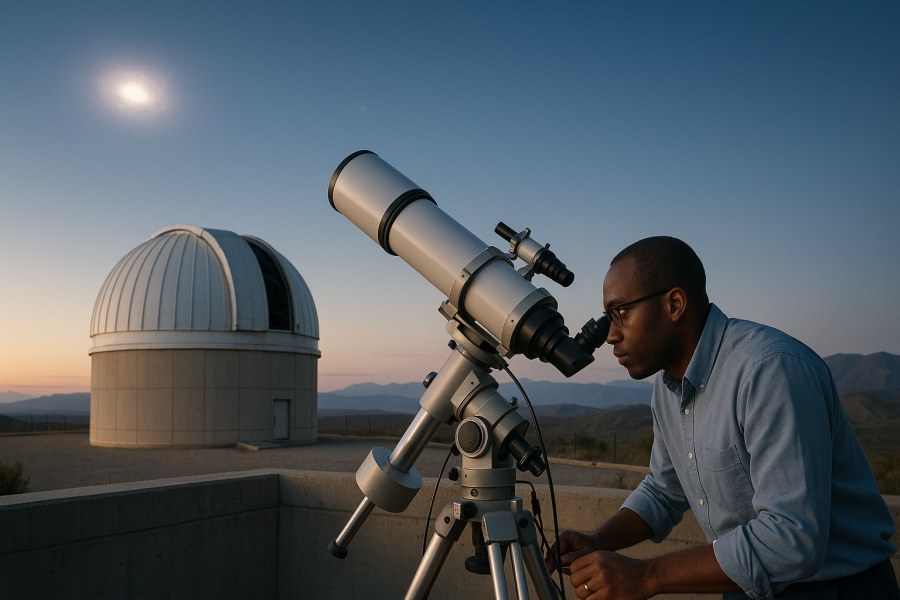
Bottom line: some “UAP” reports can sometimes be narrowed down more efficiently—often without dismissing the witness—by separating what’s measured (time, direction, duration, camera metadata, and any available instrument/context data) from what’s interpreted (“it accelerated,” “it was huge,” “it paced my car”). This guide walks you through a repeatable, evidence-conscious process to deconflict common sky objects—satellites, drones, balloons, and bright astronomical targets—before you decide what’s left is genuinely unidentified.
That matters because misclassification cuts both ways. If we label everything “just a satellite,” we may miss rare but important events. If we label everything “extraordinary,” we inflate noise and make serious analysis harder. At Taming Gravity we aim to “find the science, not the fiction,” which means treating conventional explanations and unconventional ones with the same standard: clear data, clean reasoning, and an honest accounting of what we do not know.
This post is an intermediate, practical field-and-desk workflow. You’ll learn how to capture better observations, how to interpret common visual illusions, how to triage likely causes by behavior and context, and how to document residual unknowns in a way that other investigators (or your future self) can actually test.
What “deconfliction” means (and what it doesn’t)
In UAP work, deconfliction is the process of checking whether an observation can be explained by known objects or known effects: satellites, aircraft, drones, balloons, astronomical objects, re-entering debris, sensor artifacts, and perceptual errors.
- Deconfliction does not mean assuming a witness is unreliable.
- Deconfliction does not mean proving a specific object with 100% certainty from a single video.
- Deconfliction does mean making the best-supported call given the available evidence—and clearly labeling what’s established versus inferred.
Step 1: Capture the minimum data that makes analysis possible
If you’re reading this after an event, use it as a checklist for what to collect next time. If you’re analyzing an existing report, treat missing items as constraints on what you can responsibly conclude.
Lock down time and location (down to the minute)
- Start time and end time (local time with time zone). If you can, note UTC as well.
- Location: as precise as you can provide (street/city is often enough for sky geometry, but GPS coordinates help).
- Direction and elevation: “toward the west, about 30° above the horizon” is far more useful than “in the sky.”
- Weather context: cloud cover, haze/smoke, wind, and visibility.
Record a “reference shot”
Take a wide shot showing the object and nearby reference points: rooftops, treeline, utility poles, the horizon, or a known star/planet. If filming through a window, note it—reflections and internal glass reflections can occur and may duplicate bright points in some setups, so it’s worth treating windows as a potential confounder.
Audio notes beat memory
While filming, speak out loud: “I’m facing due south; it’s moving left to right; I see no blinking lights; it just faded.” Those real-time notes can preserve details that are often lost in later retellings.
Step 2: Sort evidence types—don’t mix them
To stay honest, separate your case file into categories. This prevents “story gravity,” where an exciting interpretation slowly becomes treated like a measurement.
- Physical evidence: recovered material, ground traces, instrument logs (rare in civilian cases).
- Official records: air traffic data, NOTAMs, police logs, weather records, astronomical ephemerides (when available).
- Testimony: witness statements, especially independent witnesses.
- Inference: “If the object is above the cloud deck, then…”
- Disputed claims: statements that conflict with other evidence or rely on unknown provenance.
- Speculation: hypotheses not anchored to discriminating evidence.
Step 3: Use a behavior-based triage (what it “looks like” in motion)
Before naming a culprit, classify what the object did. The same “bright light” can be a satellite, a plane turning, a planet through thin cloud, or a drone—behavior is your first filter.
A. Slow, steady drift with no blinking
Often consistent with: satellites, the International Space Station, high-altitude aircraft seen head-on (less common), or bright stars/planets misperceived as moving due to camera motion.
Key discriminator (heuristic): satellites are frequently reported by observers to fade in/out over a pass (rather than “turning off” like a switch), but without a timestamped track match, treat any single clip as suggestive—not decisive. Limit: observations can look like a sharper “disappearance” depending on geometry, haze/clouds, and camera exposure behavior; without a match to a predicted pass, don’t over-interpret the fade.
B. Hovering or station-keeping (especially low altitude)
Often consistent with: drones, helicopters, balloons in light wind (can appear stationary), or bright planets when the observer is moving and lacks reference points.
Key discriminator (heuristic): if the object is low and you can clearly hear a rotor/whine consistent with a small aircraft or drone, that supports a drone (or helicopter) candidate. However, sound can be masked by wind, distance, ambient noise, and your phone microphone—so silence does not rule anything out by itself.
C. Sudden “zig-zags,” jumps, or instant acceleration
Often consistent with (heuristic): camera shake, autofocus hunting, digital stabilization artifacts, mis-tracking of a small bright point, or multiple objects mistaken as one.
Key discriminator: check whether the background (stars, treeline, clouds) “jumps” with the object. If both move together, you’re likely seeing camera motion, not object acceleration.
D. Brightening/dimming, color shifts, “pulsing”
Often consistent with: atmospheric effects (twinkling/scintillation), thin clouds passing, aircraft lights changing with orientation, or drone LEDs changing mode.
Key discriminator (rule-of-thumb): twinkling and apparent color changes are often reported as more noticeable for point-like lights viewed through more atmosphere (lower elevations) and less noticeable higher in the sky. Because phones can also introduce color/brightness fluctuations, treat “pulsing” in zoomed phone footage as ambiguous unless you can confirm it with a wide shot or direct visual observation.
Step 4: Deconflict the big four
Below are practical checks you can do with ordinary observation notes and the raw media you already have. When the evidence is too thin, the “best answer” may be: unknown, with plausible candidates.
1) Satellites (including “trains” and flares)
Why they fool people: observers commonly report bright satellites as silent aircraft with no strobes. Multiple satellites in similar orbits can be perceived as a “fleet.” Some passes can appear to brighten and then fade, which can read as “approaching” or “powering up.”
- Typical pattern (heuristic): smooth, steady motion across the sky over minutes; no sharp turns in the sky track under normal observing conditions. (If a clip shows sharp turns, first re-check for camera motion, loss of lock, or an aircraft/drone candidate.)
- Best evidence: exact time, direction, and a track that matches a predicted pass for your location.
- Pitfall: calling a satellite a “hovering light” because you watched it near the horizon where apparent motion can be harder to perceive, or because the camera’s field of view is narrow.
How to strengthen the call: if you can reproduce it on a later night at a similar time, or if multiple observers at different locations see the same track, satellites become a higher-confidence explanation.
2) Drones (consumer, industrial, and “FPV”)
Why they fool people: drones can stop, reverse, climb, and move laterally—behaviors that feel “non-airplane.” LEDs can create odd color patterns. At night, depth cues are limited and perceived speed can be misread, especially with zoomed video.
- Typical pattern (often reported): localized area; hovering; short bursts; returns to a point; sometimes repeated loops.
- Best evidence: a low-altitude estimate with reference (tree line, building), audible rotor noise, visible structure in daylight/twilight, or a clear light pattern consistent with a drone.
- Pitfall: assuming “no sound” means “not a drone.” Wind direction and urban noise can mask sound.
Steel-man the alternative: if the object is clearly behind clouds, it is less consistent with a nearby low-altitude drone—though cloud base height and drone capability both matter, so treat this as a weighting factor rather than a hard rule.
3) Balloons (weather, hobby, advertising; including “silver spheres”)
Why they fool people: a balloon reflecting sunlight can look metallic, spherical, and “featureless,” especially in phone zoom. Winds aloft can differ from surface winds, producing motion that seems odd to an observer on the ground.
- Typical pattern (heuristic): drift with wind; slow changes in apparent speed; occasional apparent “hover” when moving toward/away from you; can climb/descend slowly.
- Best evidence: daytime footage with clear cloud layers (to compare relative motion and infer plausible altitude ordering), consistent drift direction over time, and no propulsion cues.
- Pitfall: interpreting a change in drift direction as “intelligent maneuvering” without considering changing wind layers and the observer’s own movement.
What you usually can’t get from video alone: absolute range and size. A small nearby balloon and a large distant balloon can be visually ambiguous without parallax or other constraints.
4) Astronomical objects (planets, bright stars, the Moon, meteors)
Why they fool people: Venus, Jupiter, and bright stars can look like hovering “drones” that shimmer, pulse, or change color. Through haze and low elevation, atmospheric effects can be dramatic. If you’re in a moving vehicle, a stationary light can appear to “pace” you.
- Typical pattern: fixed position relative to other stars (for planets/stars); more noticeable twinkling near the horizon; no lateral travel across the sky on short timescales.
- Best evidence: a wide shot showing the object relative to a known constellation pattern, or repeated observation showing it remains in the same place over 10–30 minutes.
- Pitfall (common in practice): digital zoom makes point sources look like structured “orbs.” Many phone cameras can turn bright points into blobs or polygons due to focus and internal image processing—so treat “structure” in a tiny bright point as unreliable unless you can capture it with better optics and reference context.
Step 5: Recognize classic misreads (and how to test them)
“It followed me” (parallax and relative motion)
When you move, nearby objects shift quickly against the background while distant objects shift slowly. A distant bright object (including a planet) can seem to “keep up” with your car for miles, especially if the road direction stays roughly constant. To test: stop and watch. If it remains fixed relative to stars or distant landmarks, it’s likely astronomical or very far away.
“It accelerated instantly” (camera jerk and loss of lock)
If the “acceleration” coincides with a hand movement, a zoom change, or a refocus moment, treat it as a camera effect until proven otherwise. If you have the raw file, scrub frame-by-frame and watch the edges of the frame and background.
“It split into two” (two objects, one line of sight)
Two aircraft at different ranges can line up, then separate, appearing like one object dividing. The same can happen with satellites on similar tracks.
Step 6: When it stays unidentified—document it like a scientist
Some reports won’t cleanly match any single candidate because the data is incomplete or ambiguous. “Unidentified” is a valid outcome when you can’t discriminate between plausible options. The key is to preserve what could help later.
- Preserve originals: keep the raw video/photo files (not just social media uploads).
- Write a clean timeline: what happened first, second, third—avoid hindsight edits.
- Map your viewpoint: where you stood and which way you faced.
- Seek independent witnesses: but record their accounts separately to reduce cross-contamination.
How this fits Taming Gravity’s approach
If your interest is specifically close-encounter categorization—how Taming Gravity organizes “first kind” observations versus cases involving traces or effects—see Close Encounters of the First Kind. Verification note: this article does not reproduce or quote that page, so readers should treat it as a pointer for TG’s internal taxonomy rather than as evidence for any specific case conclusion.
Conclusion: reduce the sky to a shortlist, then be honest about what remains
Many UAP reports become clearer when you (1) anchor the event in time and geometry, (2) sort evidence from interpretation, and (3) test against the behavior signatures of satellites, drones, balloons, and astronomical objects. The goal isn’t to debunk—it’s to classify responsibly. When you can’t, “unidentified (with bounded possibilities)” is a stronger, more scientific outcome than an overconfident story.
If you take one practical step after reading: the next time you see something odd, get a wide reference shot and speak your direction/time notes into the recording. That small habit can turn a mysterious clip into a more usable dataset.
Q&A
What’s the single most useful detail for deconflicting a UAP sighting?
A precise time range (down to the minute) paired with your location and the direction you were facing. With that, many satellite passes and bright astronomical objects can be checked, and aircraft context becomes easier to evaluate.
Why do satellites often look like they “turn off”?
A common observer interpretation is geometry: as a satellite moves through its orbit, its illumination and viewing angle can change, and haze/clouds or camera exposure can also change what you see. To an observer, that can look like a light fading away or disappearing without sound. Without time/track matching, treat any single “turned off” impression as suggestive rather than definitive.
Can you tell speed from a single phone video at night?
Often not reliably. Without knowing distance (range), apparent motion on a screen generally can’t be converted into real-world velocity. Strong speed/acceleration claims need additional constraints like a second viewpoint, parallax, or corroborating instrument data.
How can a planet be mistaken for a drone or UAP?
Bright planets can appear to hover and can shimmer, pulse, or show apparent color shifts—especially when low on the horizon in hazy or turbulent air. If you’re moving (especially in a car), a fixed bright object can also seem to “follow” you.
When should a report stay ‘unidentified’?
When the evidence can’t discriminate between plausible candidates. If time, geometry, and reference points are missing—or the video is too ambiguous—then the most responsible outcome may be ‘unidentified, with a bounded list of likely explanations.’














Leave a Reply