
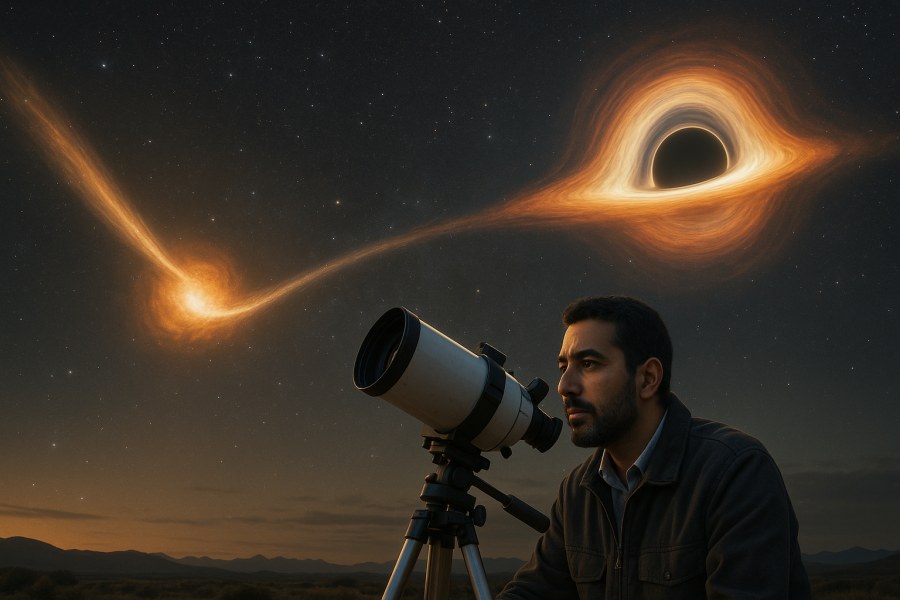
Source attribution: This post is a curated breakdown of Black holes keep tearing these stars apart, but they survive, with additional source evaluation, technical context, and evidence-based commentary from Taming Gravity.
Why this matters: most of us hear “a star met a black hole” and picture a one-time, Hollywood-style annihilation. But a growing class of observations suggests something stranger—and scientifically useful: some stars may get partially shredded, flare, survive, and come back for another pass. If that’s real (and not an observational trick), it turns black holes into repeatable laboratories for extreme gravity, stellar structure, and orbital dynamics—where the same object can be watched evolving over multiple encounters.
What the source says
The source describes astronomers studying events called repeating partial tidal disruption events (rpTDEs). In these systems, a star repeatedly skims close to a supermassive black hole (SMBH). Each close approach produces a burst (flare) of light, implying that some stellar material is stripped and then accretes (or otherwise radiates) near the black hole.
The intriguing puzzle highlighted in the summary: in some rpTDE systems, the flares become dimmer on each return. The source reports a proposed explanation: the star’s rapid spin—specifically, a star that was already rotating extremely fast before it was captured—could help explain both (a) why the flares fade from pass to pass and (b) how the star ended up on such a tight orbit around the SMBH in the first place.
It also frames rpTDEs as a valuable observational scenario because we may be seeing the same star interact with the black hole multiple times, rather than a one-off destruction.
Separating evidence from interpretation
What is relatively solid (physical mechanism level)
- Tidal disruption is real physics. If a star passes close enough to a black hole, the differential gravitational pull across the star (the tidal field) can exceed the star’s self-gravity, deforming it and potentially stripping material.
- Partial disruptions are plausible. Not every close pass must fully unbind a star. A star can lose outer layers and remain gravitationally bound to itself, depending on encounter distance, stellar structure, and orbit.
- Repeating flares have been reported in astronomy. The source asserts astronomers have found repeating systems consistent with partial disruptions.
What is more interpretive (model-dependent)
- “Rapid spin explains fading flares” is a hypothesis. It may be supported by simulations and fits, but without the paper we can’t judge assumptions (stellar spin distribution, orientation, magnetic fields, radiative efficiency, etc.).
- “Rapid spin explains capture into tight orbits” is also a hypothesis. Capture dynamics near SMBHs can involve many-body interactions, stellar clusters, and orbital diffusion. Spin may matter, but the relative importance is not obvious without detailed modeling.
What is missing (based on the summary alone)
- Direct spin measurements. The summary implies the star was already spinning fast, but measuring stellar spin in galactic centers—especially for a star undergoing repeated tidal encounters—can be extremely difficult. The case may rely on indirect inference from flare behavior.
- Quantified uncertainties and alternatives. A good paper will compare competing explanations and show why one is favored. A press-style summary often cannot.
- Selection effects. We tend to detect bright flares. A fading sequence could be partly observational: later flares might fall below detection thresholds in some bands, biasing the sample.
Practical context: what “repeating partial tidal disruption” likely means in plain physics
When a star swings by an SMBH, several things can happen depending on the closest approach (pericenter distance) relative to a characteristic “tidal radius.” If the encounter is too deep, the star is fully disrupted and you get a classic tidal disruption event (TDE). If it’s shallower, the star may be strongly distorted, lose some mass, and escape—or, in the repeating case, remain on a bound orbit that brings it back.
For an rpTDE, you can imagine a cycle like this:
- Approach: tides stretch and heat the star; outer layers can be pulled away.
- Mass loss: stripped gas forms streams; some gas can circularize into an accretion flow.
- Flare: as gas dissipates energy and falls inward, it radiates (UV/optical/X-ray depending on conditions).
- Survival and return: the star continues on an orbit and comes back again.
Two practical points often missed in casual discussions:
- The flare is not the star “lighting up.” The flare is usually attributed to gas dynamics and energy release near the black hole, not a steady “glow” from the star itself.
- “Survive” doesn’t mean “unharmed.” Even a surviving star could be structurally altered—mass-stripped, spun up or down, chemically mixed, or left in an excited state.
Why would flares fade on each return?
The source emphasizes fading flares and connects that to rapid stellar spin. That’s one plausible route, but it’s worth steel-manning several explanations—conventional first, then more speculative—while keeping evidence categories separate.
Conventional explanation A: the star runs out of “easy-to-strip” material
If the first pass removes a significant fraction of the star’s outer envelope, later passes may have less loosely bound mass available to strip. Less stripped mass can mean less gas to accrete and thus a dimmer flare.
Strength: doesn’t require exotic conditions; just cumulative mass loss.
Pitfall: depends on encounter geometry and how the star re-equilibrates. Some models predict complicated behavior (not just monotonic fading).
Conventional explanation B: changing accretion efficiency (not just changing mass)
Even if similar amounts of mass are stripped, the fraction that actually settles into a radiating flow can change. For example, orbital precession, shocks in the debris streams, or changes in how quickly debris circularizes could alter luminosity without a simple “less mass” story.
Strength: aligns with the messy reality of gas dynamics.
Pitfall: harder to pin down observationally; multiple parameter degeneracies.
Conventional explanation C: observational/selection effects
Later flares might shift in color (say, from UV to optical, or vice versa) due to changing temperatures and reprocessing. If surveys are more sensitive in one band than another, a perceived “fade” could be partly a bandpass artifact.
Strength: always worth checking in time-domain astronomy.
Pitfall: cannot explain a well-sampled, multiwavelength monotonic decline unless the effect is carefully accounted for.
Source’s highlighted explanation: rapid stellar spin changes the encounter outcome
Rapid rotation can matter because it changes a star’s shape (more oblate), internal structure, and effective gravity at the equator. In a tidal encounter, that can influence how easily material is stripped and how the star responds dynamically. If the star is already near a critical rotation rate, a close pass could remove mass in a way that rapidly alters subsequent encounters—potentially making later flares weaker.
However, the key question is not “can spin matter?” but “does spin explain this fading behavior better than alternatives, across multiple systems, with fewer special assumptions?” The source suggests the researchers think yes, but without the underlying analysis we should treat it as a promising model rather than a settled conclusion.
How could rapid spin relate to getting captured into a tight SMBH orbit?
The source also notes the model may explain how stars ended up in “extraordinarily tight” orbits. Capture and tightening mechanisms around SMBHs can include:
- Two-body relaxation / scattering in dense nuclear star clusters that drives some stars onto loss-cone orbits.
- Binary disruption (Hills mechanism): a binary wanders near the SMBH; one star is ejected at high velocity, the other becomes tightly bound.
- Repeated tidal interactions: each close pass can dissipate orbital energy via tides and mass loss, shrinking the orbit over time.
Where spin could come in: a rapidly rotating star might couple more efficiently to tidal forces (or have different dissipation properties), affecting how quickly orbital energy is drained into stellar oscillations and heat. But this is a technical claim that needs the full modeling context—especially since “spin already fast before capture” sounds like an initial-condition constraint that might narrow how common such systems can be.
What you can do as a careful reader: a checklist for evaluating rpTDE claims
If you’re reading press summaries or even abstracts about repeating TDE-like flares, here are practical questions that help separate robust inference from storyline:
1) Is the recurrence time truly periodic—and how many cycles are observed?
- Two flares can be coincidence. Three or more, with consistent spacing (or predictable evolution), is more compelling.
- Check whether cadence gaps could hide missed flares that would change the apparent pattern.
2) Are there alternative “repeating flare” engines ruled out?
Not every repeating nuclear flare is automatically an rpTDE. Competing possibilities can include variability from an active galactic nucleus (AGN), disk instabilities, or interactions with a pre-existing accretion disk. A strong case usually requires spectral/temporal signatures consistent with TDE-like debris, and inconsistency with typical AGN variability.
3) Is “fading” measured bolometrically or in one band?
- If only optical fades but UV rises, the total energy might not be fading the way the headline suggests.
- Multiwavelength coverage matters because reprocessing layers can shift energy between bands.
4) What is the inferred mass loss per passage, and is it physically plausible?
It’s common for flare luminosity to be translated (sometimes too casually) into an accreted mass estimate using assumed radiative efficiency. Those assumptions can be the soft underbelly of the argument.
5) What does the model predict next?
The most valuable part of a hypothesis is a testable prediction. For a rapid-spin explanation, useful predictions could include changes in flare duration, color evolution, polarization, or emission line behavior—especially if tied to stellar orientation and spin-down/spin-up expectations.
Where this story intersects Taming Gravity’s “science, not fiction” approach
Black holes and “stars being torn apart” are naturally sensational. But rpTDEs—if confirmed—are actually a story about repeatable measurement and constrained modeling. This is exactly the kind of topic where we can avoid two common traps:
- Trap 1: treating a press-summary hypothesis as a discovery. “Rapid spin may explain…” is not the same as “rapid spin explains.”
- Trap 2: dismissing it because it sounds weird. The universe is under no obligation to match our intuitions about one-and-done catastrophes.
If you’re new here, our editorial stance is laid out in Taming Gravity’s manifesto. We also file items like this in our News Archive and the broader News Archive category.
Practical “next steps” for following this research (without overcommitting to a headline)
Because the source is a news summary, the most practical way to engage is to treat it as a map to the underlying work. Here’s a disciplined follow-up path:
Step 1: Find the peer-reviewed paper or preprint
The ScienceDaily page is likely summarizing a university release about a specific study. The key is locating the actual paper (journal or arXiv) to see:
- Sample size (how many rpTDE candidates)
- Light curve quality and wavelength coverage
- Model assumptions (stellar type, spin distribution, orbit parameters)
- Statistical comparisons against alternative models
If the paper isn’t easily available, that’s not proof of anything—but it does limit how strongly we should update our beliefs.
Step 2: Look for independent analyses or competing interpretations
In fast-moving astrophysics, model competition is normal. A good sign is when other groups apply different simulations or semi-analytic methods and still find similar constraints.
Step 3: Watch for predictions that upcoming surveys can test
Time-domain astronomy is getting better quickly. Repeating flares are exactly what large synoptic surveys are built to catch, and multiwavelength follow-up can test whether “fading” is intrinsic, geometric, or band-dependent.
Step 4: Keep a firm boundary between “intriguing” and “settled”
A hypothesis can be both exciting and uncertain. Treat “rapid spin” as a candidate explanation that may rise or fall based on additional events, better cadence, and more complete spectral coverage.
Bottom line
The source highlights a compelling idea: some stars may survive repeated close encounters with supermassive black holes, producing recurring flares that sometimes fade over time—and rapid stellar spin might be a key ingredient linking survival, fading brightness, and unusually tight orbits.
From a “find the science, not the fiction” perspective, the big takeaway is not that the mystery is solved, but that rpTDEs (if confirmed and well-characterized) offer a rare chance to watch a single extreme system evolve across multiple passes. The decisive next step is comparing the rapid-spin model against simpler explanations (progressive mass loss, changing circularization efficiency, and observational bias) using the full datasets and transparent uncertainty budgets.
We’ll keep this filed in the archive as a research update worth tracking—especially as new repeating candidates and better multiwavelength coverage arrive.
Related reading on this site: the threat to space travel that no one’s talking about (on how environment and physics, not just engineering, can dominate outcomes), and our broader Featured on Stardrive page for select editorial highlights.
Q&A
What is a repeating partial tidal disruption event (rpTDE)?
It’s a scenario where a star repeatedly passes very close to a supermassive black hole, loses some material each time (partial disruption), and produces a flare on each encounter, rather than being fully destroyed in a single pass.
Does “the star survives” mean it’s basically intact?
Not necessarily. “Survives” typically means the star remains gravitationally bound as a star. It may still be heavily altered—stripped of outer layers, structurally perturbed, and potentially changed in rotation and internal mixing.
Why would the flares get dimmer over time?
One straightforward possibility is that successive passes strip less mass as the star’s outer layers are depleted. Another is that the same stripped mass produces less radiation because the debris circularizes differently or radiates less efficiently. The source highlights a hypothesis that rapid pre-existing stellar spin could help drive a fading pattern, but that remains model-dependent without the full paper.
How could a star’s spin affect a black hole encounter?
Rapid rotation changes the star’s shape and effective surface gravity, which can influence how tides strip material and how the star responds dynamically. In models, that can affect both how much mass is lost and how the system evolves from pass to pass.
What’s the best way to verify claims from a research-news summary like this?
Track down the underlying peer-reviewed paper or preprint and check (1) how many repeating cycles are observed, (2) whether multiwavelength data supports true fading versus a bandpass effect, (3) how uncertainties are handled, and (4) whether alternative explanations (like AGN variability) are quantitatively ruled out.














Leave a Reply