
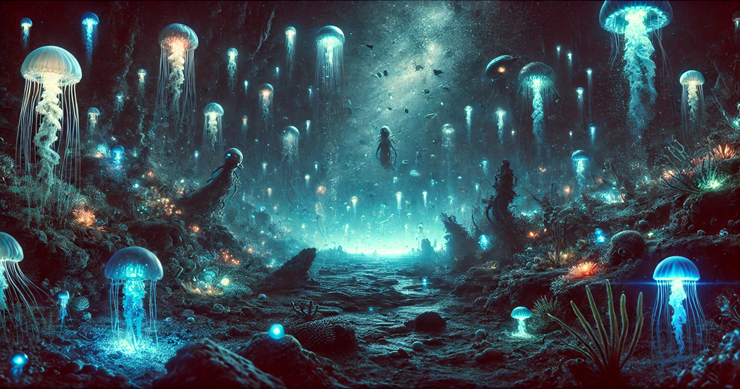
This guide walks through several popular claims often repeated in videos and posts about the trench: what is solidly established, what is merely reported, what would be required to verify it, and why deep-ocean uncertainty is sometimes used as a blank check for extraordinary conclusions. Along the way, we’ll compare that deep-sea knowledge gap to a familiar one in UAP and astrobiology: we keep discovering life in places we didn’t expect—yet evidence standards still matter.
Why the Mariana Trench is a magnet for “monster” narratives
The Mariana Trench sits in the western Pacific and includes the deepest known seafloor on Earth. The transcript underlying many viral summaries highlights a handful of true hooks: extreme depth (~11 km), immense pressure, perpetual darkness, and the fact that only a small fraction of the deep ocean has been directly observed. Those points are enough to support a sober conclusion: we should expect surprises.
But some versions add an extra claim: that “most information is deliberately concealed.” That is an assertion about intent. It’s not the same thing as “hard to study,” “expensive,” or “limited access,” all of which are boring but sufficient explanations for why we have incomplete coverage.
Established: the trench is deep, harsh, and not empty
The transcript describes a basic comparison: the trench’s deepest points are deeper than Everest is tall, so if Everest “fit” in the trench, its peak would still be underwater. While exact numbers vary by measurement method and location, the takeaway is solid: this is an environment that pushes human technology to its limits.
It also describes a 1960 descent by Jacques Piccard and colleagues in a bathyscaphe. That expedition is a matter of historical record. The key science-friendly point in the transcript is also broadly consistent with modern understanding: even at extreme depths, life is present. Deep-sea biology has repeatedly shown that organisms can persist under high pressure and low temperature, relying on falling organic material from above and (in some regions) chemical energy sources associated with vents and seep systems.
Reported claim #1: a “disc-shaped object” accompanied the bathyscaphe
The transcript asserts that a “declassified logbook” recorded a large disc-shaped object seen through a porthole, “maneuvering” as if studying the crew. This is a dramatic claim—but the transcript (as provided) does not include a verifiable archival identifier, scan, museum holding, or an official catalog entry you can independently check. Without that, the claim remains reported, not established.
Steel-manning the possibilities
- Conventional explanation: misperception through thick viewports, optical distortion, bioluminescent organisms, or a deep-water animal at an ambiguous distance. In a cramped, high-stress observation environment, “clear intention” is easy to read into motion that may be current-driven.
- Unconventional explanation: an unknown vehicle or phenomenon. If true, it would be highly significant—especially if corroborated by instrumentation, multiple witnesses, or recovered logs with chain-of-custody.
What evidence would move this toward “established”
- A primary document with provenance (where it is held, when it was archived, and how it was released).
- Contemporaneous mission notes from more than one participant.
- Instrument data (sonar returns, camera film, telemetry) consistent with the description.
Reported claim #2: the Glomar Challenger incident and a “chewed” probe
The transcript describes a 1985 scenario: a vessel lowered an automatic probe to ~11 km, heard strange noises, cables stretched as if something pulled them, and the probe returned with damage resembling bites; an “official version” blamed collision with a cliff.
Here, two different questions get tangled:
- Could deep-sea equipment be damaged in dramatic ways? Yes. Entanglement, abrasion, sudden tension loads, equipment failure, or impact on rugged terrain can damage frames and cables.
- Does the described damage specifically indicate a giant animal? Not without detailed photos, materials analysis, tension logs, location data, and a formal report.
Steel-manning both sides
- Conventional explanation: snagging, dragging, or collision—especially plausible if the seafloor is uneven and currents or cable dynamics are poorly constrained. “No mountains” in one patch doesn’t guarantee no hazards; slopes, outcrops, and trench-wall features can still exist.
- Unconventional explanation: interaction with an unknown large organism or vehicle. Extraordinary, but not logically impossible—just evidentially unsupported in the transcript as given.
Disputed claim: Megalodon in the Mariana Trench
The transcript presents Megalodon as a 22-meter, 50-ton shark and argues it might not be extinct, having “taken refuge” in the trench. It also claims a large tooth was found near the Mariana Trench and “thorough research confirmed” it belonged to Megalodon.
Here’s the evidence-sensitive way to hold this:
- Established: Megalodon is a well-known prehistoric shark species from the fossil record.
- Disputed/unsupported in the provided material: that Megalodon survives today, specifically in the Mariana Trench.
Why the trench refuge idea is a heavy lift:
- Ecology and food supply: very large predators require substantial, reliable biomass. The deep trench environment is typically energy-limited compared with surface ecosystems.
- Verification would be difficult to hide: a breeding population of enormous animals tends to leave traces—carcasses, repeated sensor detections, genetic material (eDNA), consistent sightings, or fisheries interactions.
- Teeth alone don’t prove “still alive”: a tooth can be fossil, reworked, or transported. Without context (stratigraphy, dating, provenance), it cannot establish a living animal.
A practical “find the science” checklist for deep-sea monster claims
1) Separate location truth from creature truth
“The trench is deep” can be true even if “the trench has monsters” is unproven. Don’t let accurate geography launder weak biology claims.
2) Look for primary records, not just “declassified” buzzwords
When someone claims a document was declassified, ask: declassified by whom, from which archive, with what identifier? If you want to learn how to think about primary sources and records culture, start with Taming Gravity’s framing on evidence and inquiry in the Taming Gravity manifesto.
3) Demand instrumentation context
- What sensor (camera, sonar, hydrophone)?
- What range/resolution and what were the settings?
- Is there raw data, not just a narrative summary?
4) Watch for “intention” language
Phrases like “clearly studying us” are interpretations. They might be correct—but they are not measurements.
5) Ask what a boring failure mode would look like
Before you accept “giant bite marks,” check whether cable snapping, torsion, abrasion, or impact could plausibly create similar damage.
Deep ocean vs. deep space: the shared lesson (and the big difference)
The transcript’s core emotional point lands: we keep finding life in places once thought impossible. That’s true in the deep ocean, and it’s part of what motivates astrobiology—if life thrives in extremes here, perhaps it could elsewhere.
But there’s a crucial difference in how we should reason from that fact:
- Inference we can responsibly make: life is adaptable; we should keep looking in extreme environments.
- Inference we cannot responsibly make from the transcript alone: specific extraordinary entities (a surviving Megalodon, an underwater civilization, or a craft escorting a bathyscaphe) are present without verifiable primary evidence.
If you enjoy that boundary between curiosity and proof, you may also like the site’s evidence-focused archive approach in the News Archive and the way we frame uncertain interpretations in ET in the News.
Conclusion: wonder is warranted—certainty isn’t
The Mariana Trench is one of Earth’s most extreme, least directly observed environments, and it absolutely contains life that challenges intuition. That alone is a powerful reminder: “unknown” is not the same as “empty.”
At the same time, the strongest claims in the transcript—disc-shaped escorts, monster-torn probes, and living Megalodon—are presented without the kind of primary documentation that would let a careful reader verify them. The science-forward stance is not to sneer at the possibility, but to label it correctly: reported or speculative until a traceable record, reproducible data, or physical sample closes the gap. That’s how we keep the wonder and drop the fiction.














Leave a Reply