
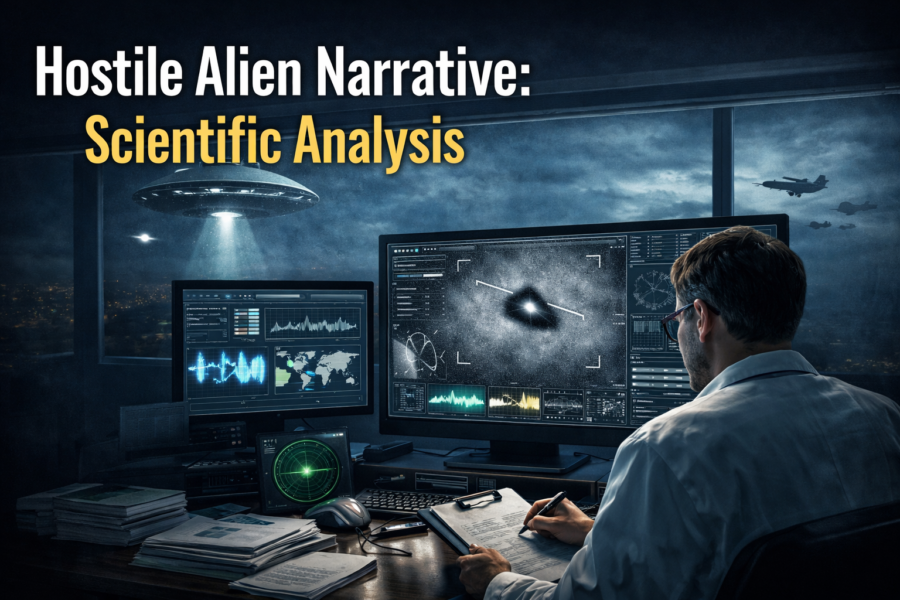
A Scientific and Strategic Examination of Hostile Alien Narratives
Introduction: The Power of Narratives in an Age of Uncertainty
Few ideas capture the human imagination as powerfully as the possibility that we are not alone in the universe. Yet alongside that curiosity runs a parallel current—one shaped not by wonder, but by fear. Stories of hostile extraterrestrials, invasive abductions, and predatory species such as the so-called “Draco” have become deeply embedded in modern culture. These narratives are often presented as hidden truths, suppressed by governments and slowly revealed through whistleblowers, insiders, and alternative media.
At the same time, humanity operates within complex geopolitical systems where information is rarely neutral. Institutions—particularly those tied to national defense—function within frameworks that reward threat perception, strategic ambiguity, and technological dominance. The intersection of these two domains—public fascination with extraterrestrial life and institutional control over advanced technologies—creates a landscape where perception and reality can become difficult to disentangle.
This tension becomes especially important when viewed within the broader UFO disclosure landscape, where competing narratives often blur the line between evidence and interpretation.
This raises a critical and necessary question:
Are hostile alien narratives grounded in verifiable evidence, or are they emerging from a mixture of misinterpretation, psychological projection, and institutional incentive structures that benefit from sustained public fear?
This article does not attempt to dismiss the unknown. Rather, it seeks to clarify the boundaries of what is known, what is hypothesized, and what is unsupported, while exploring why certain narratives persist so strongly despite limited empirical grounding.
Understanding the Framework: Separating Data from Interpretation
A major challenge in UFO discourse is the tendency to collapse multiple layers of understanding into a single conclusion. Observations, interpretations, and beliefs are often treated as interchangeable, when in reality they operate at very different levels of reliability.
At the most fundamental level, there are observations. These include documented unidentified aerial phenomena (UAP), pilot encounters, radar detections, and sensor anomalies. These observations are real in the sense that they have been recorded and, in some cases, verified across multiple instruments. However, they are inherently incomplete. A radar return or infrared signature tells us that something was detected—but not what it was.
From these observations emerge interpretations. This is where the divergence begins. Some interpret UAP as evidence of extraterrestrial craft. Others view them as advanced human technology, atmospheric phenomena, or sensor artifacts. The leap from “unknown object” to “non-human intelligence” is not trivial—it represents a significant expansion beyond the data itself.
Overlaying this is the institutional context. Governments have historically classified advanced technologies, sometimes allowing misinterpretations to persist as a form of strategic ambiguity. This does not necessarily imply deception at every level, but it does mean that the information landscape is uneven and often incomplete.
Finally, there is cultural amplification. Media, books, documentaries, and online communities shape how these topics are understood. Narratives that are emotionally compelling—particularly those involving danger or conflict—tend to spread more rapidly than neutral or uncertain explanations.
When these layers are not carefully separated, the result is a form of epistemic collapse, where uncertainty is replaced by confident but unsupported conclusions.
Official government analysis, including official UAP report findings, confirms that many aerial phenomena remain unidentified but not necessarily extraterrestrial.
Cattle Mutilations: Between Forensic Reality and Extraordinary Claims
Cattle mutilations are frequently cited as one of the strongest pieces of evidence for non-human intervention on Earth. Reports often describe animals found with precise incisions, missing organs, and an apparent absence of blood—features that are interpreted as indicative of advanced, possibly extraterrestrial technology.
However, when examined through a forensic lens, many of these features have well-understood explanations. Decomposition processes can create the appearance of clean cuts as skin dries and retracts. Scavengers—particularly insects and small animals—tend to consume soft tissues first, often producing patterns that appear surgical. Environmental factors, such as gas buildup and rupture, can further distort the appearance of the remains.
This does not mean that every case is fully explained. There are instances where the available evidence is insufficient to reach a definitive conclusion. But this is not unusual in forensic investigations. The key point is that an unexplained case is not equivalent to evidence of extraterrestrial activity.
The persistence of the extraterrestrial interpretation often reflects a broader cognitive tendency: when faced with ambiguity, the human mind seeks patterns and meaning, sometimes extending beyond what the data can support.
Alien Abductions: The Intersection of Experience and Neurobiology
Reports of alien abduction represent one of the most emotionally charged aspects of UFO discourse. Individuals describe vivid encounters involving paralysis, non-human entities, and invasive procedures. These experiences are often deeply distressing and are recounted with a level of detail that suggests authenticity.
From a scientific perspective, however, many of these experiences align closely with known neurological phenomena. Sleep paralysis, for example, can produce a state in which an individual is awake but unable to move, often accompanied by intense hallucinations. These hallucinations can include figures in the room, sensations of pressure, and a profound sense of presence.
Hypnagogic and hypnopompic states—transitional phases between sleep and wakefulness—are also associated with highly realistic sensory experiences. In these states, the brain can generate narratives that feel external, even though they originate internally.
Memory adds another layer of complexity. Under certain conditions, particularly when guided by suggestive questioning or hypnosis, memories can become more vivid while simultaneously becoming less reliable. The mind tends to organize experiences into coherent narratives, even when the underlying data is fragmented.
It is important to approach this topic with sensitivity. The goal is not to dismiss individuals’ experiences, but to understand the mechanisms through which such experiences can arise. In many cases, the evidence suggests that these encounters are real at the level of subjective experience, but not necessarily indicative of external extraterrestrial intervention.
These experiences strongly overlap with the scientific explanation of sleep paralysis experiences, which can produce vivid and convincing encounters.
The “Draco” Hypothesis: Myth, Archetype, or Misinterpretation?
The idea of hostile reptilian extraterrestrials—often referred to as “Draco”—occupies a prominent place in certain segments of UFO discourse. These entities are typically described as hierarchical, aggressive, and involved in covert interactions with humanity.
When examined critically, the Draco narrative reveals several important characteristics. First, it is almost entirely based on testimonial accounts, with little to no physical evidence. Second, the descriptions vary widely across sources, suggesting a lack of consistent underlying data. Third, the imagery closely mirrors longstanding mythological archetypes, particularly those involving serpents or dragons.
Throughout human history, serpentine figures have often been associated with power, danger, and transformation. These symbols appear in cultures around the world, from ancient mythology to modern storytelling. It is therefore plausible that the Draco narrative represents a modern reinterpretation of deep cultural archetypes, rather than a reflection of external biological reality.
This does not mean that all such claims are fabricated. It means that, in the absence of corroborating evidence, the most parsimonious explanation is that these narratives are constructed at the intersection of psychology, culture, and belief.
Institutional Incentives: Why Fear Can Be Functional
To understand why fear-based narratives persist, it is necessary to examine the systems within which information is produced and disseminated. The modern military-industrial framework operates on a scale that requires sustained justification. Defense budgets, research programs, and strategic initiatives are often supported by the perception of external threats.
Historically, governments have engaged in information management practices that include classification, selective disclosure, and, in some cases, deliberate misinformation. During the Cold War, for example, both the United States and the Soviet Union employed psychological operations designed to influence public perception and strategic behavior.
These dynamics align closely with the concerns outlined in the Taming Gravity Manifesto, which emphasizes the need to separate technological reality from narrative distortion.
In such an environment, ambiguous phenomena—such as unidentified aerial objects—can serve multiple purposes. They may be used to obscure classified technologies, to test public reactions, or simply to maintain strategic uncertainty.
It is not necessary to assume a coordinated global conspiracy to recognize that fear can be structurally advantageous. When a population perceives a threat, it is more likely to accept increased security measures, higher defense spending, and reduced transparency.
This creates a subtle but powerful dynamic: narratives that emphasize danger and conflict are more likely to be reinforced, while those that emphasize uncertainty or benign explanations receive less attention.
The Disclosure Ecosystem: Between Inquiry and Amplification
The modern “disclosure” movement is a complex and heterogeneous landscape. It includes serious researchers, former military personnel, independent investigators, and media personalities. Some contributors approach the subject with rigorous skepticism, while others present highly speculative claims as established fact.
In this ecosystem, attention functions as a form of currency. Content that is dramatic, emotionally engaging, or controversial tends to spread more rapidly than content that is cautious or nuanced. This creates an environment in which claims can escalate faster than evidence.
Psychologically, this is reinforced by several well-documented biases. Confirmation bias leads individuals to favor information that supports their existing beliefs. Pattern recognition bias encourages the identification of connections even when none exist. Identity reinforcement makes it difficult to revise beliefs that have become central to one’s worldview.
These factors do not imply deception or ill intent. They reflect the normal functioning of the human mind within a complex information environment. However, they do contribute to the persistence of narratives that are not strongly supported by empirical evidence.
This concern was notably articulated in Eisenhower’s military-industrial complex warning, which highlighted the long-term risks of unchecked defense expansion.
Reconsidering Hostility: What Would an Advanced Civilization Look Like?
One of the most important questions in this discussion is whether it is reasonable to assume that an advanced extraterrestrial civilization would be hostile. To approach this question, we can consider the technological and evolutionary requirements for interstellar travel.
A civilization capable of traversing vast distances between stars would likely possess:
- Advanced energy generation and control
- Deep understanding of spacetime and propulsion
- Long-term stability and resource management
Such capabilities imply a level of development that extends far beyond current human technology. More importantly, they suggest that the civilization has successfully navigated the challenges associated with technological growth—challenges that, on Earth, often lead to conflict and instability.
When examined through the lens of the physics of advanced propulsion systems, the assumption of inherently hostile interstellar civilizations becomes far less convincing.
This does not guarantee benevolence. However, it raises an important point:
A civilization that has achieved interstellar capability has likely already resolved many of the internal conflicts that currently define human society.
Projecting human patterns of competition and aggression onto such a civilization may therefore be more reflective of our own developmental stage than of theirs.
Competing Explanations: A Balanced Assessment
To maintain intellectual rigor, it is important to consider multiple hypotheses simultaneously.
One possibility is that hostile extraterrestrial entities are indeed present and interacting with humanity. This view is supported primarily by testimonial evidence and interpretative frameworks that assume intentionality behind unexplained phenomena.
Another possibility is that many UFO observations represent advanced human technologies, either domestic or foreign. In this scenario, secrecy and misinterpretation play significant roles.
A third possibility is that a substantial portion of reported experiences—particularly abductions—arise from psychological and neurological processes.
A fourth, more integrative view is that there are genuine unknown phenomena, but that the meanings assigned to them are often incorrect or exaggerated.
At present, the available evidence most strongly supports this fourth position. There are real anomalies, but no verified data confirming organized, hostile extraterrestrial activity.
Ethical Implications: The Cost of Fear-Based Narratives
The way we interpret these phenomena has real consequences. Narratives centered on fear and hostility can influence public perception, policy decisions, and technological development.
When fear dominates, it tends to:
- Increase support for militarization
- Reduce tolerance for uncertainty
- Amplify division and distrust
In contrast, a science-based approach encourages:
- Open inquiry
- Collaborative research
- Long-term thinking
For a platform focused on gravity, propulsion, and advanced physics, this distinction is particularly important. The development of transformative technologies requires not only technical capability, but also ethical clarity.
Toward a More Mature Framework of Understanding
Humanity is in the early stages of grappling with questions that extend beyond our planet. In this context, it is natural for uncertainty to coexist with speculation. The challenge is to ensure that speculation does not outpace evidence to the point where it distorts understanding.
A more mature framework involves:
- Accepting uncertainty without rushing to conclusions
- Distinguishing between experience and explanation
- Recognizing the role of institutional and psychological factors
This does not diminish the mystery. On the contrary, it allows the mystery to be explored more effectively.
Conclusion: Clarity Over Fear
The question of extraterrestrial life remains one of the most profound open questions in science. However, the specific claim that humanity is being targeted by hostile alien species is not supported by strong empirical evidence.
What we observe instead is a complex interplay of:
- Genuine unknown phenomena
- Human cognitive processes
- Institutional dynamics
- Cultural storytelling
Understanding this interplay is essential if we are to move forward responsibly.
Ultimately, humanity’s future lies not in fear, but in the continued pursuit of scientific exploration beyond Earth grounded in evidence and clarity.
Final Reflection
The unknown does not become clearer through fear.
It becomes clearer through disciplined inquiry.
Call to Action: Think Critically, Explore Responsibly
As readers and participants in this evolving field:
- Seek evidence before conclusions
- Question narratives that rely on fear
- Examine the incentives behind information
- Remain open—but grounded
Humanity’s future will not be shaped by what we fear in the cosmos, but by how clearly we learn to understand it.














Leave a Reply