
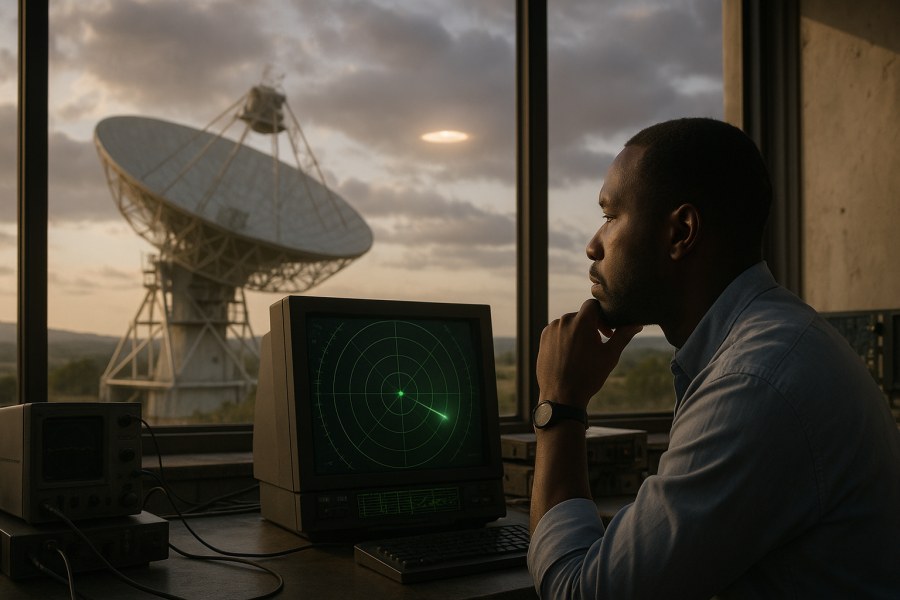
When an unusual aerial event is reported, two phrases tend to do a lot of work: “multiple witnesses” and “radar confirmed.” Both can be valuable. Both can also be misunderstood. The hard part is that “matching” does not automatically mean “the same thing happened in the sky,” and “radar” does not automatically mean “a solid object.”
This guide lays out a practical, evidence-conscious way to judge corroboration when radar tracks and human testimony seem to line up. You’ll learn what radar can and can’t tell you in general, what eyewitnesses tend to do well (and poorly), what it really means for two sources to be independent, and how to sort physical evidence, official records, and testimony from inference and speculation—under Taming Gravity’s principle: find the science, not the fiction.
Why “radar + witness” feels decisive (and why it often isn’t)
Humans and instruments fail in different ways, so combining them feels like a lock. A witness can describe shape, sound, brightness, and perceived behavior. Radar can provide time-stamped tracks and motion cues. When they agree, it’s tempting to conclude: “There was an object doing X.”
But there are two traps:
- Same story, different causes: a witness may be looking at a bright planet while radar is tracking a normal aircraft (or a weather-related return) elsewhere in the same general direction.
- Same cause, distorted measurements: radar and human perception can both be biased by geometry, propagation conditions, clutter, and expectations—sometimes in ways that create apparent agreement.
The goal is not to dismiss radar or testimony. It’s to ask: what exactly is each source measuring, and do they overlap on the same thing?
Step 1: Separate evidence types before you interpret
A disciplined evaluation starts by sorting what you have into categories. This prevents “the narrative” from hardening before you’ve checked what’s actually on the table.
- Physical evidence: imagery, instrument logs, debris, electromagnetic recordings, environmental traces, medical data (handled carefully), etc.
- Official records: radar logs, ATC recordings, incident reports, duty logs, ship/aircraft navigation data, maintenance notes, weather data.
- Testimony: witness statements, interviews, contemporaneous notes, 911 calls.
- Inference: reconstructed trajectories, speed estimates, “it must have been X,” triangulations based on assumptions.
- Disputed claims: unverified documents, secondhand leaks, anonymous accounts, edited clips without provenance.
- Speculation: “it was advanced propulsion,” “it was plasma,” “it was a secret program,” etc.
Step 2: Understand what “radar” might mean in the report
“Radar” is not one thing. The evidential weight depends heavily on radar type, processing, and context. Without system details, many confident-sounding conclusions are premature.
Common “radar” categories you may see mentioned
- Primary surveillance radar (PSR): in many aviation contexts, “primary” refers to detecting targets from reflected energy rather than from a transponder reply. Terminology and implementation details can vary by system.
- Secondary surveillance radar (SSR) / transponder-based: in many aviation contexts, “secondary” refers to cooperative surveillance in which aircraft equipment replies to interrogation, enabling identity/altitude information. Details vary with mode and region.
- Fire-control radar: a broad label often used for higher-precision tracking/targeting radars in military contexts; the reporting conventions and processing can be highly system-specific.
- Weather radar: radars designed to map meteorological phenomena; interpreting those displays as “solid objects” can be misleading without expert context and system details.
Two practical questions that often decide the value of “radar confirmation”:
- Was it a raw return, or a tracked/processed output? In many systems, what gets described publicly as a “track” can be a processed estimate built from multiple measurements and assumptions rather than a simple list of raw detections. Without knowing what the output represents, evidential confidence should be limited.
- Is there supporting context? For example: concurrent ATC traffic, known exercises, unusual weather, or maintenance anomalies.
Step 3: Make the “same event” test (time, place, geometry)
A common failure mode in radar-and-witness cases is assuming both sources refer to the same thing because they occurred “around the same time” in “the same area.” Corroboration requires more.
A practical alignment test
- Time alignment: Do you have synchronized timestamps? A witness’s “about 9:30” may be off by minutes. Radar logs might be in UTC; interviews might use local time.
- Spatial alignment: Where was the witness (exact location, elevation, view obstructions)? Where was the radar (site location)?
- Line-of-sight geometry: What azimuth/elevation did the witness report? Does that plausibly intersect the radar track position at that time?
- Range ambiguity: A witness sees angular position; radar (when range is available) provides range/bearing. Many mismatches hide in “range.”
If you can’t do this test with at least rough numbers, you may still have an interesting report, but you do not yet have strong corroboration.
Step 4: Treat eyewitness testimony as measurement—with known error bars
Eyewitnesses contribute real information: timing of onset, direction changes, relative motion against landmarks, sound delays, and qualitative behavior (hovering, flashing, breakup, etc.). But human perception has limitations—especially at night or over featureless backgrounds (ocean, desert, skyglow). This doesn’t “debunk” an observation—it sets expectations for uncertainty.
Common pitfalls that inflate “extraordinary motion” (described generally)
- Distance ambiguity: If you don’t know distance, you can’t reliably infer size or speed. A nearby drone and a far aircraft can look similar in angular motion.
- Weak visual references: A point of light against a dark sky, with few anchors, can be hard to judge accurately for motion and depth.
- Parallax from moving observers: A witness in a car, aircraft, or ship can perceive dramatic motion from modest relative geometry changes.
- Brightness and glare: Overexposure, atmospheric effects, and lens artifacts can be misread as structure.
Step 5: Independence is the whole game
Two sources only strengthen a case if they are meaningfully independent. If a witness learns details about what “radar saw” before giving a statement, that can shape confidence and later retellings. If radar operators are cued to “look there,” that can change attention and labeling in ways that matter for what gets reported afterward.
Independence questions to ask
- Information flow: Did witnesses learn about the radar hit before giving statements? Did radar operators receive a visual cue?
- Shared expectations: Was there a known exercise, recent local rumors, or heightened alert?
- Common-mode environment: Weather and propagation conditions can sometimes affect multiple sensors (and interpretation) at once; treat that as a reason to be extra careful about assuming independence.
- Separate recording chains: Ideally, each source has its own contemporaneous records created automatically (timestamps, storage) rather than reconstructed later.
Step 6: Beware the “speed from radar” and “acceleration from video” traps
Once radar and testimony “match,” people often jump to high speeds, right-angle turns, or extreme acceleration. Those claims can be true in principle—but in practice they’re easy to overstate.
Radar-derived motion: what you need to know
- Position error matters: Speed and acceleration are derived from position-over-time. As an analysis caution, when you compute derivatives from noisy measurements, the noise can dominate the apparent acceleration unless uncertainties are carried through carefully.
- Processing matters: Depending on how a system reports or records data, the output may reflect smoothing, association choices, or assumptions used to maintain a continuous target report through gaps. Without knowing what the output represents, it’s hard to treat it as precise physics.
- Altitude and 3D geometry matter: If altitude (or range) is uncertain, reconstructions of 3D maneuvers can be far less reliable than they appear in a 2D plot or retelling.
Witness-derived motion: what you need to know
- Angular motion is not speed: A light crossing your field of view quickly could be close and slow or far and fast.
- “Hover” can be “moving toward/away”: Motion directly along the line of sight produces little apparent lateral movement.
Step 7: Steel-man the explanations—conventional and unconventional
A science-first approach doesn’t mean forcing everything into “it was a plane.” It means giving each hypothesis its best fair shot, then checking which one needs the fewest special assumptions while still fitting the evidence you actually have.
Conventional explanations worth testing hard
- Known aircraft (including military) + perception error: especially at night, over water, or with unusual viewing angles.
- Weather and propagation conditions: some environments can make sensor interpretation (and human interpretation) harder than usual.
- Balloons, drones, birds: can confuse both radar and humans depending on altitude, lighting, and clutter environment.
- Sensor/processing artifacts: interference, miscalibration, mis-association, or reporting/recording limitations.
Unconventional explanations worth describing carefully (without overclaiming)
- Rare atmospheric luminous phenomena: could plausibly produce some visual reports; whether they produce consistent radar constraints is case-dependent and often uncertain.
- Novel or unreported human technology: possible in principle; requires a match to capabilities, basing, and operational context—without assuming omnipotent “secret tech.”
- Unknowns: Sometimes the honest answer is that available data can’t discriminate among several hypotheses.
Step 8: What “corroboration” can and cannot establish about physics
Because Taming Gravity often touches gravity and propulsion claims, it’s worth being explicit: radar-and-witness corroboration by itself typically does not establish anything direct about gravity manipulation, “anti-gravity,” or new spacetime engineering. At best, it can constrain a trajectory and perhaps a performance envelope—and even those are often uncertain unless range/altitude and system details are well characterized.
If someone argues, “The motion implies impossible g-forces, therefore new physics,” the missing steps usually include: verified range/altitude, error bars, and a demonstration that conventional explanations have been excluded. That doesn’t mean new physics is impossible; it means the claim is usually underdetermined by the available evidence.
If you want a broader orientation to how this site approaches high-claim topics, you can browse Taming Gravity’s editorial manifesto and Gravity Science. (These are navigation links, not external technical citations.)
Step 9: A practical workflow you can use on real cases
1) Build a timeline table
- List every event marker (first sighting, closest approach, disappearance, radar acquisition/loss, radio calls).
- Note the time source (device timestamp, log time, memory estimate).
- Convert to a single time standard (and document the conversion).
2) Map observers and sensors
- Plot witness locations and headings; note altitude if airborne.
- Plot radar site(s) and coverage constraints if known.
3) Write “direct measurement” statements
- Example (witness): “Observer A reports a bright light moving from west to south over 40–60 seconds, no sound noted.”
- Example (radar): “System B produced a reported target/track at bearings X–Y over minutes; altitude unknown/estimated.”
4) Test candidate matches and reject weak matches early
- If witness azimuth doesn’t overlap radar bearing at the same time window, don’t force the match.
- If multiple radar targets exist, explore mundane correlations first (known traffic patterns, approach/departure lanes).
5) Only then discuss hypotheses
Once you’ve constrained what likely matches what, you can compare explanations. If you want a deeper library of technical and historical material (and examples of how claims can evolve over time), browsing the Gravity Science category can help you calibrate what counts as strong versus weak evidence. (This is a navigation link, not an external technical citation.)
Common pitfalls that make “radar corroboration” sound stronger than it is
- Conflating sensor types: “Radar” could mean transponder-based replies, primary returns, or processed tracks—very different evidentially.
- Relying on retellings: A statement like “operators said it accelerated to Mach 10” is not the same as a plotted, time-stamped dataset.
- Ignoring base rates: Airspace has lots of targets. A radar hit near a reported light can occur by chance unless geometry and timing are tight.
- Assuming absence implies anomaly: “No transponder” may indicate a military aircraft, a system limitation, or coverage/line-of-sight issues.
What stronger corroboration looks like (and what to ask for)
If you’re evaluating a public case or interviewing someone about an incident, here are high-yield asks that improve clarity without demanding unrealistic access:
- Exact timestamps for key events (even approximate, but with documented uncertainty).
- Radar type and mode (primary/secondary/fire-control; any mode switches).
- Raw vs processed data (plots, track files, operator logs).
- Weather conditions (especially inversions and unusual layers, if known).
- Independent recordings (audio, video with metadata, or separate sensor corroboration).
Conclusion: Corroboration is a constraint, not a conclusion
When radar matches eyewitness reports, you may have something genuinely worth studying. But the value lies in what the pairing can constrain: timing, bearing, persistence, and sometimes coarse motion. To treat it as corroboration in the strong sense, you need independence, shared geometry, and an honest accounting of uncertainties.
Done well, this approach is not cynicism—it’s how you keep the door open to surprising truths without mistaking a compelling story for a measured result. That’s the balance: find the science, not the fiction.
Q&A
If radar saw it, doesn’t that prove it was a solid craft?
Not by itself. “Radar confirmed” is a shorthand claim that needs context about the radar type, what the system output actually was (raw detections vs processed reporting), and what alternative interpretations were considered. Stronger support comes from knowing the radar mode, the data provenance, and whether other independent sensors and records line up with the same event geometry.
What’s the single most important test for ‘radar matched the witness’?
Geometry with timing. You want the witness’s reported direction (azimuth/elevation) at a specific time to intersect the radar target’s bearing/range at that same time window, accounting for uncertainty. Without that alignment, “same time, same area” can be a coincidence or two different things being conflated.
How can two sources fail to be independent?
If information flows between them. A witness who hears “radar has a track” may unconsciously reshape later descriptions or confidence. A radar operator who is cued to “look over there” may change attention and labeling in ways that affect what gets reported. Independence is stronger when each source produces its own contemporaneous records without being prompted by the other.
Why do speed and acceleration claims often blow up in these cases?
Because speed and acceleration are derived quantities that amplify errors. Small uncertainties in position, time, range, or altitude can produce large apparent accelerations when you compute changes over time. If you don’t know exactly what a system’s reported outputs represent, the safest stance is to treat dramatic kinematics as unconfirmed.
Does radar-and-witness corroboration imply new physics like antigravity?
Usually it does not. At best, it may constrain a trajectory or persistence of a target, often with significant uncertainty. Claims of gravity manipulation require additional steps: verified range/altitude, quantified error bars, and careful elimination of conventional explanations (aircraft, balloons, atmospheric effects, or sensor/processing limitations). If key measurements are missing, the honest conclusion is often that multiple explanations remain viable.














Leave a Reply