
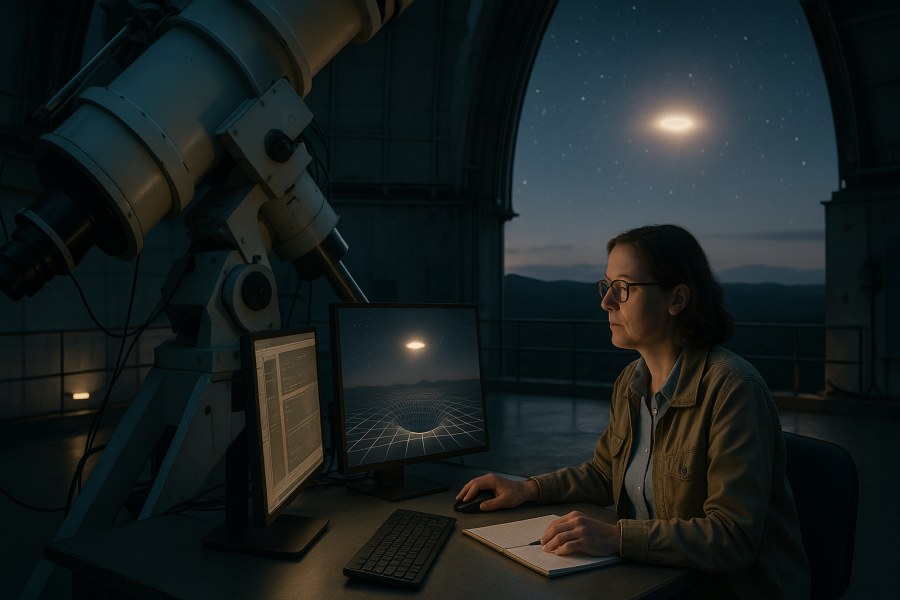
Witness testimony sits at the center of many UAP cases—especially the ones that never produce a clear photo, recovered material, or instrument data. That makes testimony valuable, but also easy to overtrust. In general, people can notice anomalies quickly, yet human perception and memory are not precision measurement tools—especially under stress, at night, or when distance and speed are unknown.
Important note about evidence levels: This article is a methods guide. It does not present new measurements, case-specific findings, or externally cited research in the text below. Treat the items here as practical investigative heuristics (best practices), not as claims that have been “proven” within this article via citations. Where the text makes a general-sounding statement about perception, sensors, or measurement, read it as typical behavior and a prompt to check constraints—not as a universal rule.
This guide gives you a practical, evidence-first method to evaluate UAP witness statements without dismissing people or inflating claims. You’ll learn how to separate what was directly observed from what was inferred, how to check internal consistency, how to rebuild context (sky, weather, geometry, timing), and how to look for corroboration that actually reduces uncertainty.
What testimony can and can’t establish
Before you start vetting, decide what kind of claim the testimony could realistically support.
- Testimony can often establish: that someone perceived an unusual light/object; approximate direction; rough timing; the sequence of events; emotional response; sometimes relative motion (e.g., “it crossed from near that ridge to above that tree”).
- Testimony often struggles to establish precisely: size, distance, altitude, and speed; exact shapes at night; whether motion was “impossible” (without geometry); whether something was silent (wind, distance, hearing limits); whether it was not a plane (without checked air traffic context).
- Testimony alone is typically not sufficient to establish: exotic propulsion, gravity control, non-human origin, or “defying physics.” Those are interpretations layered on top of perception.
A step-by-step method to vet a UAP witness account
Step 1: Split the story into observation vs. interpretation
Write two columns.
- Observed (direct sensory data): a bright light low in the west, three lights in a line, a dark object passed in front of the moon, it blinked red/green, it moved behind clouds.
- Inferred (conclusions): it was a craft, it followed me, it accelerated instantly, it was the size of a bus, it was intelligently controlled.
This isn’t about policing language; it’s about identifying which parts are falsifiable. Often, the case becomes clearer when you keep the observations and bracket the inferences.
Step 2: Build a timeline that a third party could audit
Ask for times and durations in the simplest possible format:
- Start time (as close as possible): ~9:17 pm is better than “around night.”
- Duration: ~45 seconds is better than “a while.”
- Sequence: what happened first, what changed, what ended the event.
- Interruptions: phone call, walking indoors, driving, losing view behind trees.
Then look for contradictions like “it hovered for ten minutes” but also “I filmed it for 12 seconds and it was already gone.” Contradictions don’t automatically debunk a witness—they can flag where memory is compressing, where uncertainty should be recorded explicitly, or where multiple moments may be getting merged.
Step 3: Anchor geometry using the sky and the horizon
A common failure mode in UAP descriptions is geometry: a point light at unknown distance can seem close and fast even when it’s far and slow.
- Direction: Which way were they facing (N/E/S/W)? Can they identify a landmark?
- Elevation angle: Was it near the horizon, halfway up the sky, or overhead?
- Reference objects: above the radio tower, between two stars, over the tree line.
- Motion in angles: “moved from above the roof peak to the chimney” is more useful than “shot across the sky.”
If there’s video, pause it and identify fixed objects (rooftops, poles, tree silhouettes). You’re trying to recover angular change; in many real-world clips, you often can’t recover distance unless you also have additional constraints (multiple viewpoints, a known scale in frame, or calibrated camera metadata).
Step 4: Reconstruct environmental context (often the whole case)
Context doesn’t “explain it away.” It bounds what was possible to see and hear.
- Weather: cloud layers, haze, wind, precipitation, temperature inversions.
- Lighting: streetlights, stadiums, car headlights, advertising signs, moon phase/brightness.
- Sound conditions: wind in trees, traffic, indoor/outdoor, distance to highways.
- Obstructions: trees, buildings, mountains that can hide or reveal aircraft on approach paths.
Two key questions: (1) what could have produced reflections, glare, or moving lights through branches? (2) what could have been present but unseen (aircraft behind cloud, drones beyond hearing range, satellites not noticed until they flared)?
Step 5: Look for corroboration that is independent—not contagious
Not all corroboration is equal. Aim for sources that were not shaped by the primary witness.
- Independent witnesses who did not speak to each other until after recording their accounts.
- Independent media: separate videos from different positions and devices.
- Instrumental records: radar logs, ATC audio, ADS-B history, satellite passes, astronomical logs, lightning detection, seismic/infrasound (rarely available, but strong when it is).
Limitation to document explicitly: “Instrumental records” are not automatically definitive. Coverage and access can be incomplete (for example, a record set might not capture everything in the sky), time synchronization can be messy, and filtering/interpretation can introduce error. Treat them as constraints that must be checked, not as instant answers.
Corroboration is weaker when witnesses are in a group actively discussing what they’re seeing in real time, or when later accounts borrow vivid details (e.g., “it was a cube inside a sphere”) that weren’t present in the first telling.
Step 6: Stress-test alternative explanations (steel-man both sides)
Alternative explanations shouldn’t be strawmen. Build the strongest plausible conventional explanation and the strongest plausible anomalous explanation, then compare what each would predict.
Conventional candidates to steel-man:
- Aircraft (including approach/departure geometry that can, in some viewing conditions, be perceived as hovering)
- Satellites and satellite flares
- Meteors/fireballs (brief, bright, often described as sparks or breaking apart)
- Drones (especially with LEDs; depending on distance, wind, and background noise, sound may be hard to detect)
- Atmospheric/optical and perceptual effects (for example: apparent wandering of point lights in the dark, star twinkling, reflections in windows)
Unconventional candidates to steel-man (without overclaiming):
- Unknown aerial object with atypical flight profile (only if geometry supports it)
- Electronic warfare/spoofing effects (only if sensor anomalies are documented)
- Novel or unrecognized human technology (requires evidence of performance, not just impression)
Then ask: which explanation requires fewer special pleas (unknown distance, missing time, unverified speeds), and which one best matches the full set of observations without forcing details into the gaps?
Step 7: Rate the testimony quality (a simple rubric)
Instead of “credible/not credible,” use a multi-factor score you can explain. Here’s a practical rubric you can apply in notes:
- Specificity: concrete time, direction, duration, landmarks.
- Internal consistency: stable core details across retellings.
- Context completeness: weather, lighting, location, viewing conditions.
- Corroboration: independent witnesses, independent media, records.
- Calibration: witness acknowledges uncertainty and avoids exact numbers unless measured.
This keeps you honest: a sincere witness can still deliver low-utility data; a messy narrative can still contain a strong observational core.
Handling inconsistency: when it matters and when it doesn’t
Inconsistencies come in different types:
- Normal memory drift: small shifts in color, exact time, or shape language (oval vs. disk). This can happen and isn’t automatically disqualifying.
- Geometry contradictions: object both “over the neighbor’s house” and “over the mountains 20 miles away.” These matter because they change distance and speed.
- Physics tensions (signals to investigate, not automatic debunks): claims of “no sound” plus “very low altitude,” or “instant stop” plus no clear changes in direction/brightness/track. These can signal inference creep, wind/background-noise masking, or missing context. Treat them as prompts to tighten constraints.
- Narrative inflation: details that get sharper with retelling instead of being admitted as uncertain. That can be a red flag for contamination by media, forums, or repeated rehearsal.
What to ask a witness (without leading them)
Leading questions can contaminate testimony. Prefer open prompts first, then narrow follow-ups that request measurable anchors.
Start with open prompts
- Tell me what happened from the beginning, in your own words.
- What made you notice it?
- What changed during the sighting?
- What ended the sighting?
Then add anchoring questions
- Which direction were you facing? Any landmarks?
- How high above the horizon was it (low/medium/overhead)?
- Did it pass behind anything—trees, clouds, buildings?
- Were you moving (walking/driving)?
- How confident are you about distance/size?
Avoid these contamination traps
- Did it accelerate instantly? (suggests an interpretation)
- Did it move like it was defying gravity? (frames the conclusion)
- Was it a triangle/tic-tac/cube? (injects culturally popular shapes)
Using photos and video: what they add (and what they don’t)
Video can feel objective, but many UAP clips don’t function as good measurement instruments. Consumer cameras and phones often apply significant processing (compression, exposure/tone mapping, stabilization, sharpening, and denoising), and in low light that processing can sometimes create artifacts or distort apparent shape and brightness changes. None of that makes footage useless—it just means you should treat it as a clue first and a measuring device only when it’s calibrated or well-constrained.
- What video is good for: confirming timing; showing relative motion to trees/rooftops; capturing blinking patterns; documenting witness reactions; allowing frame-by-frame checks for camera motion.
- What video is weak for: size and distance; shape of bright lights (often bokeh or saturated pixels); speed (without a known scale); color (auto white balance shifts).
If multiple videos exist from different positions, you may be able to triangulate direction and angular change—but only if you can also align timing and recover reliable camera positions and reference points.
Connecting testimony to gravity claims: what’s warranted
Because Taming Gravity focuses on the boundary between established physics and frontier claims, it’s worth stating this clearly: witness testimony by itself is generally not a reliable way to diagnose gravitational or inertial effects. People can report sensations and impressions, but without constrained geometry or instruments, those reports usually aren’t specific enough to separate extraordinary kinematics from ordinary perceptual ambiguity.
People often use gravity language (“it had no inertia,” “it made no sonic boom,” “it turned on a dime”). These phrases may reflect perceived motion without a known distance scale. To even begin evaluating extraordinary acceleration you need (at minimum) constrained distance, time, and a consistent track—usually requiring multiple viewpoints or calibrated sensors.
Where to go next on Taming Gravity
This article intentionally focuses on process over platforms and case studies. On Taming Gravity, the next step is to pair better testimony-vetting with better constraints: what sensors can and can’t measure, what “extraordinary motion” would require to demonstrate, and how to separate unresolved observation (UAP) from a technological conclusion.
A practical conclusion: aim for better constrained, not perfectly proven
Many UAP cases won’t resolve to a single, certain answer. But you can still improve them—sometimes substantially—by tightening the parts that are tighten-able: a clean timeline, geometric anchors, environmental context, and truly independent corroboration.
When you apply consistency, context, and corroboration as separate filters, you’ll often find that dramatic interpretations can depend on missing measurements rather than strong constraints. You may also find a smaller set of cases where the observations remain difficult to explain after common errors are removed—exactly the set worth careful, science-forward attention.
Q&A
What’s the single most important step in vetting a UAP witness account?
Separate what was directly observed (light, direction, duration, relative motion to landmarks) from what was inferred (speed, distance, intent, “defying physics”). That split prevents conclusions from being mistaken for data.
Do multiple witnesses automatically make a case strong?
Not automatically. The strength comes from independence and specificity: separate accounts that agree on time window, direction, and changes—without witnesses shaping each other’s memories—are typically more valuable than a group story built through discussion.
Why are distance and speed so hard to estimate from testimony?
Because the sky often provides no scale. A small nearby object and a large distant object can produce the same apparent size and motion. Without constrained geometry (multiple viewpoints, known landmarks, or instrument data), speed and acceleration claims are usually underdetermined.
How should I treat inconsistencies in a witness story?
Classify them. Minor drift in color or wording is common. Contradictions that change geometry (where it was in the sky, how high, what it passed behind) matter more because they directly affect any later estimates of distance, speed, or altitude.
What kind of corroboration actually reduces uncertainty?
Independent sources: separate videos from different positions, witnesses who record accounts without conferring, and official or instrument records that lock in timing or location. Corroboration is weaker when it’s socially contagious or repeats a memorable narrative detail without measurement anchors.














Leave a Reply