
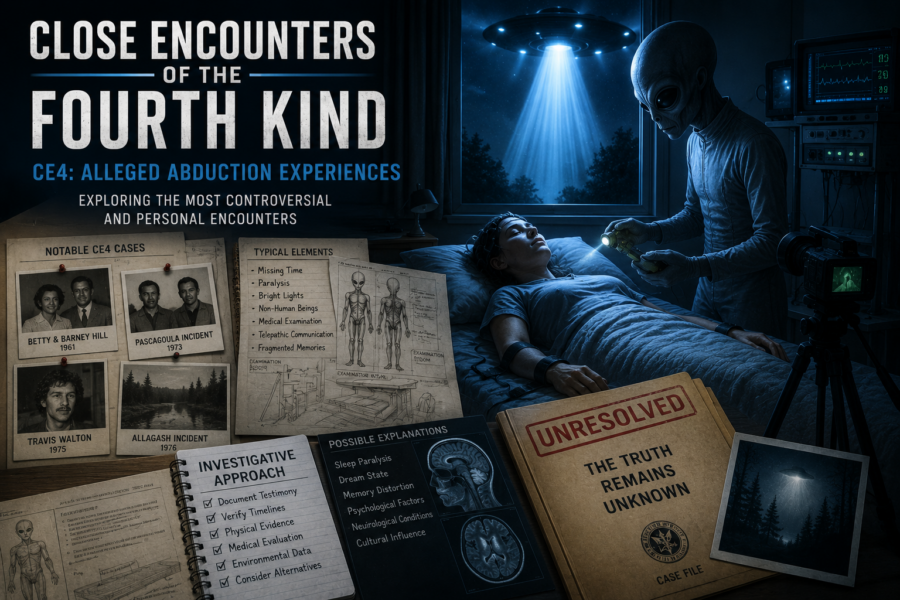
Understanding Close Encounters of the Fourth Kind (CE4): Evolution, Current Research, and Future Outlook
The term “Close Encounters of the Fourth Kind” was an extension of the classification system developed by astronomer and UFO researcher Dr. J. Allen Hynek. Initially, Hynek’s system included Close Encounters of the First, Second, and Third Kinds, which were encounters with UFOs at increasing levels of proximity but without personal contact with extraterrestrial beings. The Fourth Kind was added to account for the rising number of reports that claimed not just sightings or evidence of UFOs, but direct, personal encounters in the form of abductions by extraterrestrial entities.
Background and Evolution of Close Encounters of the Fourth Kind (CE4)
Close Encounters of the Fourth Kind is a term that was first proposed by the astronomer and UFO researcher Dr. J. Allen Hynek. This classification extends Hynek’s initial Close Encounter scale, which initially only included three kinds of encounters. Close Encounters of the Fourth Kind refers to instances where an individual alleges to have been abducted by an extraterrestrial entity or entities. These encounters often include narratives of missing time, physical examinations, telepathic communication, and sometimes, long-term physiological and psychological effects.
Hynek proposed this expanded classification system to better categorize the increasingly complex nature of reported UFO experiences. Close Encounters of the Fourth Kind represents the most intimate type of encounter in Hynek’s system, where the witness claims direct, personal contact with alien entities. These encounters often come with highly detailed accounts of the event and sometimes even include specific information about the aliens’ intentions, technology, and home world.
However, it’s crucial to understand that this category of encounter, and indeed, the concept of extraterrestrial visitation itself, remains controversial within mainstream science and academia. Many explanations have been proposed for these experiences, ranging from actual alien contact to various psychological phenomena, including sleep paralysis, hallucinations, and the influence of popular culture.
Historic Principles and Practices
The historic principles and practices surrounding Close Encounters of the Fourth Kind (CE4) offer an intriguing glimpse into how the phenomenon has evolved since its introduction. Originally a niche area within ufology, CE4 became a field of its own, largely driven by the increasing number of people coming forward with their own personal accounts. Early practices involved firsthand testimonies, newspaper articles, and later, books and documentaries that narrated these experiences. As the stories proliferated, researchers started using hypnotic regression as a method to help “abductees” recover memories of their experiences, although this method would later become a subject of debate within the scientific community. The necessity to add this category in the classification system arose as a way to deal with the increasingly complex and personal nature of these reported encounters.
The Biggening Principles and Practices
- Origins with Hynek: J. Allen Hynek’s work in the 1970s laid the groundwork for studying UFO encounters in a more structured way.
- Rising Reports: The late 20th century saw a surge in abduction reports, starting with the Betty and Barney Hill case in 1961.
- Media Influence: Movies and TV shows in the 1970s and 1980s, such as “Close Encounters of the Third Kind” and “Fire in the Sky,” played a role in popularizing the concept.
- Hypnotic Regression: As a controversial practice, hypnotic regression became a common tool for “recovering” memories of alleged abductions.
- Scientific Scrutiny: Over the years, the CE4 experiences have been scrutinized from various academic and psychological perspectives, with no conclusive evidence in favor or against them.
Historic Examples of Close Encounters of the 4th Kind (CE4)
- The Betty and Barney Hill Case (1961): This is perhaps one of the most famous examples of a reported alien abduction. The Hills, an American couple, claimed they were abducted by extraterrestrials in a rural portion of New Hampshire. Under hypnosis, both Betty and Barney separately recounted detailed narratives of being medically examined by non-human entities. Their case gained significant media attention, becoming a touchstone in UFO culture.
- Travis Walton Abduction (1975): Travis Walton, a logger from Arizona, was reportedly abducted while working with his crew in the Apache-Sitgreaves National Forests. Walton claimed to have been taken aboard an alien spacecraft and to have interacted with humanoid beings. His case became widely known, thanks to the 1993 film, “Fire in the Sky,” which depicts his experience.
- Antonio Vilas Boas Case (1957): Antonio, a Brazilian farmer, reported being abducted by extraterrestrials while working in his fields. He claimed to have been taken aboard an alien craft and engaged in intimate acts with a female entity. The case stands out for its sexual elements, a recurring theme in many later abduction reports.
- Pascagoula Abduction (1973): Charles Hickson and Calvin Parker claimed they were abducted by robotic-like aliens while fishing on the Pascagoula River. Despite undergoing severe stress and scrutiny, both men stuck to their story. The Pascagoula case has remained one of the most controversial incidents in UFO history.
- Allagash Abductions (1976): Four men – Jim Weiner, Jack Weiner, Charles Foltz, and Charles Rak – claimed they were abducted while on a camping trip in Maine. They all reported experiencing periods of missing time, which they later filled in under hypnosis with detailed accounts of an abduction and medical examinations.
- Linda Napolitano Abduction (1989): In one of the most sensational claims, Napolitano reported being abducted from her Manhattan apartment and levitated into a massive spacecraft by extraterrestrials. The case became famous due to its urban setting and the alleged corroboration by two bodyguards who were supposedly protecting a senior diplomat at the time of the event.
- The Zanfretta Abductions (1978-1981): Italian security guard Pier Fortunato Zanfretta claimed to have been abducted multiple times over several years. His encounters, often accompanied by periods of missing time, included descriptions of reptilian entities and large, semi-transparent spacecraft.
Discovery Prime “Travis Walton Abduction” Story Trailer
By acknowledging how the practices have evolved, we can better understand the context in which CE4 exists today, and how it might continue to change in the future.
Current Knowledge of CE4
As we move further into the 21st century, the study of Close Encounters of the Fourth Kind (CE4) has seen significant shifts both in public perception and scientific scrutiny. While mainstream science remains largely skeptical, a sub-discipline within ufology has continued to gather data and testimonies related to CE4, aiming for a more nuanced understanding. Advances in psychology, technology, and forensic science have provided new avenues to investigate these claims. Importantly, the discussion has expanded to incorporate various disciplinary perspectives, ranging from psychology and neuroscience to quantum physics. Despite the complex and often controversial nature of CE4, the field itself is moving toward adopting more rigorous scientific methodologies in an effort to either validate or debunk the experiences people report.
Current Practice
- Anecdotal Evidence: Personal testimonies remain a significant aspect of CE4 research.
- Technological Monitoring: Devices like cameras and Geiger counters are sometimes used by researchers to document potential evidence.
- Cross-Comparative Analysis: Modern ufologists often use databases to cross-reference cases to find similarities or patterns.
- Increased Skepticism: Today’s researchers often apply stricter standards for considering evidence, reflecting increased skepticism but also a desire for more rigorous methodology.
- This shift toward a more methodical approach has implications not only for those who study CE4 but also for the individuals who report experiencing these puzzling and often life-altering events.
Predictions and Confirmations for Future CE4
The future of studying Close Encounters of the Fourth Kind (CE4) is full of uncertainties but also brimming with possibilities. As technologies improve and as our understanding of psychology and neuroscience expands, new methods for investigating CE4 could emerge. The use of advanced surveillance technology, biometric analysis, and even artificial intelligence could revolutionize the way these cases are studied. Although the core phenomenon remains enigmatic and speculative, the advancements in related scientific fields offer a tantalizing potential for more comprehensive, objective analyses. Within this framework, the strategies for both confirming and debunking CE4 claims could be radically transformed, leading to perhaps the most exciting or sobering period in the history of ufology and CE4 research.
Predictions and Confirmations
- Tech-Based Documentation: It’s predicted that the use of advanced surveillance technology may either confirm or debunk more CE4 claims.
- Genetic Testing: As technology evolves, there could be more focus on genetic or biochemical changes in abductees as a form of evidence.
- Virtual Reality: VR could be used to recreate and study reported CE4 experiences in a controlled environment.
- Mainstreaming: If compelling evidence is found, CE4 may transition from fringe research to mainstream scientific investigation.
- International Collaboration: A global database and international cooperation could help in the objective analysis of CE4 encounters.
- Given these emerging technologies and methods, the future of CE4 research could be markedly different from its past, providing a clearer lens through which to explore this enduring mystery.
Frequently Asked Questions About Close Encounters of the Fourth Kind (CE4)
Close Encounters of the Fourth Kind involve some of the most personal and controversial reports in ufology. The following questions distinguish reported experiences from established evidence while examining psychological, cultural, and scientific interpretations.
What is a Close Encounter of the Fourth Kind?
A Close Encounter of the Fourth Kind, commonly abbreviated CE4, describes a reported experience in which a person claims to have been taken, transported, restrained, or examined by non-human entities. CE4 is most often associated with alleged alien-abduction accounts. It is a classification used within ufology, not a scientifically verified category of extraterrestrial contact.
How does CE4 differ from earlier close-encounter categories?
Close Encounters of the First Kind generally involve observing an unidentified object at relatively close range. Second-kind reports include alleged physical effects, while third-kind reports involve the claimed observation of occupants or entities. CE4 goes further by describing alleged direct and involuntary interaction, frequently including removal from the original location or an examination experience.
What features commonly appear in reported CE4 experiences?
Frequently reported elements include missing time, temporary paralysis, unusual lights, perceived telepathic communication, medical examinations, humanoid beings, and fragmented or difficult-to-reconstruct memories. Similarities among accounts are noteworthy, but they do not by themselves establish that the events share an extraterrestrial cause.
Is there scientific evidence proving that alien abductions occur?
No conclusive, independently verified scientific evidence currently demonstrates that extraterrestrial beings are abducting humans. CE4 research relies heavily on personal testimony, retrospective recollection, and occasionally ambiguous physical findings. Such material may justify careful investigation, but it does not yet meet the evidentiary standard required to confirm an extraordinary physical event.
What conventional explanations have been proposed for CE4 reports?
Researchers have proposed sleep paralysis, vivid dreaming, hallucinations, memory distortion, dissociation, neurological events, trauma, expectation, cultural influence, and misinterpretation of ordinary experiences. These mechanisms may explain many reports, although individual cases can differ substantially and should not automatically be reduced to a single explanation.
What is missing time in an alleged abduction account?
Missing time refers to a period that a witness cannot readily remember or account for. In CE4 narratives, people may interpret that gap as evidence that an encounter occurred. However, incomplete memory can also result from fatigue, stress, sleep, distraction, substance effects, neurological factors, or the ordinary limitations of human memory. A memory gap alone does not demonstrate abduction.
Is hypnotic regression a reliable way to recover abduction memories?
Hypnotic regression was frequently used by earlier UFO investigators to help witnesses reconstruct alleged encounters. Its reliability is strongly disputed because hypnosis can increase suggestibility and confidence without guaranteeing accuracy. Questions asked by an investigator may unintentionally shape a narrative or contribute to false memories. Information obtained under hypnosis therefore requires independent corroboration.
What are some well-known reported CE4 cases?
Frequently discussed cases include Betty and Barney Hill in 1961, Antonio Vilas Boas in 1957, the Pascagoula incident involving Charles Hickson and Calvin Parker in 1973, Travis Walton in 1975, and the reported Allagash experiences of 1976. These cases became influential within UFO culture, but their interpretation remains contested.
Do similarities between abduction accounts prove that they are real?
No. Repeated motifs may indicate a common external event, but they can also arise from shared psychology, cultural expectations, media exposure, interviewing methods, or common physiological experiences such as sleep paralysis. Similarity is a pattern worth studying, not proof of a particular explanation.
How has popular culture influenced CE4 reports?
Books, television programs, documentaries, movies, and widely publicized cases have helped establish a familiar vocabulary for alleged abduction experiences. Images of gray beings, examination rooms, missing time, and telepathic communication may influence how ambiguous memories are understood and described. Cultural influence does not prove that every report is fabricated, but it complicates efforts to identify independent patterns.
How should a reported CE4 experience be investigated?
A careful investigation should document the witness’s account as early as possible, preserve original photographs or recordings, examine medical or environmental evidence, verify timelines, identify aircraft and astronomical activity, and avoid leading questions. Investigators should consider psychological, neurological, environmental, technological, and extraordinary explanations without assuming the conclusion in advance.
Could modern technology improve CE4 investigations?
Potentially. Continuous video monitoring, biometric sensors, precise location data, sleep studies, environmental instruments, forensic testing, and standardized international databases could produce more objective information. Artificial intelligence may help identify patterns across reports, although it cannot compensate for unreliable source data or establish causation by itself.
Should people who report CE4 experiences be taken seriously?
Their experiences should be treated respectfully, particularly when they produce genuine fear, distress, or lasting psychological effects. Respecting a witness does not require accepting an extraterrestrial explanation without evidence. A responsible response combines empathy, medical or psychological support where appropriate, and disciplined investigation.
What would be required to scientifically confirm a CE4 event?
Scientific confirmation would require strong evidence that can be independently examined and that clearly distinguishes an extraordinary event from psychological, environmental, technological, or fraudulent explanations. Examples might include verified multi-sensor records, trace evidence with a secure chain of custody, independently corroborated observations, reproducible biological findings, or other data that withstand expert scrutiny.
What is the most balanced conclusion about CE4 reports?
CE4 reports form a significant cultural, psychological, and ufological phenomenon involving experiences that witnesses may perceive as profoundly real. Their ultimate cause remains unresolved. The available evidence does not establish extraterrestrial abduction, but the reports can still be studied scientifically for what they may reveal about perception, memory, sleep, trauma, culture, unidentified phenomena, and the limits of current investigative methods.
Rounding It Up
The phenomenon of Close Encounters of the Fourth Kind has evolved significantly since its introduction by J. Allen Hynek. From its roots in anecdotal reports and hypnosis-aided memory recovery, the field has moved toward a more rigorous methodology, albeit without gaining full mainstream scientific acceptance. The future holds the promise of technological and methodological advancements that could either validate or debunk these experiences, potentially changing our understanding of reality itself.
As we examine the historic evolution, current state, and future possibilities surrounding Close Encounters of the Fourth Kind (CE4), it becomes evident that this phenomenon is more than just a fringe area of study. It is a field that challenges our understanding of reality, human perception, and even the boundaries of scientific inquiry. Over the years, the study of CE4 has moved from anecdotal accounts and hypnotic regressions to a more nuanced approach that incorporates advances in technology, psychology, and methodology. Yet, the phenomenon remains as mysterious as ever, tantalizing researchers with the possibility of breakthroughs that could redefine our understanding of life beyond Earth—or reveal insights into the complexities of the human mind. Regardless of one’s stance on the veracity of CE4 encounters, it’s undeniable that the field has evolved to a point where ignoring it would be a disservice to both scientific curiosity and the individuals who report these experiences. As we look to the future, one thing is certain: CE4 will continue to provoke, challenge, and hopefully enlighten, as we grapple with the questions it raises about the known and unknown universe.
While the empirical evidence for these cases is often sparse, they’ve left lasting imprints on popular culture and the study of UFOs. The commonalities among many of the abduction narratives – periods of missing time, medical examinations, humanoid entities – suggest a shared phenomenon. However, whether this phenomenon represents actual extraterrestrial contact, psychological occurrences, or a mixture of social and cultural factors remains a topic of fierce debate.
Key Takeaways:
- CE4 was an extension of Hynek’s classification to include abduction experiences.
- These narratives often share common elements, such as missing time, medical examinations by aliens, and encounters with humanoid entities.
- The phenomenon gained prominence through both real-world reports and media portrayals
- While controversial, CE4 continues to challenge our perception of the known world and demands a multifaceted approach for its investigation.
- The validity of these stories remains highly contested, with explanations ranging from actual extraterrestrial encounters to psychological and sociocultural phenomena.
- Current practice incorporates more advanced technology and cross-comparative methodologies.
- Future research could leverage advancements in technology, genetics, and psychology.
“It’s not about lights in the sky; it’s about lies on the ground.”
– Stephen Bassett, UFO lobbyist and Disclosure advocate
References:
- Hynek, J. A. (1972). The UFO Experience: A Scientific Inquiry. Henry Regnery.
- Jacobs, D. M. (1992). Secret Life: Firsthand Documented Accounts of UFO Abductions. Simon & Schuster.
- Mack, J. E. (1994). Abduction: Human Encounters with Aliens. Charles Scribner’s Sons.
- Bullard, T. E. (1987). UFO Abductions: The Measure of a Mystery. FUFOR.
- Clancy, S. A. (2005). Abducted: How People Come to Believe They Were Kidnapped by Aliens. Harvard University Press.
- Fuller, J. G. (1966). The Interrupted Journey. Dial Press.
- Walton, T. (1978). The Walton Experience. Berkley Publishing Group.
- Strieber, W. (1987). Communion: A True Story. Avon.
- Randle, K. D., Estes, G. P., & Cone, F. W. (1997). The Allagash Abductions: Undeniable Evidence of Alien Intervention. New Paradigm Press.
- Hopkins, B. (1991). Missing Time. Richard Marek Publishers.
- Bianchi, E. (1984). The Zanfretta Case. Edizioni Mediterranee.
- Jacobs, D. M. (1992). Secret Life: Firsthand Documented Accounts of UFO Abductions. Simon & Schuster.
- McNally, R. J. (2012). Explaining ‘Memory’ for Alien Abduction in the Harvard Gazette: Memory Distortion and False Memory Creation. The Journal of Anxiety Disorders.
- “This blog post was generated with the assistance of GPT-3, an AI language model developed by Openai.com.”
- discovery plus (YouTube Channel)