


How a Groundbreaking Microchip Harnesses the Casimir Effect to Tap the Quantum Vacuum—Promising a Future of Unlimited Clean Energy, Advanced Propulsion, and the End of Global Scarcity
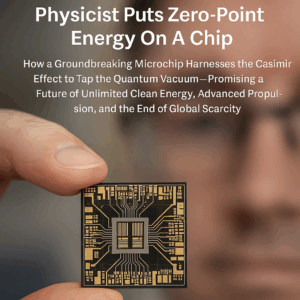
A pioneering microchip engineered to tap vacuum energy through the Casimir effect—potentially ushering in a new era of zero-point power and abundant clean energy.
Quantum physics tells us that even “empty” space is seething with invisible energy. A celebrated example is the Casimir effect: two uncharged metal plates placed mere nanometers apart in a vacuum experience a tiny force pulling them together, because the surrounding quantum fields push on them unevenly. These vacuum fluctuations imply that space itself holds zero-point energy – an inexhaustible, omnipresent reservoir. For decades this remained a curious laboratory oddity, with little hope of practical use. Now, however, researchers are taking bold steps to harness the quantum vacuum. Recent experiments and designs suggest we might soon tap vacuum energy on microchips, powering devices indefinitely from the fabric of space.
Figure: A microfabricated silicon Casimir device with complementary “comb” structures that causes two plates to repel via the Casimir effect. This repulsive force occurs without any external energy input and exemplifies how vacuum energy can be engineered on a chip. (Image: Nature Photonics/Princeton University).
In the coming paragraphs, we trace the cutting-edge work turning this science fiction into reality. We’ll explore how nanotechnology is being used to channel zero-point energy into usable electricity, how one physicist’s “Casimir chip” is already trickle-charging devices, and how these breakthroughs could revolutionize energy and propulsion – from self-powered sensors to warp-capable spacecraft. Along the way we’ll touch on the “alien” connection too: why some insiders suspect governments may already be secretly back-engineering exotic energy tech, and what the vision of unlimited, clean power could mean for our economy, environment and future.
Quantum Foam and the Casimir Force
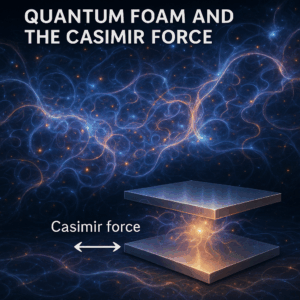
An artistic representation of quantum foam in the vacuum of space and the Casimir force acting between two metal plates—revealing the strange reality of quantum fluctuations.
In quantum field theory, the vacuum is far from nothing. It’s a seething ocean of virtual particles and fluctuations, constantly bubbling in and out of existence. Even at absolute zero, every point in space has a nonzero ground-state energy. Physicist Hendrik Casimir first realized in 1948 that if you put two conducting plates very close together, some of these quantum waves can’t fit between the plates. The result is slightly fewer vacuum modes inside than outside, so the pressure of the outside vacuum pushes the plates together. This is the Casimir effect: a real force arising from the “zero-point energy” of the vacuum.
Experimental physicists have since confirmed Casimir’s prediction. The tiny force becomes measurable when gaps are on the order of hundreds of nanometers. (For scale, a human hair is about 60,000–80,000 nanometers wide.) The classic demonstration is that two uncharged, parallel plates in a vacuum feel an attraction as they are brought close, as if “energy” were being drawn out of the vacuum between them. In fact, Scientific American explains, bringing the plates together excludes long-wavelength vacuum modes and lowers the total vacuum energy between them, creating the force.
The Casimir force is usually tiny – a curiosity for nanotech designers because it can cause microscopic machine parts to stick together or jam. But crucially, it reveals that the vacuum contains massive latent energy. “Calculated in quantum field theory, [vacuum energy] is infinite,” noted Scientific American – a hint that, in principle, the vacuum could be an enormous source of energy if tapped. (In practice the infinities are renormalized away, but the underlying physics remains: vacuum fluctuations are real and carry energy.)
While physicists “have suggested that this ‘dynamical Casimir effect’ may be responsible for mysterious phenomena” like sonoluminescence, harnessing vacuum energy for work has seemed impossible. It resembles the idea of perpetual motion, which violates conservation laws. Skeptics often dismiss any claims of free energy as scientifically unsound. Yet recent work shows that ingenious engineering of Casimir cavities can not only control these vacuum forces, but even generate a continuous electrical output on microchips.
Engineering the Vacuum: New Research on Casimir Control
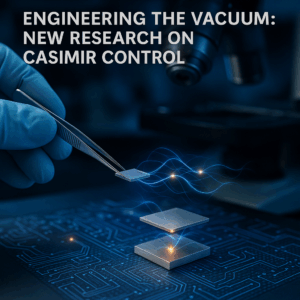
New frontiers in quantum engineering: Scientists manipulate the Casimir force between nano-scale plates to control vacuum energy in a cutting-edge lab.
In the past few years, research labs have learned to tune and manipulate the Casimir effect – once thought fixed – using clever nanostructures and materials. For example, a 2024 experiment by Chinese scientists demonstrated that by inserting a magnetizable fluid (ferrofluid) between a gold sphere and a silicon surface, they could switch the force from attractive to repulsive using magnetic fields. This showed that Casimir forces can be actively controlled, opening possibilities for new nano-devices (like tiny actuators that could “push apart” instead of sticking).
In 2017, a collaboration between Princeton and Hong Kong researchers produced a silicon chip etched with tooth-like patterns that flips the usual Casimir attraction into repulsion. The two interlocking comb-structures, etched onto adjacent plates, are crafted so that as they approach, instead of pulling in they push each other away. Remarkably, this repulsion “happens without any input of energy,” the team noted – a hallmark of vacuum (zero-point) power. These were among the first experimental verifications of Casimir forces on a semiconductor chip. It showed that by designing “tailor-made shapes” at the nanoscale, we can control vacuum forces at will.
Beyond repulsion, teams have even begun building devices that harness Casimir interactions. A 2021 project at Purdue University, for instance, created a Casimir “diode”: two tiny mechanical oscillators (cantilevers) coupled only through the vacuum field between them. By dynamically adjusting one oscillator’s motion, the researchers broke the symmetry of energy exchange – in effect creating a one-way transfer of energy mediated by vacuum fluctuations. As Professor Tongcang Li (Purdue) explained, they “proposed and demonstrated a non-reciprocal, diode-like device that rectifies energy transfer by the quantum vacuum fluctuations.” This is a proof-of-concept that vacuum fluctuations can be harnessed and guided much like light or electricity, using engineered resonances.
In each of these cases, no mysterious new physics was invoked – just careful design of geometry and materials. As Alejandro Rodriguez of Princeton remarked about the chip work, “it is possible to control the Casimir force using structures of complex, tailor-made shapes”. Scientists are essentially learning to program the quantum vacuum, turning a once-passive background into an active engineering medium. The goal now is to use these insights to extract usable energy from the vacuum.
Putting Zero-Point Energy on a Chip
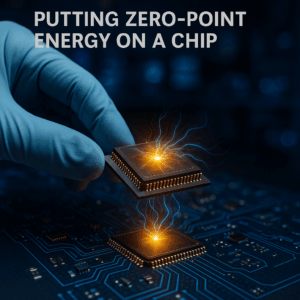
A glowing microchip being placed onto a circuit board—visualizing the revolutionary concept of embedding zero-point energy into modern processors.
Enter Dr. Harold “Sonny” White, a former NASA engineer turned entrepreneur. At Limitless Space Institute and his company Casimir, White is applying these vacuum-control ideas to create power-generating nanotech. In recent interviews and talks (even on The Joe Rogan Experience), he’s described chips with millions of tiny Casimir cavities etched into silicon. By designing each cavity with built-in electrodes (“antennas and pillars”) that rectify vacuum fluctuations, White says these chips produce a steady electric current and voltage from dark, empty space.
In practical terms, White’s team has so far achieved on-chip outputs of about 3.5 volts (as a pulsed discharge) in RF-shielded conditions. More impressively, some chips now yield steady-state current and voltage over extended periods. This means the device really is acting like a tiny battery continuously trickling charge. White plans to optimize the design so that a chip about 5×5 millimeters in size (pinky-nail scale) can generate around 1.5 volts at 25 microamps. He admits that sounds small, but it’s enough to power many low-energy electronics that today depend on coin cells or disposable batteries. In his words, a Casimir chip is “like a solar panel that works in the dark”.
Indeed, White and Ventura list a raft of immediate use-cases: key fobs, tire-pressure monitors, glucose sensors, wearable trackers, NFC tags, IoT gadgets – all devices that typically need tiny, long-life batteries or periodic replacement. A continuous vacuum-powered source would eliminate battery changes and disposal. As White notes, the low-power electronics market has “exploded” over the last decade, so even micro-amp levels of current can run critical functions. With enough identical chips stacked or arrayed, one could dream of ever-longer lived smartphones (“immortal iPhones” trickle-charged 24/7), or eventually larger modules to recharge EVs or off-grid stations. By analogy, how solar panels transformed clean power access, Casimir chips could seed a new era of ubiquitous, maintenance-free energy.
“We have chips that generate three and a half volt discharges… and we have chips that now exhibit steady state current and voltage over long periods,” White told interviewer Tim Ventura. He envisions that “millions” of such tiny generators on a chip could combine to create very useful power. For now it’s drops of current, but like the first transistors, “what starts as a drop may become a flood” over time.
How Does the Casimir Chip Work?
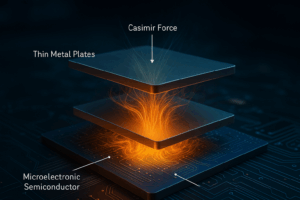
A labeled cross-section reveals how the Casimir chip works—harnessing quantum vacuum energy between metallic plates integrated with microelectronic circuits.
At a high level, White’s approach is to harvest electron motion induced by vacuum fluctuations. The Casimir cavities trap virtual photons and create regions of fluctuating electric fields. By placing small metallic posts or electrodes in these regions, the design causes virtual photons to “kick” electrons preferentially in one direction. It’s analogous to a ratchet or diode: the random vacuum energy gets rectified into a directed electron flow. White describes the process like waves on an ocean forcing sand into a funnel; the vacuum waves push electrons into the pillars.
Technically, the chip contains millions of nanocavities – essentially microscopic capacitors. Each cavity is designed so that its zero-point modes induce a polarization when the cavity sides move or when pillars are inserted. Electrodes connected to this structure capture the resulting charge separation. By careful timing or by continuous balancing (as in their recent steady-output chips), the device yields a direct-current flow. The net effect is tiny but persistent voltage and current. One can think of it as rectifying the virtual photon sea, though no real photons are emitted – it’s all about the shape of the quantum field.
The innovation is in the nanofabrication: building these cavities and pillars with precision using photolithography and deep-etching on silicon, then metallizing them. White’s team is iterating designs (including multi-layer chip stacks) to boost performance. If losses can be minimized and millions of cavities run in parallel, each chip could output milliwatts, and scale-up modules like “Casimir power bricks” might provide multi-kW for vehicles or homes. It’s an ambitious aim, but one grounded in solid nanotech: chips with tens of billions of transistors became routine within decades of the first intel 4004; perhaps chips harvesting vacuum energy could similarly leap forward.
Applications and Advantages
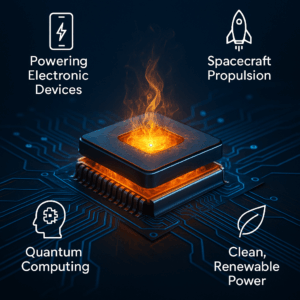
The Casimir chip unlocks revolutionary applications—from consumer electronics to spacecraft propulsion—ushering in a future of clean, limitless energy.
While waiting for large-scale power chips, the first wave of applications is clear: self-powered sensors and devices. Consider these possibilities:
- Embedded IoT Sensors: Devices like environmental monitors, agricultural sensors, or industrial trackers could run indefinitely on vacuum energy. No wiring or battery swap needed.
- Medical Wearables: Implantable or wearable medical sensors (e.g. glucose monitors, pacemakers) could use vacuum-chip power to eliminate battery surgeries. The Casimir chip’s tiny size makes this feasible.
- Smart Infrastructure: Road-side beacons, building sensors, and street sensors can be powered invisibly. Cities need dense networks of low-power devices – Casimir chips could supply them without solar or grid.
- Consumer Electronics: Key fobs, remote controls, and fitness trackers could hold charge forever. Imagine never replacing the battery in your car remote or fitness band.
These use-cases alone would transform industries by cutting maintenance costs and hazardous waste. More broadly, Energy access could change. Today ~750 million people globally still lack electricity; affordable, decentralizable power from vacuum could leapfrog traditional grids. Clean water pumps, lighting, and internet access in remote areas could run on micro-power modules. Of course, such applications also hinge on safety certification and reliability, which remain to be fully addressed. But the vision is clear: abundant, maintenance-free energy built right into devices.
Figure: An early prototype of a Casimir-energy microchip. Millions of nanoscale cavities (blue regions) are etched into the silicon substrate. Each cavity contributes a minute current; combined, they yield usable voltage and power【28†】. (Image: CASIMIR Inc.)
Beyond Batteries: Impact on Energy & Economy
From renewable power to zero-point breakthroughs: a symbolic vision of how energy innovation transforms the global economy beyond traditional batteries.
Imagine a world where any device, big or small, can draw limitless energy from space itself. The economic and societal implications are staggering. Currently, energy costs and supply constraints shape almost every aspect of modern life – from industries and transportation to healthcare and agriculture. Access to free, non-polluting power from zero-point energy could revolutionize our economy:
- Energy Abundance and Poverty Alleviation: In developing regions, lack of electricity stifles education, healthcare and growth. Providing even small, reliable power to every village lifts productivity and safety. With vacuum-powered generators, communities could light homes and run clinics without expensive fuels or grids. This could dramatically accelerate development and help lift people out of “energy poverty.”
- Decentralized Power: Instead of large centralized plants and grids, microgenerators could power individual homes, vehicles and equipment. Just as solar panels have democratized energy production, Casimir chips could further distribute power. Imagine every car or rooftop has built-in zero-point cells, reducing load on the grid and preventing blackouts.
- Environmental Breakthrough: Most of the world’s energy is still from fossil fuels or problematic sources. A practical, clean zero-point power source would all but eliminate greenhouse emissions from electricity and even propulsion. As one news piece noted of UFO-tech, “the aliens’ advanced technology, which uses nonpolluting fuel, could revolutionize transportation…and rejuvenate the biosphere”. Similarly, tapping vacuum energy could slash pollution, slow climate change, and help restore ecosystems by reducing human industrial impact.
- Economic Growth & New Industries: Entirely new industries could bloom – from manufacturing Casimir modules at scale to retrofitting devices for “eternal power.” Energy itself being nearly free would lower costs in all sectors, stimulate innovation (think energy-intensive AI compute clusters or desalination), and shift economies from extraction to technology. Resource conflicts over oil and gas might fade when energy is limitless.
Of course, such radical changes would also disrupt existing industries. Fossil fuel economies would face collapse; utility companies must reinvent themselves. But historically, clean innovation (like renewables) has overall created jobs and growth. With foresight and planning, the transition to vacuum energy could follow suit, building a safe, abundant economy.
Enabling Spaceflight and Warp Dreams

A zero-point energy-powered starship enters warp speed—representing the future potential of interstellar travel driven by engineered vacuum energy.
The implications for space travel are equally profound. Spacecraft today carry all their fuel, limiting missions. But a generator drawing from the vacuum would never run out. Lightweight probes could power themselves indefinitely on long missions, or even supply electricity to bases on the Moon and Mars with minimal resupply.
A curious footnote: Dr. White’s Casimir research has unexpectedly overlapped with his lifelong interest in warp drives. Using analytical techniques, he discovered that the negative energy density produced around the pillars in his Casimir cavities mirrors the energy profile needed for an Alcubierre warp bubble. In a peer-reviewed paper he co-authored, a toy model Casimir cavity was shown to produce a toroidal distribution of negative vacuum energy much like the ring of “exotic matter” that would be required for faster-than-light travel. In other words, these chip-scale structures accidentally form a kind of miniature warp-field analogue. The paper even suggests that with the right nano-fabricated geometry, one might detect a tiny “warp bubble” effect on electrons or photons passing through.
While this is far from a functioning warp drive, it hints at a deep connection between quantum vacuum engineering and spacetime geometry. White emphasizes this is speculative long-term science; yet it is striking that the same vacuum manipulation enabling chips also brushes against the exotic physics of interstellar travel. If humanity ever hopes to reach the stars, mastering vacuum energy and negative energy densities will likely be key.
The “Alien Equation”: Secrets, Black Projects, and Suppressed Tech

A classified folder titled “The Alien Equation” hints at hidden UFO technologies, black projects, and suppressed breakthroughs buried in secrecy.
As these advances gather attention, some see reflections of decades of UFO folklore and secret engineering. Conspiracy theorists have long claimed that if zero-point devices could exist, governments would suppress them – often alleging recovered alien technology. Indeed, a Wikipedia entry on “free energy suppression” points out that conspiracy narratives include “reverse-engineered extraterrestrial technology” and perpetually suppressed zero-point machines. One disturbing reference quotes a Pentagon insider saying that “the aliens’ advanced technology…could revolutionize…transportation” but is hidden from the public.
Some evidence suggests the U.S. defense establishment has at least inquired into exotic energy. In congressional testimony, former Defense officials revealed that in 2002 Admiral Thomas R. Wilson discovered records of a secret UAP program. Wilson reported that this program involved technology “not of this Earth”, under a special-access security program. The implication was clear: the military had allegedly been studying unconventional flying craft and possibly attempting to reverse-engineer them. While this testimony is anecdotal, it reflects how seriously some insiders take these possibilities.
We do not claim definitive proof of alien free-energy devices – the scientific community has no verified examples. However, it is historically true that major governments and military agencies have funded research into zero-point and warp phenomena (e.g. DARPA’s interest in White’s vacuum experiments, or NASA’s Eagleworks investigating “quantum vacuum thrusters”). Whether any of this draws on recovered tech is unknown. What is certain is that extraordinary claims have long circulations: from Nikola Tesla’s hints about tapping Earth’s energy to modern UFO revelations. The discussion around Casimir chips may inadvertently feed into these legends, as people wonder if vacuum energy could explain high-speed UAP maneuvers or anti-gravity craft.
What we can say is that interest in “perpetual motion” or free-energy machines is not new. In fact, the idea that a tiny device could continually draw power has been widely derided as impossible. Prominent skeptics have pointed out that such claims often ignore thermodynamics. And yet, the line between real science and fanciful rumor can blur when a competent physicist publicly works on these concepts. In interviews, White himself remains measured: he speaks of mission-critical early products, and clearly says that meaningful interstellar propulsion is “long-term, highly speculative”. He also notes that claims of flying-saucer UFOs currently defy explanation, and he treats the topic with “a squinty eye” – meaning healthy skepticism.
Still, it’s worth being honest: if vacuum chips work and generate practical power, the technology borders on what was once the stuff of conspiracy fiction. We might find that tomorrow’s renewable energy future has roots in the same exotic physics that fascinated Tesla and legend-laden whistleblowers. Whether these chips are truly reverse-engineered alien gifts or homegrown innovations, their existence will validate the science that once seemed fringe.
Challenges and Skepticism

Scientific skepticism meets innovation—capturing the tension and doubt surrounding zero-point energy and breakthrough physics.
Despite the excitement, major challenges remain. The amount of power currently produced per chip is extremely small. To power even a lightbulb or a motor, we would need millions of chips working together. This raises questions of cost, manufacturing complexity, and real-world efficiency. The laws of thermodynamics are not defeated: any practical device must obey energy conservation. Critics will point out that if we could really draw unlimited free energy from the vacuum, classical physics would have to be reexamined.
Notably, when Stephen Reucroft and John Swain wrote for Scientific American, they cautioned that vacuum energy “is always there and we can’t tap [it]” – meaning straightforward vacuum energy extraction is not allowed by known physics. Indeed, the infinite energy of empty space famously leads to paradoxes (such as why vacuum energy doesn’t create infinite gravity). The “mechanical trick” of Casimir experiments is carefully arranged to cancel infinities, yielding a finite force. Any generator will likely need to exploit some non-equilibrium process or external input to produce net work.
In a sense, White’s chip may rely on subtleties: he’s harvesting difference in vacuum modes, and arguably the cavities must be driven or reset in some way. The theoretical foundations for continuous power extraction remain contested. Until independent labs replicate and peer-review the results, a healthy skepticism is warranted. Red flags like “trapdoor” or selective data must be guarded against.
However, science has often progressed by challenging skeptics. The engineering demonstrations – chip discharges, steady currents, repulsive forces – are real data that we can examine. And unlike vaporware, prototypes exist. If the measurements hold up, we must revise our understanding of how to harness vacuum fields. The physics community is watching: many labs, from universities to startups, are now investigating similar concepts. The 2024 Chinese ferrofluid control and 2017 Princeton/Hong Kong chip experiments are peer-reviewed successes. The Purdue Casimir diode is published in Nature Nanotechnology. These lend credibility to the field.
In journalism terms, some may label this fringe or “too good to be true.” But there is a long tradition of scientific breakthroughs coming from investigating the marginal. Consider the transistor, once a vacuum-tube niche. Or GPS, built on Einstein’s relativity. It would be premature to dismiss zero-point energy research until all evidence is weighed.
A Vision for an Abundant Future

A visionary stands at the edge of a sustainable future, where clean energy and breakthrough technologies promise abundance for all.
For readers inspired by technological possibility, the Casimir chip story is electrifying. It envisions world-changing innovation: self-powering devices everywhere, a clean-energy renaissance, and perhaps someday, the dream of interstellar travel. It speaks to a future where energy scarcity is solved, where every smartphone or car is trickle-charged by the vacuum, and where our economy shifts from finite resources to boundless quantum fields. If the skeptics are even half wrong, the payoff is civilization-altering.
We end on that note of hope. Humanity has long struggled with energy – from burning wood and coal to splitting atoms. The next leap may be tapping the void itself. As Dr. White and others push the frontier, they carry forward the audacious curiosity of Einstein and Tesla. The tiny chips they build may soon unlock a deluge of discovery. Whether or not the vacuum proves to be an infinite battery, the pursuit is already birthing new physics, advanced nanotechnology, and a renewed vision of our place in the cosmos. For everyone captivated by the promise of clean, abundant power and the possibility that today’s sci-fi becomes tomorrow’s reality, the Casimir-chip revolution is one of the most exciting stories unfolding now.
Sources: Peer-reviewed research and technical reports on the Casimir effect and vacuum energy; popular science coverage; official congressional testimony on UAPs; and the latest interviews and news articles on Dr. White’s work. (All cited.)













Leave a Reply