

The Maverick Physicist Who Dares to Bend Spacetime: Dr. Jack Sarfatti’s Revolutionary Vision for Gravity Propulsion and the Future of Clean Energy
Early Life and Academic Journey
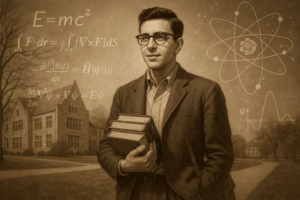
A young Jack Sarfatti in his formative academic years — immersed in physics at Cornell, laying the foundation for his visionary work in quantum mechanics and gravity.
Dr. Jack Sarfatti (born September 14, 1939) is an American theoretical physicist known for his bold exploration of quantum mechanics, consciousness, and gravity. He was born in Brooklyn, New York and earned a B.A. in physics from Cornell University in 1960. Sarfatti then pursued graduate work at the University of California, where he collaborated with Nobel Laureate Abdus Salam at the International Centre for Theoretical Physics (ICTP) in Trieste and worked with David Bohm at Birkbeck College in London. He completed an M.S. (1967) and Ph.D. (1969) in physics at UC San Diego/Riverside, and became an assistant professor at San Diego State University. By the early 1970s he chose to leave conventional academia, preferring the freedom to investigate the deepest mysteries of physics on his own terms.
Fundamental Fysiks and Counterculture Science

Members of the Fundamental Fysiks Group gather in a San Francisco café to explore quantum physics, consciousness, and the fringes of scientific thought
In the 1970s Sarfatti emerged as a leading figure in the Fundamental Fysiks Group, an informal circle of physicists in California who explored quantum mechanics alongside consciousness and philosophical ideas. This group – which met in venues like San Francisco’s Caffè Trieste – sought to challenge scientific orthodoxies and “inspire investigations into quantum physics that underlie parts of quantum information science”. Along with Bob Toben and Fred Alan Wolf, Sarfatti co-wrote the influential book Space-Time and Beyond (1975), merging rigorous physics with visionary speculation. His early work in this milieu, blending physics with Eastern philosophy and ufology, helped seed what historians call the quantum revival. Through these efforts, Sarfatti cultivated a reputation as an outsider-scientist willing to tackle taboo topics.
Charting a Course to Tame Gravity
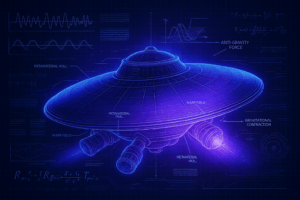
A conceptual gravity propulsion spacecraft design based on Sarfatti’s theories — featuring metamaterial hulls, warp field generators, and controlled spacetime contraction zones.
One of Sarfatti’s boldest contributions is his theoretical design for artificial gravity propulsion. He envisions spacecraft hulls made of gravitational metamaterials – engineered materials with exotic electromagnetic properties. In his model, these metamaterials create regions of negative energy density that can locally warp spacetime. By embedding a Bose–Einstein condensate (BEC) to slow down light within the material, a craft could, in principle, “bend” space in an anti-gravity direction. Crucially, this approach stays within Einstein’s relativity; it simply adds a new, variable scalar coupling field S(x)S(x) to the gravity equations. Sarfatti has shown that by carefully modulating this field, engineers could dial gravity up or down locally on the craft’s surface.
In practice, Sarfatti describes a low-power warp drive system built from these ideas. Each microscopic “meta-atom” in the metamaterial hull can be driven to produce either a tiny gravitational contraction (redshift) or expansion (antigravity) field. By coordinating these fields across the vehicle, the craft generates a macroscopic warp bubble – effectively a moving distortion of space – that propels it forward without rockets. Sarfatti even applies this model to real-world phenomena: he suggests that the U.S. Navy’s famous “Tic Tac” UFO could be using such a metamaterial-based warp drive, explaining its remarkable maneuvers within established physics.
- Gravitational Metamaterials: Sarfatti proposes that materials structured at the nano-scale can amplify minute gravitational effects. “Negative energy,” usually infinitesimal, becomes significant in a carefully engineered metamaterial, allowing controlled spacetime distortion.
- Low-Power Warp Fields: Drawing on Alcubierre’s warp-drive metric, he shows that resonantly pumping the hull’s metamaterial can create a “blue-shift” expansion of space behind the craft. A small phase shift in the electromagnetic pump field – easier to achieve than static negative susceptibilities – is key to this effect.
- Meta-Atom Control: In Sarfatti’s vision, every element of the craft’s hull can be tuned. Each meta-atom alternates between generating a local gravitational pull or repulsion. By sequencing these, the hull as a whole pushes and pulls on spacetime to “ride” its own warping field.
- Quantum Vacuum Engineering: He insists that all vacuum fluctuations must be included. The tiny Hawking–Unruh radiation felt by an accelerating observer means the metamaterial must account for every virtual charge in the vacuum. This opens the door to tapping zero-point energy for propulsion, blurring the line between electromagnetism and gravity.
- Consciousness Connection: Beyond hardware, Sarfatti continues to explore the link between quantum fields and the mind. He maintains that a truly complete physics of propulsion will not ignore consciousness; the very notion of a pilot or computer controlling the warp field bridges physics with information and perhaps awareness.
Above the mountains, the Milky Way arches across the sky – a fitting metaphor for Sarfatti’s vision of navigating the cosmos. For him, mastering gravity is not fantasy but the next logical engineering leap.
A New Era of Clean Propulsion and Sustainability

A future divided: from fossil-fuel decay to a clean world of gravity propulsion and renewable energy — Sarfatti’s vision for sustainable progress.
The practical promise of Sarfatti’s theories is breathtaking. If implemented, gravity-controlled propulsion could revolutionize transportation worldwide. Imagine vehicles and rockets that do not burn fuel but glide on engineered spacetime fields. As one analyst observes, “taming gravity would drastically change the way we transport on every level” and could end our reliance on fossil fuels. This means cars, planes, and rockets that emit no exhaust and operate on energy drawn directly from the vacuum.
- Zero-Emission Travel: By harnessing spacetime itself, vehicles could move without combustion, sharply cutting pollution and carbon emissions.
- Revolutionized Spaceflight: Low-power warp drives would make the solar system – and even nearby stars – accessible. Sarfatti’s involvement in NASA’s 100 Year Starship program highlights how his ideas feed into humanity’s quest for interstellar travel.
- New Industries: Gravitational propulsion could create entirely new technologies and jobs, akin to how electronics emerged from Maxwell’s equations. Spaceplanes or hovertrains powered by gravity fields might become commonplace.
- Unified Science: Pursuing these breakthroughs would also unify physics. Sarfatti believes that developing gravity engines will tie together quantum mechanics, relativity, and even cosmology (he links warp drive concepts to dark energy observations). Each advance peels back the fabric of reality toward a deeper theory.
Gazing upward from Earth or from orbit, one can sense the impact of such changes. In Sarfatti’s work, the cosmos is no longer an unreachable frontier but the raw material of progress. His books (Super Cosmos, Destiny Matrix, etc.) and lectures lay out the physics and potential in detail. He speaks of a future where energy scarcity vanishes – the universe’s quantum vacuum becomes the ultimate power source, and humanity pilots ships powered by gravity, not oil.
Facing the Black-Budget Barrier

The hidden frontier — Sarfatti’s theories risk clashing with the secrecy of black-budget programs shielding advanced propulsion research.
Unlike researchers funded by governments, Sarfatti has spent decades outside the traditional establishment. This independence grants creativity but poses obstacles. He often warns that true breakthroughs in antigravity can be swallowed by secret military programs. For example, he recounted how colleague Dr. Ning Li (a notable antigravity experimentalist) “disappeared and went back to China”, implying U.S. agencies lost touch with her research. He warned that the “most likely people to develop the first anti-gravity propulsion technology are the Chinese”, highlighting intense global competition. Sarfatti’s message is clear: while independent researchers blaze trails, classified projects may be racing alongside, shrouded in secrecy.
- Limited Funding: Sarfatti has had no large lab or big grants. He relies on independent symposia (like the Alternative Propulsion conferences) to present ideas. Without institutional support, each experiment or prototype must be modest.
- Secret Competition: He points out that advanced technologies are often co-opted by defense budgets. His commentary on Dr. Li’s disappearance suggests that some breakthroughs vanish behind the cloak of classified research.
- Skepticism and Criticism: Mainstream physicists frequently dismiss antigravity claims. Sarfatti has even clashed with peers over these ideas, at one point accusing an academic colleague of “misdirection” regarding vacuum energy. Regardless, he keeps publishing and lecturing – convinced that truth will outlast institutional resistance.
In sum, Sarfatti navigates the frontier as an intellectual maverick. He freely mixes advanced mathematics with futuristic concepts, fully aware that he stands outside the black-budget world. This outsider status means extra vigilance and fewer resources, but it also keeps his vision unconfined by bureaucracy.
Publications and Outreach
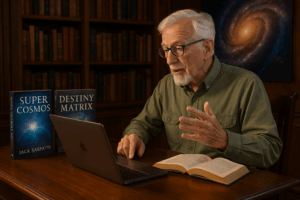
From page to pixel — Dr. Jack Sarfatti bridges theoretical physics and public outreach through his books and global lectures.
Over the decades, Sarfatti has documented his ideas prolifically. He co-authored Space-Time and Beyond (1975) and later penned books like Destiny Matrix (2002) and Super Cosmos (2005), covering everything from zero-point gravity to time travel. He has compiled lecture notes and papers on Zero-Point Energy Gravity Physics and shared them on his website StarDrive.org. Through interviews, podcasts, and conferences he explains how antigravity might work. Interestingly, his flamboyant career even inspired popular culture: he was cited as an inspiration for the eccentric Dr. Emmett Brown in Back to the Future. This illustrates how Sarfatti’s image – a wizened genius at the edge of scientific knowledge – has captured the imagination beyond academia.
Legacy and Inspiration
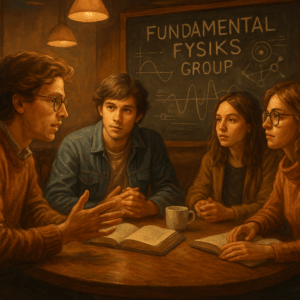
Inspired by vision — a new generation of physicists gathers around ideas once thought radical, continuing Sarfatti’s legacy of open inquiry.
Jack Sarfatti’s life is driven by curiosity and courage. He preaches a future where physics and engineering finally command gravity, lifting humanity to a cleaner, liberated destiny. As the historian David Kaiser notes, Sarfatti’s circle “aimed to inspire” new lines of research by questioning orthodoxies. Many young physicists and UFO researchers today trace their motivation to his work. Even if mainstream science remains cautious, Sarfatti’s contributions have already shifted the conversation: topics once labeled pseudoscience (like warp drives or zero-point manipulation) are now discussed in serious forums. His passionate belief in a gravity-powered future – from silent flying cars to manned starflight – stands as a powerful tribute to scientific daring.
“Taming gravity would drastically change the way we transport on every level… [and] effectively end our reliance on fossil fuels.” – This vision, spoken by those who follow Sarfatti’s work, captures why his pursuit remains inspiring.
Sources: Authoritative publications and conference records on Dr. Sarfatti’s career and theories have been used to document his life and work. (Image credits: free space imagery from public archives.)













Leave a Reply