
Source attribution: This post is a curated breakdown of NASA’s Roman Space Telescope is ready to hunt thousands of alien worlds, with additional source evaluation, technical context, and evidence-based commentary from Taming Gravity.
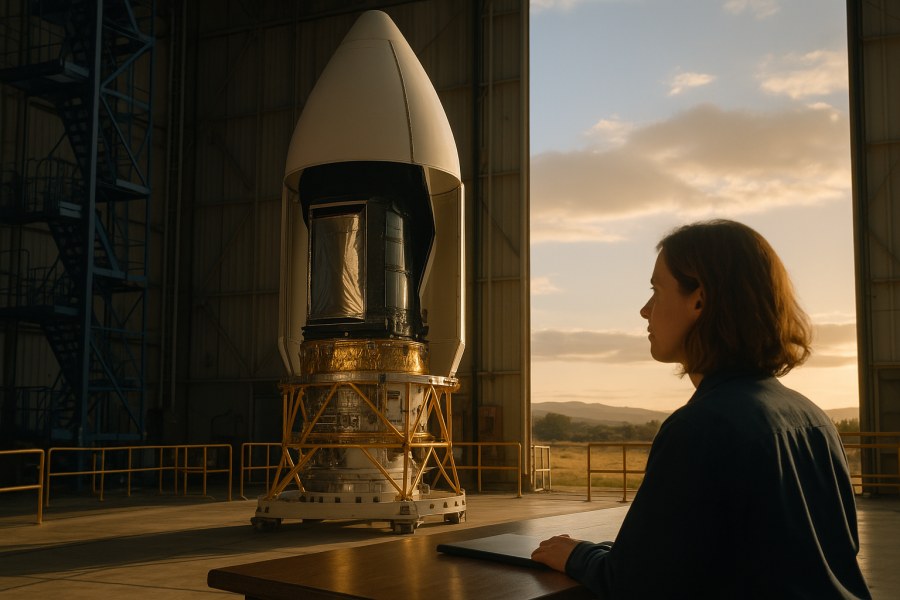
NASA’s Nancy Grace Roman Space Telescope is nearing launch, and the latest update isn’t about a new discovery—it’s about a very unglamorous but crucial milestone: according to NASA’s update as reposted by ScienceDaily, the observatory has been sealed inside the payload fairing for its Falcon Heavy launch, ahead of mating/attachment to the rocket.
That kind of progress matters because Roman is designed to scale up two of astronomy’s biggest storylines at once: (1) a statistical census of exoplanets—potentially thousands—rather than a handful of headline targets, and (2) wide-field measurements that help test what we think we know about dark matter and dark energy. Here at Taming Gravity, the point is “find the science, not the fiction”—so we’ll separate what’s established, what’s being reported (per the NASA/ScienceDaily update), and what the mission can and cannot prove.
- Quick takeaway #1: Encapsulation inside the rocket fairing means Roman has cleared a major, risk-sensitive integration step and is close to launch operations (this is Taming Gravity commentary based on standard launch workflows; the encapsulation itself is reported in the NASA/ScienceDaily update).
- Quick takeaway #2: “Thousands of alien worlds” is best understood as thousands of exoplanets for population statistics—not thousands of confirmed Earth twins, and not evidence of life.
- Quick takeaway #3: Roman’s wide-field surveys can strengthen (or strain) today’s cosmology models, but it won’t “solve dark energy” overnight—expect careful, incremental constraints.
What the source says
According to the NASA update as reposted by ScienceDaily (source), a specific set of events and expectations frame Roman’s readiness:
- Encapsulation milestone: NASA teams enclosed Roman inside the Falcon Heavy payload fairing at Kennedy Space Center’s Payload Hazardous Servicing Facility (source). The fairing is described as a protective shell that helps maintain a controlled environment on the ground and shields the spacecraft during the loud, high-pressure, high-heating early phase of ascent (source).
- Fairing separation: A few minutes after liftoff—once the atmosphere is thin enough—the fairing halves separate and fall away (source), and the source notes SpaceX plans to recover both sections (source).
- Destination: Roman is bound for Sun–Earth Lagrange point 2 (L2), a region commonly used for space observatories because it enables stable viewing conditions and long, uninterrupted observation windows (source).
- Near-term launch flow: The encapsulated payload is to be transported for mating/attachment with Falcon Heavy at Launch Pad 39A, with a target liftoff time listed as “no earlier than” a specific morning window (source).
- Science goals: The source emphasizes two primary science arcs: discovering thousands of exoplanets and surveying large sky areas to probe the distribution of matter and galaxies—work that can inform dark matter and dark energy research (source).
Plain-English translation: what this milestone really means
Encapsulating a space telescope is like placing a precision lab instrument into a protective shipping container—except the “shipping” includes intense vibration, acoustic shock, aerodynamic forces, and heating while accelerating through the atmosphere. The fairing’s job is to keep those stresses below what the spacecraft was designed and tested to survive.
So while this news doesn’t change Roman’s scientific capabilities, it does tell us something important: the mission is progressing from “hardware completion” toward “launch execution.” For readers tracking timelines, this is a more meaningful signal than a generic “we’re excited” announcement.
Established physics behind the story (what’s not controversial)
Roman’s plans sit on mature, well-tested physics and engineering:
- Orbital mechanics & L2: Lagrange points are solutions within the restricted three-body problem. Spacecraft do not “sit” perfectly at L2; they typically orbit around it in a controlled “halo” or “Lissajous” path using station-keeping. The advantage is stable viewing geometry and thermal conditions.
- Why fairings matter: During ascent, aerodynamic pressure (often referenced via max-Q), acoustic loads, and vibration can damage optics, structures, and electronics. A fairing reduces acoustic and aerodynamic coupling and provides a cleaner thermal and contamination environment.
- How wide-field surveys work: Exoplanets and cosmology both benefit from large, uniform datasets. Roman is built to observe broad regions efficiently, which is crucial for statistics (how common are planet types?) and for mapping large-scale structure (how matter clusters over cosmic time).
“Thousands of alien worlds”: what Roman can realistically claim
Science headlines love the word “alien.” In astronomy, it usually means simply “outside our solar system.” Roman’s likely exoplanet impact is less about singular showpieces and more about population-level discovery.
What “discover thousands” means in practice
- Detection is not full characterization: Finding a planet signal doesn’t automatically yield its surface temperature, oceans, or atmosphere. Many detections are limited to size or mass ratios, orbital periods, and rough distances—depending on method.
- Statistical power is the point: Thousands of detections let astronomers ask: How common are compact multi-planet systems? How often do planets form far from their star? How does planet frequency depend on stellar type or galactic environment?
- “Earth-like” is a strict bar: “Earth-sized” is not the same as “Earth-like,” and “in the habitable zone” is not the same as “habitable.” Any implication that thousands of Roman planets are Earth analogs would be an overreach.
Roman and the “dark” universe: what it can test (and what it can’t)
The source ties Roman’s surveys to dark matter and dark energy. Here’s the careful framing:
(1) Established theory and verified physics
- General relativity (GR): GR links the distribution of mass-energy to spacetime curvature, predicting lensing and the growth of cosmic structure. GR is extensively tested in many regimes; the debate is about cosmology-scale parameters and whether modifications are needed at the largest scales.
- Standard cosmology as a working model: “Dark matter” and “dark energy” are names for observed gravitational effects and expansion behavior that don’t match visible matter alone. They are not confirmed substances in the everyday sense, but the evidence for the effects is robust across multiple observations.
(2) Observational signals Roman can help measure
- Weak gravitational lensing: Subtle distortions in galaxy shapes caused by foreground mass. Measuring it across huge sky areas helps map how matter clumps—even when that matter is not luminous.
- Large-scale structure and expansion history: By surveying many galaxies over large volumes, Roman can refine how structure grows over time and how expansion has evolved—key inputs for dark energy constraints.
(3) What remains unproven or model-dependent
- What dark matter “is”: Roman can help map its gravitational footprint, but identifying the particle (if it’s a particle) is usually the job of particle physics experiments and other astrophysical probes.
- What dark energy “is”: Roman can narrow which models remain plausible, but “explaining” dark energy could require new theory or new data from multiple missions.
Steel-manning both the conventional and the unconventional (without mixing levels)
Taming Gravity readers often ask: if we’re mapping “dark” phenomena, could this hint at exotic propulsion, hidden physics, or UAP-related implications? Here’s the careful separation.
Conventional explanation (strongest current footing)
- Roman is built for astrophysics, not anomaly hunting: Its surveys target well-defined cosmology and exoplanet questions using established inference pipelines.
- Dark matter/energy are placeholders for real measured effects: They are not admissions of ignorance about everything—rather, they are precise labels attached to specific mismatches between prediction and observation.
Unconventional interpretation (possible to discuss, not established)
- Modified gravity proposals: Some researchers explore whether GR needs adjustment on the largest scales instead of invoking dark matter or dark energy. Roman-quality surveys can help test these ideas—but they remain unproven theoretical proposals until they outperform existing models across datasets.
- “Exotic tech” leaps are not warranted: Nothing in the cited NASA/ScienceDaily update indicates non-human technology, nor does a “dark sector” automatically connect to propulsion or UAP. Those are separate claims requiring separate evidence.
Practical guidance: how to follow Roman news without getting spun
If you want to track Roman in a science-first way, use this checklist when new updates drop:
- Identify the claim type: Is it (a) a hardware milestone, (b) a launch schedule update, (c) a first-light/commissioning result, or (d) peer-reviewed science?
- Ask what’s measured: For exoplanets: is it a brightness change, a positional wobble, or a lensing event? For cosmology: is it lensing shear, redshift distribution, supernova light curves, or clustering statistics?
- Look for uncertainty and systematics: The most important lines in serious results are often about calibration, biases, and error bars—not the headline number.
- Expect follow-up dependencies: Roman detections may need other observatories for confirmation/characterization. “Candidate” is not the same as “confirmed.”
Where this sits in Taming Gravity’s “find the science” approach
Roman is a reminder that the most transformative advances often come from better measurement, not louder stories. If you’re interested in how we curate developing science and separate it from speculative leaps, see the Taming Gravity manifesto.
Why this matters (even if you’re not an astronomer)
- It’s a reality check on “alien worlds” discourse: Roman’s exoplanet yield will likely reshape what we consider normal planetary architecture—useful context whenever life or “Earth-like” claims circulate.
- It strengthens scientific literacy around uncertainty: Big surveys teach us to think in distributions and confidence intervals, not isolated anecdotes.
- It’s part of a broader space-science ecosystem: Missions like Roman set the table for later, more targeted instruments and for years of cross-validation between teams.
Related reading on Taming Gravity
- Taming Gravity’s News Archive for ongoing curated science and space coverage
- Browse the News Archive category to follow updates in sequence
- ET in the News (carefully framed) for how we separate evidence, inference, and speculation in “alien” headlines
Conclusion
The source’s main point is straightforward and solid: per the NASA update as reposted by ScienceDaily (source), Roman has been encapsulated in its Falcon Heavy fairing and is approaching launch operations, with L2 as its destination and a science plan aimed at surveying the universe at scale. The most grounded expectation is not a single dramatic reveal, but a flood of high-quality measurements—thousands of exoplanet detections and wide-field cosmology data—that will let scientists test models with sharper statistical power.
If you want to keep your footing amid the hype, treat “thousands of worlds” as a statement about detection statistics, and treat “dark matter/dark energy” as ongoing investigations of measurable gravitational and expansion effects—not as solved mysteries or invitations to fill gaps with fiction.
Q&A
Does encapsulation mean Roman is definitely launching on the announced date?
No. Encapsulation is a major milestone, but launches still depend on range availability, weather, rocket readiness, and final checkouts. “No earlier than” windows can slip for routine reasons.
Will Roman find alien life?
Roman is designed to discover and measure large numbers of exoplanets and to run wide-field cosmology surveys. Discovering life requires much more specific evidence (typically atmospheric or surface biosignatures) and careful follow-up; Roman’s main strength is population statistics, not life detection by itself.
Why send Roman to L2 instead of low Earth orbit?
L2 offers a stable thermal environment and consistent viewing geometry that supports long, uninterrupted observations. That stability is valuable for sensitive surveys and calibration, even though the spacecraft still needs station-keeping.
Does studying dark matter and dark energy mean scientists don’t understand gravity?
Gravity is well tested in many regimes, and general relativity is extremely successful. “Dark matter” and “dark energy” label specific, repeated observational mismatches in cosmology-scale data. Roman’s role is to improve measurements that can narrow which explanations remain viable.














Leave a Reply