
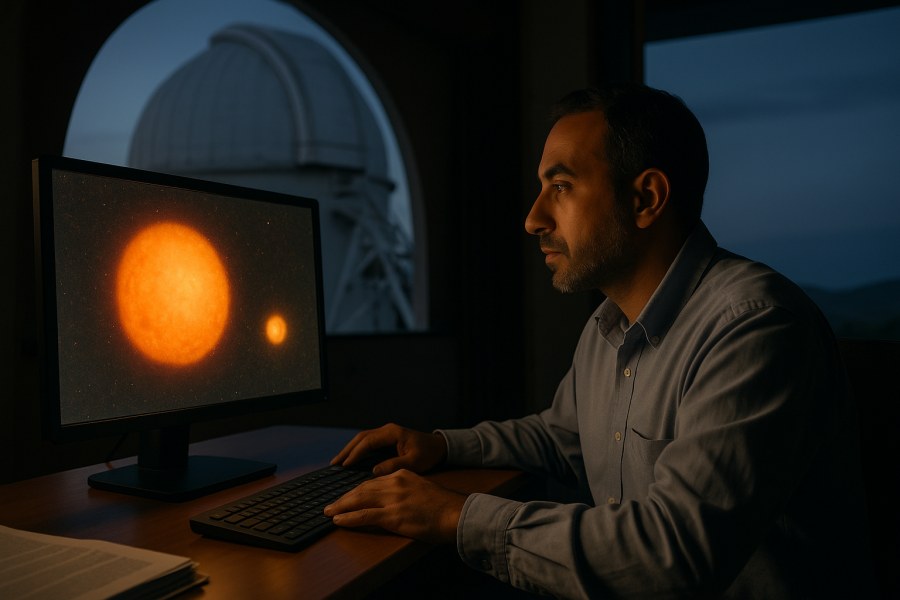
Source attribution: This post is a curated breakdown of “I jumped from my chair” – Astronomers spot Betelgeuse’s hidden companion, with additional source evaluation, technical context, and evidence-based commentary from Taming Gravity.
Three quick takeaways
- A new image-based detection: Astronomers report their clearest direct imaging evidence yet for a faint companion near Betelgeuse—often nicknamed “Betelgeuse B.”
- Timing mattered: The team observed at a moment when earlier work predicted the companion would be at its widest apparent separation from Betelgeuse, making it easier to spot.
- Not fully “case closed”: The researchers say they still want a follow-up observation at the next predicted orbital position to lock the identification down.
Betelgeuse is one of those rare sky objects that sits at the intersection of public fascination and serious astrophysics: it’s bright, nearby (in cosmic terms), and visibly changeable. That combination makes it a magnet for speculation—especially after its headline-grabbing dimming in recent years.
This post breaks down what a new report is actually claiming about a possible companion star, what kind of evidence it’s based on, and what would count as stronger confirmation. We’re sticking to Taming Gravity’s rule: find the science, not the fiction—which means separating instrument data, processing choices, predictions, and interpretation.
What the source says
The ScienceDaily/ESO summary describes a team led by astronomer Miguel Montargès using the European Southern Observatory’s Very Large Telescope (VLT) to obtain what they call the clearest image yet of a long-suspected companion near Betelgeuse.
Key claims and details presented in the source:
- Direct imaging with SPHERE: The team used the SPHERE instrument on ESO’s VLT and reports a direct detection of light from a nearby source consistent with the predicted companion.
- Why December 2024 mattered: Two studies published in 2024 (not named in the excerpt) reportedly predicted where the companion should appear, including that it would be farthest from Betelgeuse in apparent separation in December 2024. The team observed then and spent months processing/analyzing the data.
- Mass estimate higher than expected: Earlier expectations described in the source suggested a roughly Sun-mass companion, but the new analysis suggests something more like 2–3 solar masses.
- Follow-up is still needed: The source emphasizes that another observation at the next predicted orbital position would make the identification more secure—though the lead author expresses that there is “very little space left for doubt.”
- Context for Betelgeuse’s dimming: The write-up reminds readers that Betelgeuse’s dramatic dimming event was previously studied with the VLT and attributed to dust obscuring part of the star’s light, not an imminent supernova.
- Open question: Whether a companion could influence Betelgeuse’s future evolution and eventual supernova is presented as an active research question, not a settled result.
Plain-English explanation: what’s new here?
The basic challenge is that Betelgeuse is bright and messy—its surface and extended atmosphere aren’t a clean point of light. If you’re trying to see a much fainter star close by, you’re fighting glare, turbulence, and the star’s own complex light pattern.
What the report suggests is that the team took advantage of a predicted “best moment” in the companion’s apparent orbit (maximum separation as seen from Earth), then used an instrument and data-processing workflow designed for exactly this kind of problem: finding faint points of light near bright ones.
In other words: the novelty isn’t just “we looked again.” It’s “we looked at the predicted time and used tools optimized for high-contrast imaging.” The result is a candidate source that lines up with what the orbit prediction expects.
Why this matters (beyond astronomy trivia)
Betelgeuse isn’t just famous; it’s scientifically useful. It’s a nearby red supergiant—an evolutionary stage associated with heavy mass loss, huge convective cells, dust formation, and eventual core collapse. When an object is that important, a hidden companion isn’t a minor footnote. It can affect:
- Brightness changes: A companion can introduce periodic effects (geometry, interaction with outflowing material), and it can complicate the interpretation of irregular variability.
- Mass loss and circumstellar structure: A secondary star can shape winds, carve spirals/wakes, or help concentrate dust—effects we see in other evolved-star systems.
- Supernova expectations: Whether it meaningfully changes Betelgeuse’s final outcome is not established here, but binary evolution is a major theme in modern stellar astrophysics, so the question is worth asking carefully.
What the source does not claim (and what readers may assume)
Because Betelgeuse has become a pop-science lightning rod, it’s easy to over-read any new result. The source is fairly restrained, but here are common leaps to avoid:
- “This proves Betelgeuse will explode soon.” The write-up does not say that. It frames supernova impact as an open question.
- “The companion explains the Great Dimming.” The source explicitly points back to dust obscuration as the explanation developed by Montargès’ team for the dimming episode, not the companion.
- “One image settles it.” Even the researchers quoted in the source call for another observation to confirm the orbital prediction.
Steel-manning the explanations: companion vs. alternatives
The conventional interpretation: a real companion star
The report’s preferred interpretation is straightforward: there is a faint star physically bound to Betelgeuse. What makes that plausible (based on what’s described in the source) is the combination of (1) a predicted position from prior studies, (2) observations taken at maximum apparent separation, and (3) detection using an instrument purpose-built for high-contrast imaging.
The “2–3 solar masses” estimate, if it holds up, also fits the idea that this wouldn’t be an ultra-faint object—you’d expect it to be intrinsically brighter than the Sun, just overwhelmed by Betelgeuse’s glare at close separation.
Reasonable alternative interpretations (that still fit the data description)
- Image-processing artifact: Post-processing designed to remove Betelgeuse’s light could, in principle, leave behind a false point source. The best antidote is repeat detection with different methods/pipelines and at a different orbital phase.
- Temporary bright clump in circumstellar material: Betelgeuse is known for complex outflows and dust. A compact knot could masquerade as a point source in some analyses. Multi-wavelength checks (not described in the excerpt) can help distinguish dust-scattered light from stellar light.
- Background star coincidence: Less likely if the motion matches an orbit around Betelgeuse, but a single-epoch image can’t fully exclude chance alignment without follow-up astrometry.
Practical context: how to read a “companion discovered” headline
If you’re an interested reader (not an instrument specialist), here’s a useful checklist for calibrating confidence without slipping into cynicism:
- Was it seen directly or inferred indirectly? This report describes direct imaging (a positive sign), but direct imaging near a bright target still requires careful validation.
- Is there an orbital prediction? The source says yes—based on 2024 studies—and the team observed at a predicted favorable geometry.
- Is there multi-epoch confirmation? Not yet, per the write-up. That’s the next step they call for.
- Does the story distinguish earlier explanations? Here it does: the earlier dimming is attributed to dust, and the companion is introduced as an additional factor in Betelgeuse’s long-term evolution.
Why Taming Gravity is paying attention
At Taming Gravity, we often cover topics where evidence quality varies wildly—especially around things that capture the public imagination. A claimed companion to a famous star is a great reminder that “mystery” can shrink not by a single dramatic reveal, but by prediction + timing + better instruments + careful analysis.
If you want the broader philosophy behind how we separate curiosity from credulity, our approach is laid out here: Taming Gravity manifesto.
And if you’d like more of this kind of attribution-first breakdown, you can browse the running section here: News Archive and its category hub: News Archive category. For comparison with how we handle more speculative, culturally charged topics, see our coverage of media trends here: Fox News is going deep into abductions, UFOs, and conspiracies.
Conclusion: a strong candidate, with a clear next test
The ScienceDaily/ESO summary presents what sounds like the strongest imaging evidence yet for a long-suspected companion to Betelgeuse, captured at a time when predictions said the companion should be most visible. It also models good scientific hygiene: despite the excitement, the team points to a straightforward next step—observe again and confirm the candidate appears where the orbit says it should.
Until that follow-up lands, the responsible stance is: compelling, plausibly real, and worth watching—but still an active, testable claim rather than a forever-fact.
Bottom line
For most readers, the safest approach is to treat the source as a useful starting point, then verify the details on your own device before making changes. If the issue affects a work computer, important files, or business operations, get help before taking risky steps.
Q&A
Did astronomers definitively confirm Betelgeuse has a companion star?
Not definitively, based on the source summary alone. The report describes the strongest direct imaging evidence yet for a candidate companion, but it also says a follow-up observation at the next predicted orbital position is still needed for full confirmation.
Is the companion supposed to explain Betelgeuse’s famous dimming event?
The source does not frame it that way. It reiterates that the dramatic dimming was previously attributed (by Montargès’ team using VLT observations) to a dust cloud blocking part of Betelgeuse’s light, not to an imminent supernova or necessarily to the companion.
What’s the strongest next piece of evidence to look for?
A repeat detection at a later date showing the candidate source on the opposite side (or otherwise along) the position expected from the predicted orbit. That time-based motion test helps rule out one-off artifacts, temporary dust clumps, or chance background alignments.
Does a companion mean Betelgeuse will go supernova soon?
No. The source presents any effect on Betelgeuse’s future supernova as an open question for further study, not a claim that the explosion is imminent.














Leave a Reply