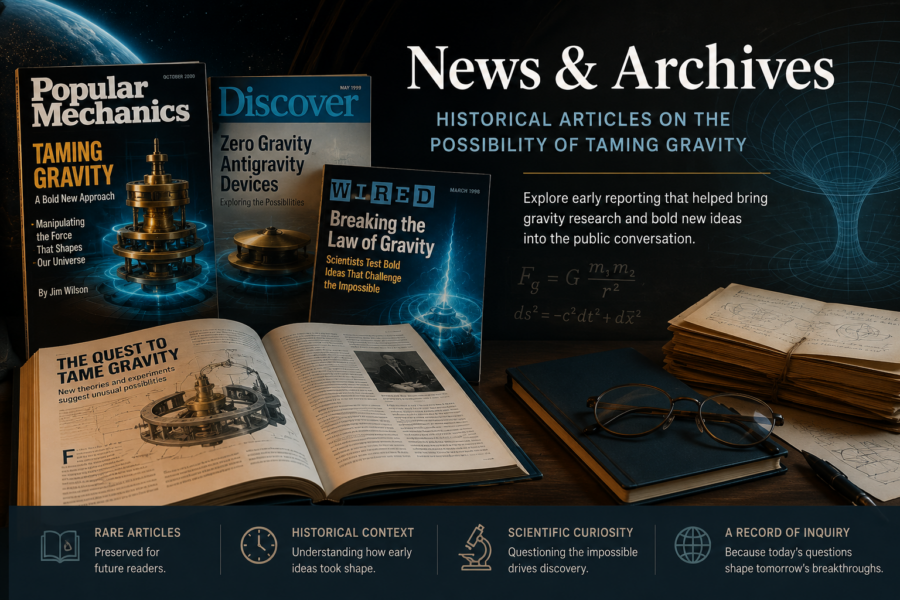
The Taming Gravity Archive preserves a small but historically important collection of mainstream magazine reporting from the late 1990s and early 2000s. These articles captured a moment when physicists, aerospace researchers, and science journalists were publicly asking whether gravity might ever become more than a force to measure—whether some aspect of it could become technologically accessible.
This collection is preserved as a record of scientific ideas, experimental claims, and public expectations. Inclusion does not mean that TamingGravity.com endorses every claim in an article or regards it as proof of gravity control. The archive asks a more disciplined question: What was proposed, what evidence existed at the time, and what has later research clarified?
Why Preserve Early Gravity-Control Reporting?
Before research papers, interviews, and institutional announcements could circulate instantly online, print magazines played a central role in bringing unconventional scientific work to the public. Wired, Discover, and Popular Mechanics reached readers who would never encounter a specialist paper on gravitation, superconductivity, or advanced propulsion.
The articles preserved here form a narrow historical window rather than a complete history. Published between 1998 and 2000, they show how journalists described several ideas then attracting attention: claimed weight changes above rotating superconductors, laboratory attempts to reproduce those claims, speculative links between superconductivity and gravitomagnetism, possible gravitational behavior of antimatter, and proposed connections between inertia and propulsion.
They also illustrate a recurring difficulty in frontier reporting. A scientifically legitimate question, a mathematical proposal, an unexplained measurement, and a functioning technology are not the same thing. Popular accounts sometimes placed them closer together than the evidence justified.
These articles demonstrate that gravity-modification ideas received public and institutional attention. They do not demonstrate that gravity shielding, antigravity, propellantless propulsion, or a controllable gravity-like field was achieved.
Dr. Ning Li and the Origins of Taming Gravity
The central figure in this collection is physicist Dr. Ning Li, whose work at the University of Alabama in Huntsville explored whether coherent motion within superconducting materials could produce an unusually strong gravitomagnetic effect. Gravitomagnetism itself is not speculative: it is a weak effect predicted by General Relativity in which rotating mass contributes to spacetime effects analogous, in a limited mathematical sense, to magnetism.
Li’s proposed amplification mechanism was a different matter. It was a theoretical proposal requiring experimental confirmation. Reports described efforts to fabricate large high-temperature superconducting discs and test whether the predicted gravity-like field could be detected or controlled. The public record preserved here does not contain an independently replicated demonstration of such a field.
For TamingGravity.com, Li’s historical importance does not depend on treating the proposed device as successful. Her work represented a conceptual shift: gravity control was being framed not merely as science fiction, but as a question involving equations, materials, measurement, and engineering constraints.
Jim Wilson’s October 2000 Popular Mechanics article, “Taming Gravity,” introduced me to Dr. Li’s work and inspired the name of this website. The enduring influence of that article is not a guarantee that its technological expectations were correct. It is evidence that careful science communication can open a question important enough to guide a lifetime of inquiry.
Can gravity remain one of nature’s least technologically accessible interactions forever—or might future discoveries make some form of gravitational engineering possible?
How to Read the Archive
Taming Gravity evaluates historical sources through four distinct levels of understanding. Keeping these levels separate protects both open-minded inquiry and scientific credibility.
| Level | Meaning in This Archive |
|---|---|
| 1. Established Theory | General Relativity predicts gravitomagnetic and frame-dragging effects. Superconductivity, quantum coherence, and electromagnetic levitation are also established phenomena. Their existence does not by itself establish gravity control. |
| 2. Experimental or Observational Signals | Reported weight changes, anomalous forces, or laboratory measurements belong here until systematic error is excluded and independent teams reproduce the effect. |
| 3. Theoretical Proposals | Models suggesting enhanced gravitomagnetism, mass fluctuation, gravity shielding, or new propulsion mechanisms may be mathematically interesting without being experimentally validated. |
| 4. Philosophical Interpretation | Ideas about what gravity engineering could mean for civilization, exploration, or human evolution belong to a broader interpretive layer—not to the experimental evidence itself. |
When reading any archived claim, ask: Was an effect predicted? Was it measured under controlled conditions? Was it independently replicated? Did a practical device follow? Each step requires new evidence.
Articles in the Collection
The collection currently contains three articles published during a concentrated period of public interest. Each should be read both for what it reported and for the expectations of its era.
“Taming Gravity” by Jim Wilson
Why it matters: This is the article that gave TamingGravity.com its name. It presents the clearest public account in this collection of the attempt to move from a theoretical proposal toward a proof-of-concept device.
Read with caution: Its development timelines and descriptions of technological capability were expectations, not verified outcomes.
“Zero Gravity: Antigravity Devices” by Corey S. Powell
Why it matters: The article captures the unusually wide range of gravity and propulsion questions being discussed at the end of the twentieth century.
Read with caution: The piece brings together proposals with very different evidentiary status. Proximity within one article does not mean equal scientific support.
“Breaking the Law of Gravity” by Charles Platt
Why it matters: It preserves the tension between investigating an anomalous result and demanding reproducibility before accepting an extraordinary conclusion.
Read with caution: Investigation by additional laboratories is evidence of scientific interest, not confirmation of the reported effect.
Then and Now: What Science Has Clarified
A historical archive becomes more useful when later evidence is placed beside earlier expectations. Several questions mentioned in these articles have advanced substantially, although not toward a demonstrated gravity-control technology.
Frame Dragging Was Measured—At the Scale General Relativity Predicts
The archived articles referred to NASA and Stanford’s Gravity Probe B mission, which had not yet launched. The mission later measured the geodetic and frame-dragging effects around Earth, with final results broadly consistent with General Relativity. This was an important confirmation that rotating mass affects spacetime. It was not evidence that superconductors produce a greatly amplified or technologically useful gravitational field.
Antimatter Did Not Fall Upward
The 1999 Discover article treated the gravitational behavior of antimatter as an open experimental question. In 2023, CERN’s ALPHA collaboration directly observed antihydrogen behaving consistently with downward gravitational attraction. Within the experiment’s precision, repulsive “antigravity” for antihydrogen was ruled out. Higher-precision tests remain valuable, but one prominent route imagined in the older reporting now faces direct experimental constraint.
Superconducting Gravity Control Remains Unverified
Superconductors can produce striking electromagnetic effects, including magnetic levitation, but electromagnetic levitation is not gravity modification. No publicly verified and independently replicated experiment has established that a rotating superconductor shields gravity, cancels weight, or generates the strong controllable gravity-like field envisioned in these reports.
General Relativity remains extraordinarily successful within the regimes where it has been tested. Gravity and quantum theory are not yet unified, and important cosmological questions remain open. Those open problems justify continued research; they do not provide evidence that a particular gravity-control claim is true.
The Continuing Value of the Archive
If these articles do not prove gravity control, why preserve them? Because the history of inquiry matters. Scientific progress includes successful theories and experiments, but it also includes bold proposals, failed replications, premature expectations, improved instruments, and questions reformulated as evidence accumulates.
- They preserve intellectual history. The articles document how gravity modification and advanced propulsion entered mainstream public discussion at the turn of the century.
- They reveal the difference between attention and validation. A subject can receive funding, journalism, or institutional interest without producing a confirmed effect.
- They provide a benchmark. Readers can compare past forecasts with later experimental results and see where expectations were accurate, incomplete, or mistaken.
- They protect fragile sources. Links disappear, publications reorganize, and historically influential reporting becomes difficult to locate.
- They preserve the origin story of this project. The collection records the article and scientific questions that helped inspire Taming Gravity.
The deeper lesson is methodological. Extraordinary possibilities should neither be dismissed merely because they are unconventional nor accepted because they are inspiring. They should be translated into measurable predictions and exposed to increasingly stringent tests.
Future Additions and Selection Standards
This archive may grow, but it is not intended to become an indiscriminate collection of antigravity claims. Future additions should have clear historical or scientific value and enough provenance to be responsibly evaluated.
Priority will be given to material that includes identifiable authorship and publication history; documents a significant experiment, research program, or shift in public understanding; can be compared with later evidence; and helps readers distinguish established physics from proposals and unresolved claims.
The archive preserves the past, but its interpretation should evolve. When stronger evidence, successful replications, decisive null results, or better theoretical analysis become available, the contextual notes should be updated accordingly.
What discoveries—and what quality of evidence—would be required before gravity could genuinely become an engineering discipline?