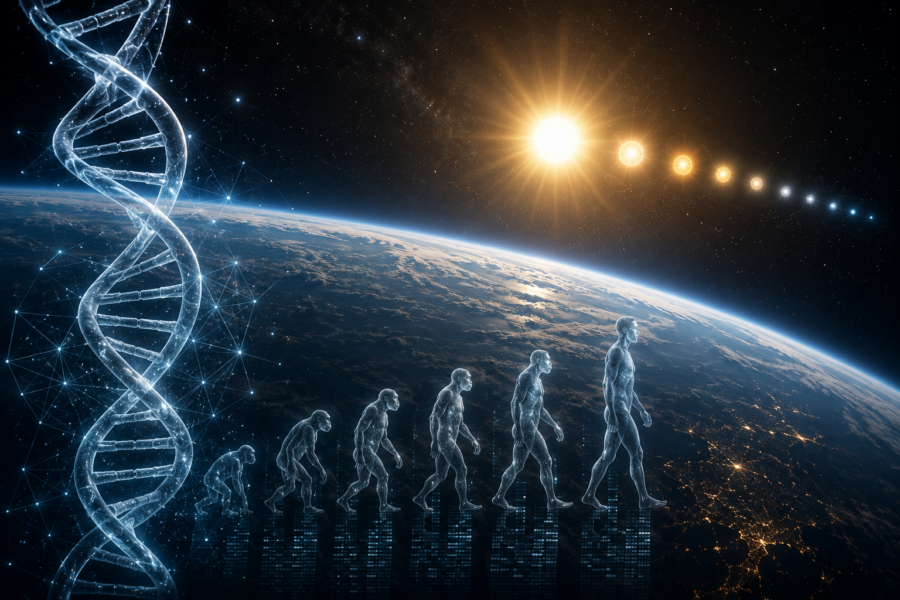
A science-first examination of stellar lifetimes, directed panspermia, genetic intervention claims, and the evolutionary time-window hypothesis
THE CENTRAL QUESTION If technological civilizations exist and value the continuation of life, might they ever accelerate evolution on a world whose habitable era could close before intelligence emerges? This page examines that possibility without treating it as established history.
Human beings appeared late in Earth’s long biological history. Our
planet formed about 4.54 billion years ago; evidence of life reaches
back more than 3.5 billion years; complex animals became widespread only
in the last roughly 600 million years; and Homo sapiens is approximately
300,000 years old. Meanwhile, the Sun has steadily brightened and will
eventually make Earth hostile to oxygen-rich complex life long before it
reaches its red-giant phase.
That timing invites a legitimate astrobiological question: is the
emergence of technological intelligence normally so slow that some
inhabited planets run out of favorable time? A more speculative question
follows: could an older civilization ever intervene—not to create life
from nothing, but to increase the probability that a biosphere produces
a self-aware, technologically capable species before its environmental
window narrows?
This is the hypothesis explored here. It was prompted in part by Bob
Lazar’s account that briefing materials he allegedly read described
extraterrestrial modification of human evolution. Lazar’s broader story
remains disputed, and no authenticated copy of those supposed briefing
documents has been produced publicly. His statement therefore belongs in
the category of testimony, not verified evidence. The scientific
argument must stand or fall independently of it.
Table of Contents
The argument in one
paragraph
JOHN ZETTEL’S PROPOSED INTERPRETATION If extraterrestrial genetic intervention ever occurs, its most coherent life-centered purpose would be to help an existing biosphere cross a difficult evolutionary threshold before stellar or planetary change closes its opportunity. On Earth, such intervention would not replace evolution; it would act within evolution, perhaps accelerating a lineage already moving toward greater cognition and technological agency.
This proposal contains a scientifically sound premise, a
plausible-but-unproven extrapolation, and an unsupported historical
claim. The sound premise is that stars and planets provide finite,
highly variable windows for complex life. The extrapolation is that an
advanced civilization might value life strongly enough to preserve or
accelerate it elsewhere. The unsupported claim is that this actually
happened to our ancestors. Keeping those three layers separate is
essential.
1. The stellar
clock: why a star’s mass matters
A star is not simply a lamp beside a planet. Its mass largely
controls its luminosity, surface activity, rate of fuel consumption, and
main-sequence lifetime. High-mass stars burn through nuclear fuel
rapidly and may live only millions of years—far too briefly for anything
resembling Earth’s slow biological history. Lower-mass stars consume
fuel more slowly and can remain on the main sequence for tens of
billions to trillions of years.
The Sun is a G-type main-sequence star with an expected main-sequence
life of roughly 10 billion years. It formed about 4.6 billion years ago,
so it is near the middle of that stellar lifetime. Calling the Sun
“average-sized” is reasonable in a broad descriptive sense, but it is
larger and more massive than the red dwarfs that dominate the Milky
Way’s star count. NASA estimates that red dwarfs constitute about 73–75
percent of the Galaxy’s stars, while Sun-like G stars are only about 6
percent and K dwarfs about 13 percent.
IMPORTANT CORRECTION The draft’s “top 25 percent” wording should not be used as a precise scientific statistic without defining whether size, mass, luminosity, or the local stellar population is meant. The defensible statement is that the Sun is more massive and shorter-lived than the numerous M-dwarf stars, but far less massive than genuinely high-mass stars.
A planet’s useful biological window is also shorter than the star’s
total life. Stars brighten while on the main sequence. The young Sun was
roughly 30 percent dimmer than today, and Earth remained habitable
through geochemical climate feedbacks. Future brightening will
eventually overwhelm those stabilizing mechanisms. One modeling study
estimated that Earth’s oxygen-rich atmosphere may persist for about 1.08
± 0.14 billion more years; other recent models allow parts of the
complex biosphere to survive closer to 1.6–1.8 billion years. These are
model-dependent ranges, not a scheduled expiration date.
2. Why
smaller stars are not automatically better homes
At first glance, red dwarfs seem ideal for evolution: they are
abundant and extraordinarily long-lived. A biosphere could, in
principle, have vastly more time than Earth. But longevity is only one
variable. Because red dwarfs are faint, a planet must orbit close to
receive enough energy for surface liquid water. Close orbits increase
the likelihood of tidal locking, and many red dwarfs remain magnetically
active, producing flares, ultraviolet radiation, and X-rays capable of
altering or eroding planetary atmospheres.
This does not prove that red-dwarf planets are sterile. Atmospheres,
oceans, magnetic fields, planetary mass, chemistry, flare history, and
orbital dynamics can change the outcome. It does mean that “longer-lived
star” cannot be translated directly into “more evolutionary time.” A
star can offer a long clock but a harsh laboratory.
K-type orange dwarfs may offer a particularly interesting compromise:
longer main-sequence lifetimes than the Sun, less extreme activity than
many red dwarfs, and potentially stable habitable zones. NASA summarizes
possible K-dwarf lifetimes as roughly 15–45 billion years. If complex
life commonly needs more time than it received on Earth, such systems
might be especially favorable. That remains an astrobiological
expectation, not an observation of inhabited worlds.
3. Earth’s evolutionary
timetable
Life began relatively early in Earth’s history, but complex
intelligence appeared late. For most of the planet’s inhabited
existence, life was microbial. Oxygenation, eukaryotic cells,
multicellularity, nervous systems, land ecosystems, mammals, primates,
and technological humans emerged through a long sequence of contingent
transitions. Mass extinctions repeatedly pruned and redirected that
history.
This pattern supports a modest conclusion: an inhabited planet need
not rapidly produce technological intelligence. It does not demonstrate
that intelligence is an evolutionary destination. Natural selection
favors reproductive success in local environments, not progress toward a
predetermined human-like form. Octopuses, corvids, cetaceans, elephants,
and primates show that sophisticated cognition can arise in very
different bodies, yet only one surviving lineage on Earth developed
cumulative technology capable of radio astronomy and genome
engineering.
ESTABLISHED SCIENCE Humanity is part of the terrestrial tree of life. Comparative anatomy, fossils, biogeography, chromosome structure, shared genetic errors, endogenous retroviral insertions, and ancient DNA form a mutually reinforcing record of common descent.
The crucial insight for this hypothesis is therefore not that
evolution “should” make humans. It is that a civilization might
recognize rare transitions—such as stable multicellularity, symbolic
cognition, language, or cumulative culture—and try to preserve or
accelerate them. That motivation can be imagined coherently, but it
cannot be inferred from the mere existence of Homo sapiens.
4. What “intervention” could
mean
Several very different ideas are often bundled together under “alien
genetic engineering.” They should be separated.
Directed panspermia
Francis Crick and Leslie Orgel used this term in 1973 for the
deliberate transport of microorganisms to seed life on a suitable world.
They explicitly said the available scientific evidence was inadequate to
assign the idea a probability. Directed panspermia concerns the origin
or distribution of life, not necessarily the later engineering of
humans.
Ecological or genomic
steering
A civilization could hypothetically introduce genes, microbes,
selective pressures, or ecological changes into an existing biosphere.
This would be far more difficult and unpredictable than editing an
individual organism. Genes have effects that depend on regulatory
networks, development, environment, population structure, and chance.
Engineering a species across evolutionary time would require enormous
knowledge, monitoring, and restraint.
Targeted alteration
of a hominin population
The most specific version proposes changes to one or more ancestral
human populations. For such edits to spread, they would need to enter
germ cells, confer advantages or be driven through a population, and
remain compatible with the rest of the genome. Modern gene drives
illustrate in limited organisms that inheritance can be biased, but
extrapolating that capacity to ancient hominins—without leaving an
identifiable signature—is highly speculative.
Cultural
acceleration rather than genetic editing
A less literal intervention could involve teaching, ecological
assistance, or the transfer of tools and information. This would leave
different evidence: discontinuities in material culture, anomalous
artifacts, or knowledge appearing without precursors. Archaeology
instead generally reveals cumulative, regionally varied development,
although the record remains incomplete.
5. Bob Lazar’s
claim: source, influence, and limits
Bob Lazar became publicly known in 1989 through television interviews
with journalist George Knapp. Lazar said he had worked at a facility
called S-4 near Area 51 on the reverse engineering of nonhuman craft. In
retellings of his account, he has also described briefing material that
allegedly stated human beings were genetically altered by
extraterrestrials, sometimes with a specified number of
interventions.
EVIDENCE STATUS No publicly authenticated briefing paper, chain of custody, biological sample, or independently verified program record substantiates the human-genetic-modification portion of Lazar’s story. The claim may be discussed as culturally influential testimony, but it cannot serve as scientific evidence for the hypothesis.
Lazar’s educational and employment history has also been the subject
of long-running dispute. Some details associated with Los Alamos have
been offered in support, while his claimed degrees from MIT and Caltech
have not been independently documented. None of this logically proves
that every statement he made is false; it does mean that the evidentiary
burden remains unmet. The present argument should therefore say:
“Lazar’s account prompted the question,” not “Lazar established that
intervention occurred.”
6. What the
genome and fossil record actually show
The mainstream account of human origins is not supported by a single
fossil or one similarity in DNA. It is a convergent framework. Humans
and chimpanzees share a common ancestral population roughly six to eight
million years ago. Hominin fossils show mosaics of traits across time.
Ancient DNA reveals interbreeding among Homo sapiens, Neanderthals, and
Denisovans. Human chromosome 2 preserves the expected signature of a
fusion between two ancestral ape chromosomes. Shared endogenous
retroviral insertions record ancient viral integrations inherited
through common ancestry.
These facts sharply constrain intervention claims. A proposed edit
cannot be used as a substitute for evolution, because our genome is
nested within primate and mammalian history. Any defensible hypothesis
must describe intervention as a modification of an already terrestrial
lineage. It must also explain why the change fits the surrounding
evolutionary record instead of breaking it.
Could advanced engineering be made to look natural? In principle, a
sufficiently capable engineer could alter existing sequences, regulatory
regions, or population frequencies while preserving phylogenetic
continuity. But that escape route weakens testability: the more
perfectly an intervention imitates natural evolution, the less evidence
distinguishes it from natural evolution. A hypothesis that is compatible
with every possible observation risks explaining nothing.
CURRENT BOTTOM LINE No accepted genomic analysis has identified a sequence that requires extraterrestrial engineering as its explanation. Rapid human brain evolution, language-related genes, chromosome 2 fusion, “junk DNA,” and endogenous retroviruses all have active natural research programs and cannot responsibly be presented as alien signatures.
7. The evolutionary
time-window hypothesis
A disciplined version of the proposal can now be stated: Some
biospheres may begin life but face a limited remaining interval for
complex evolution because of stellar brightening, atmospheric loss,
geological decline, orbital instability, or other planetary constraints.
A technologically mature civilization that places intrinsic value on
living systems might sometimes intervene to preserve diversity or help a
promising lineage cross a rare evolutionary threshold.
Applied to Earth, the hypothesis suggests that an intervention—if one
occurred—could have been intended to increase the probability that
technological intelligence emerged before long-term solar brightening
closed Earth’s complex-life window. This is more coherent than motives
centered on exploitation or spectacle because it connects action to a
general astrobiological constraint. It also aligns with an ethic in
which advanced capability brings stewardship obligations.
Yet Earth’s timing does not obviously require rescue. Technological
intelligence appeared while perhaps a billion years or more of
oxygenated habitability remains. Evolution had sufficient time in this
one observed case. We do not know whether Earth was unusually fast,
unusually slow, or typical, because we have a sample size of one
inhabited planet and one known technological species.
The strongest form of the idea is therefore comparative, not
historical: civilizations might triage biospheres according to remaining
habitability, evolutionary complexity, and the risk of irreversible
loss. The Earth-specific claim is a possible instance that would require
independent evidence.
8. Strong objections and
the best replies
Objection: The
hypothesis is unnecessary
Natural evolution already explains human continuity with other life,
so extraterrestrial intervention adds an entity without explanatory
need. This is the strongest objection. The proper reply is not to reject
evolution, but to ask whether future evidence ever reveals an anomaly
that natural mechanisms fail to explain. Until then, natural evolution
is the warranted account.
Objection: Evolution has no
goal
Correct. The hypothesis should not claim that nature aims at humans.
It proposes a goal only for a hypothetical intervener: protecting or
expanding life’s future options. That is an ethical intention imposed by
an agent, not a law of evolution.
Objection:
Why intervene genetically rather than relocate life?
An advanced civilization might seed empty worlds, move threatened
organisms, stabilize a climate, or do nothing. Genetic acceleration
would be only one tool and could be ethically hazardous. The hypothesis
becomes more plausible when treated as part of a range of conservation
strategies, not as the sole behavior of all advanced civilizations.
Objection:
Non-interference may be the more mature ethic
Intervention could destroy indigenous trajectories, create
dependency, or impose alien values. A civilization might therefore adopt
strict non-interference except when extinction is otherwise unavoidable.
This objection substantially limits the draft’s suggestion that
acceleration would be the “only reason” to intervene. It may be one
intelligible reason, but not a conclusion about universal motives.
Objection: The idea
cannot be falsified
A vague claim that invisible engineers can erase every trace is
unfalsifiable. A scientific version must make risky predictions:
identifiable non-natural sequence design, a dated and localized genomic
discontinuity, an artificial delivery mechanism, independent
archaeological context, or repeated patterns across unrelated
biospheres. Without such predictions, the proposal remains philosophy or
speculative astrobiology.
9. What evidence could test
the idea
A credible case would require multiple independent lines of evidence,
not an unusual gene by itself. Investigators would look for a sequence
with demonstrable functional design and no plausible ancestry; molecular
“watermarks” resistant to natural-generation explanations; a precisely
dated change inconsistent with known mutation, selection, introgression,
drift, or viral insertion; an associated artifact in secure
archaeological context; and replication by independent laboratories.
Comparative astrobiology would be even more powerful. If life is
found elsewhere and uses closely related biochemistry or contains a
recognizable informational signature, directed panspermia would become
more testable. Conversely, a second genesis with wholly independent
chemistry would show that life arises more than once, while saying
little by itself about later intervention.
A FAIR STANDARD Extraordinary claims do not need ridicule; they need unusually strong controls. Before calling a genomic feature engineered, researchers must exclude contamination, sequencing error, incomplete lineage sorting, introgression, gene duplication, horizontal gene transfer, endogenous viruses, selection, drift, and unknown—but natural—biology.
10. Ethical and
philosophical implications
The hypothesis may be most valuable as a mirror for humanity. We are
approaching the capacity to edit genomes, revive lost alleles, move
species, and perhaps one day seed life beyond Earth. The same questions
we project onto older civilizations are becoming our own: When does
stewardship become domination? Is preserving life sufficient
justification for altering it? Who decides which traits represent
“greater evolution”?
A life-centered interpretation resonates with traditions that see
existence as an expansion of awareness, relationship, and fulfillment.
The Vedic idea that life moves toward greater fullness can provide
philosophical orientation, but it should not be presented as an
empirical mechanism or confirmation of alien action. Science asks what
happened and how; philosophy asks what it may mean and what values
should govern our response.
From a species-level perspective, technological intelligence matters
not because humans are evolution’s predetermined endpoint, but because a
species capable of foresight can deliberately protect—or destroy—the
wider tree of life. If intelligence has a defensible cosmic purpose,
stewardship is a stronger candidate than supremacy.
Conclusion: a
disciplined open question
The Sun’s finite habitable window is real. Stellar mass and activity
shape how much time a biosphere may receive. Earth’s history shows that
complex intelligence can take billions of years, and the Galaxy contains
many stars that live far longer than the Sun. These facts establish an
important astrobiological problem: life’s opportunity is neither
infinite nor equal from world to world.
They do not establish that extraterrestrials altered human evolution.
The fossil and genomic record strongly supports terrestrial common
descent, and no verified artifact or genetic signature currently
requires an intervention explanation. Bob Lazar’s story remains
testimony without the documentation needed to carry scientific
weight.
The proposed contribution of this page is narrower and more durable:
if advanced civilizations ever intervene in evolution, preserving a
biosphere’s future before its window closes is one coherent motive. That
possibility deserves careful exploration as speculative astrobiology and
ethics—not as settled human history. The question stays open, but the
standards of evidence stay high.
Frequently Asked Questions
Does science
show that aliens engineered humans?
No. Current fossil, archaeological, and genomic evidence supports
human evolution within the terrestrial tree of life. No accepted
evidence requires extraterrestrial engineering.
Did
Bob Lazar claim that humans were genetically altered?
Accounts of Lazar’s alleged S-4 briefings include that claim.
However, no authenticated briefing document or biological evidence has
been publicly produced, so it remains unverified testimony.
Would alien
intervention disprove evolution?
Not necessarily. Any intervention in an ancestral population would
occur within an existing evolutionary lineage. The evidence for common
descent would remain; the question would be whether an external agent
altered part of that process.
Are
red-dwarf systems better for complex life because they last longer?
Not automatically. Their longevity is favorable, but close-in
habitable zones, tidal effects, flares, and atmospheric erosion can
create serious challenges. Actual habitability depends on the whole
star–planet system.
What is directed panspermia?
It is the hypothesis that a technological civilization deliberately
transported microorganisms to seed life elsewhere. It differs from the
later genetic engineering of an already complex species.
Could
genetic engineering be hidden in the human genome?
A sufficiently advanced intervention is imaginable, but no verified
signature has been found. Claims must be compared against
well-established natural processes and must make testable
predictions.
Should this be a
new Close Encounter category?
Probably not. Close Encounter categories classify reported
encounters. This topic is a theoretical astrobiology and human-origins
hypothesis, not a distinct encounter type.
Sources and further reading
1. NASA, Our Sun:
Facts — Solar age, lifetime, structure, and future
evolution.
2. NASA, Stars in an
Exoplanet World — Relative abundance, lifetimes, and radiation
environments of G, K, and M stars.
3. NASA
Astrobiology, Red Dwarf Stars and the Planets Around Them —
Habitability opportunities and complications around M dwarfs.
4. NASA/Chandra,
Assessing the Habitability of Planets Around Old Red Dwarfs —
High-energy radiation and atmospheric challenges.
5. Kasting
& Catling, Evolution of a Habitable Planet, Annual Review
(2003) — Long-term solar luminosity, climate feedbacks, and
planetary habitability.
6. Ozaki &
Reinhard, The Future Lifespan of Earth’s Oxygenated Atmosphere
(2021) — Model estimate for the future duration of oxygen-rich
conditions.
7. Smithsonian
Human Origins Program, Introduction to Human Evolution —
Overview of the fossil and biological evidence for human evolution.
8. Smithsonian
Human Origins Program, Genetics — Genetic evidence and the
human–chimpanzee common ancestral timeline.
9. NHGRI,
Analysis of Human Chromosomes 2 and 4 — Evidence for ancestral
chromosome fusion in human chromosome 2.
10. Crick
& Orgel, Directed Panspermia, Icarus 19 (1973) — Original
scientific proposal and its explicit evidentiary caution.
11. Trombetta et al.,
Human Endogenous Retrovirus Gene Conversion (2016) — ERVs as
inherited products of ancient germline viral integrations.
12. NASA,
Increasing the Lifespan of Life on Earth — How atmospheric
change may affect future biosphere longevity.