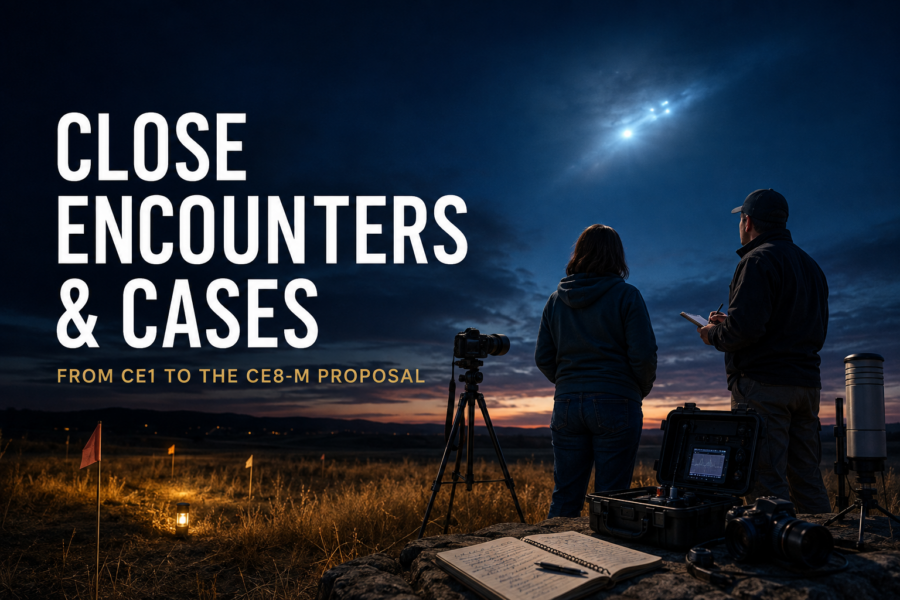
A close encounter is first a report of human experience. Before it becomes evidence of extraterrestrial visitors, unknown technology, consciousness effects or institutional deception, we must determine what was observed, what was recorded and what was added through interpretation.
Some UAP cases concern a distant light or an ambiguous image. Close encounters are different. They describe events reported at short range or with direct effects upon witnesses, vehicles, animals, the environment—or, in later extensions of the classification, human memory, consciousness and claimed interaction.
The closer and more consequential a report becomes, the greater the need for care. Proximity may provide detail, but it can also bring fear, trauma, expectation and incomplete perception. Physical claims require physical evidence. Extraordinary personal experiences deserve respect without being converted automatically into proof of a particular origin.
Three principles for every close-encounter case
- The report, the experience and the explanation are not the same thing.
- Hynek created CE1–CE3. CE4 and above are later, nonstandard extensions whose definitions vary.
- Respect and verification belong together. Witnesses should not be ridiculed, and claims should not be exempted from examination.
Why Classify Close Encounters?
A classification system does not explain a phenomenon. It organizes reports so that similar observations can be compared. Astronomer J. Allen Hynek developed his system while working with UFO reports and later presented it in The UFO Experience: A Scientific Inquiry. His categories described what witnesses reported—not where an object came from.
That distinction is essential. A report of an apparent entity is not equivalent to proof of an extraterrestrial being. A vehicle malfunction occurring near an unusual light is not automatically caused by the light. A witness’s inability to identify something does not establish that no ordinary explanation exists.
Good classification helps researchers ask better questions:
- Which cases involve only visual observation?
- Which include measurable environmental or physiological effects?
- Which add reported entities, communication, missing time or other experiences?
- Which details were documented at the time, and which appeared later?
- Which proposed categories describe evidence, and which already assume an explanation?
Hynek’s Original Close-Encounter System
Hynek distinguished distant reports—such as nocturnal lights, daylight discs and radar-visual observations—from close encounters occurring at roughly 500 feet or less. His original close-encounter scale contained three categories.
CE1: Close Observation
A reported object, structured form or anomalous light is observed at close range without a claimed physical effect or entity.
CE2: Reported Effects
The observation is associated with physical traces, electromagnetic interference, vehicle effects, animal reactions or physiological symptoms.
CE3: Reported Entities
A witness reports an animate figure, occupant or entity associated with the observed phenomenon. The category describes the report without identifying the being.
A correction that matters
Hynek did not create CE4–CE7, and his original CE3 category did not prove that reported occupants were extraterrestrial. Later writers expanded and reinterpreted the vocabulary. Those additions may still be useful, but they must be attributed accurately.
Later Extensions: CE4 Through CE7
As encounter literature grew, researchers and popular culture added new categories. Unlike Hynek’s original three, these extensions have never acquired one universally accepted definition. They often move from observable characteristics toward claims about agency, intention or origin. Taming Gravity retains them because they organize recurring reports, but labels them explicitly as later, nonstandard extensions.
CE4: Alleged Abduction or Involuntary Encounter
CE4 commonly describes reports of being taken, restrained, examined or subjected to an experience without consent. Accounts may include missing time, fragmented memory, bodily sensations and later recollection. These reports can be deeply consequential for the experiencer. Investigation must separate the sincerity and impact of the experience from conclusions about its external cause.
Possible lines of inquiry include contemporaneous evidence, independent witnesses, location records, medical documentation, sleep phenomena, trauma, memory reconstruction and cultural influence. Psychological explanations should be examined without being used as automatic dismissal; extraordinary physical explanations require independently verifiable support.
Explore Close Encounters of the Fourth Kind →
CE5: Claimed Human-Initiated Contact
CE5 is now widely used for practices intended to initiate contact through meditation, focused intention, signaling or group observation. Steven Greer and CSETI helped popularize this usage. The practice combines testable components—times, locations, instruments and recorded observations—with personal or consciousness-related experience.
Meditation can alter attention and experience; an observed light can be recorded; neither fact alone identifies a responding intelligence. Strong CE5 research would preregister protocols, document the full sky, compare control sessions, preserve metadata and test conventional explanations before claiming communication.
Explore Close Encounters of the Fifth Kind →
CE6: Reported Injury or Death
CE6 is sometimes applied to alleged injuries or deaths associated with a UFO or entity encounter. Other versions include animal deaths or mutilations. Because these claims involve health, mortality and potentially identifiable people, they require exceptional care: medical and veterinary records, toxicology, pathology, chronology, environmental testing and alternative causal analysis.
An unexplained injury is not proof that an unknown craft caused it. Nor should a temporal association be treated automatically as coincidence. The appropriate conclusion must follow the available medical and physical evidence.
Explore Close Encounters of the Sixth Kind →
CE7: Alleged Hybridization or Reproductive Intervention
CE7 refers in some encounter literature to claimed human–nonhuman hybridization, reproductive procedures or genetic intervention. This is among the most consequential and least empirically established extensions. Testimony may be meaningful as experience, but biological claims require biological evidence with documented provenance, chain of custody, appropriate controls and independent replication.
The category should never be used to present hybrid beings or genetic programs as established fact. It is a way to organize a class of claims so their narrative, psychological, cultural and—where evidence permits—biological dimensions can be examined.
A Taming Gravity Proposal: CE8 False-Flag Events
CE8-FF: False-Flag Events
Proposed definition: An alleged UFO, UAP or apparent nonhuman encounter deliberately staged or manipulated by human military, intelligence, aerospace or black-budget actors and falsely attributed to hostile nonhuman intelligence.
John J. Zettel and Taming Gravity propose CE8-FF for claims that an apparent alien threat was manufactured to shape public opinion, justify weaponization, expand secrecy or preserve military-industrial power. It is an investigative proposition—not a declaration that any particular alien false-flag operation has been proven.
The category requires affirmative evidence of human production or manipulation, deliberate false attribution and strategic intent. It does not include every classified-aircraft sighting, ordinary hoax, unresolved encounter or inconsistent government explanation.
Explore the full CE8-FF definition, evidence standard and implications →
An Evidence Framework for Encounter Claims
Different evidence answers different questions. A careful case file keeps the layers separate.
| Evidence layer | What it can establish | What it cannot establish alone |
|---|---|---|
| Direct testimony | What a witness recalls observing or experiencing. | The external cause or origin. |
| Contemporaneous records | What was documented near the time of the event. | That every documented interpretation was correct. |
| Sensor data | Instrument readings within known technical limits. | Size, distance or performance when required variables are missing. |
| Physical or medical evidence | A material, trace, condition or injury exists. | A connection to UAP without causation and provenance. |
| Official records | An agency recorded, discussed or investigated a claim. | That the claim was verified or the official conclusion was complete. |
| Researcher interpretation | How evidence has been synthesized into an argument. | That competing interpretations have been eliminated. |
Investigating Close Encounters Responsibly
Begin with the earliest account. Preserve original images, recordings and metadata. Establish the timeline before discussing theories. Interview witnesses separately when possible. Record location, direction, duration, weather, visibility, apparent angular size, physical sensations and environmental effects. Search for independent observers and ordinary aerial, astronomical or atmospheric explanations.
For historical cases, trace every important detail to its first documented appearance. Later recollection may be sincere while altered by time, repeated interviews, hypnosis, media exposure or researcher expectations. Hypnotically recovered material should not be treated as a literal recording of events.
When injury, death, abduction, reproductive intervention, implants or government interference are alleged, the standard must become more careful—not more sensational. Protect privacy. Avoid diagnosis without clinical grounds. Do not invent corroboration. Do not publish accusations against identifiable people without reliable evidence and an opportunity for response.
A humane evidence standard
It is possible to say, “I believe that you experienced something profound,” without claiming to know exactly what caused it. Respect does not require certainty, and uncertainty does not require ridicule.
From Categories to Cases
Real reports do not always fit one box. A close visual observation accompanied by vehicle interference could include both CE1 and CE2 characteristics. An experiencer account may combine an anomalous light, missing time and later recollection. A case could begin as a genuine unknown and later acquire misinformation. Classification should clarify the record rather than force it into a predetermined story.
Taming Gravity will evaluate individual cases by confidence and evidence type:
- Documented: the underlying record or event is independently established.
- Corroborated: multiple independent sources support a material element.
- Credibly reported: a serious account exists, but decisive corroboration is absent.
- Disputed: significant evidence or interpretations conflict.
- Insufficient data: too little reliable information remains.
- Speculative: the claim depends primarily on inference, belief or unverified testimony.
Explore the Close-Encounter Framework
- CE1: Close Encounters of the First Kind — close visual observation without reported physical effects.
- Nocturnal Lights — a supporting examination of unusual lights seen at night.
- CE2: Close Encounters of the Second Kind — reported physical, environmental or physiological effects.
- CE3: Close Encounters of the Third Kind — reported entities or occupants.
- CE4: Close Encounters of the Fourth Kind — alleged abduction or involuntary encounter.
- CE5: Close Encounters of the Fifth Kind — claimed human-initiated contact.
- CE6: Close Encounters of the Sixth Kind — reported injury, death or severe biological effect.
- CE7: Close Encounters of the Seventh Kind — alleged reproductive or hybridization claims.
- CE8-FF: Close Encounters of the Eighth Kind — Taming Gravity’s proposed category for staged false-flag events attributed to hostile nonhuman intelligence.
Return to the top-level investigative framework.
Review terminology, evidence and investigative methods.
Examine records, testimony, classification and institutional conduct.
Frequently Asked Questions
Did J. Allen Hynek create CE1 through CE7?
No. Hynek created CE1–CE3. Higher-numbered categories are later extensions, and their definitions vary among researchers.
Does a CE3 report prove that extraterrestrials were seen?
No. CE3 records a reported animate entity associated with an encounter. It does not establish the entity’s nature or origin.
Are CE4 and CE5 scientifically accepted categories?
They are widely recognized within ufology but are not standardized scientific classifications. They organize reported experiences and practices whose explanations remain disputed.
What is Taming Gravity’s proposed CE8-FF?
CE8-FF describes an alleged false-flag encounter deliberately staged or manipulated by human military, intelligence, aerospace or black-budget actors and falsely attributed to hostile nonhuman intelligence. It requires affirmative evidence of planning, human production or false attribution and should not be assigned merely because secrecy or inconsistency exists.
Is CE8-FF the first use of CE8?
No universal CE8 definition exists, and other people have used or proposed the label differently. Taming Gravity’s proposed contribution is the specific CE8-FF definition for False-Flag Events attributed to hostile nonhuman intelligence.
Can a witness be sincere even when the explanation is wrong?
Yes. Sincerity, accuracy and interpretation are separate questions. A witness may honestly report a profound event while its ultimate cause remains unresolved.
Selected Resources
- Hynek, J. Allen. The UFO Experience: A Scientific Inquiry (1972).
- Center for UFO Studies: Hynek’s Classification System
- National Archives: Project Blue Book records
- National Archives: UFO and UAP records
- NASA UAP Independent Study
- AARO UAP Records and Information Papers
- CIA FOIA: U-2s, UFOs and Operation Blue Book
A classification should open an investigation—not close it.
Close encounters occupy the boundary between observation, human experience, physical evidence and interpretation. Taming Gravity’s purpose is to preserve what people report, investigate what can be tested and remain honest about what has not yet been demonstrated.