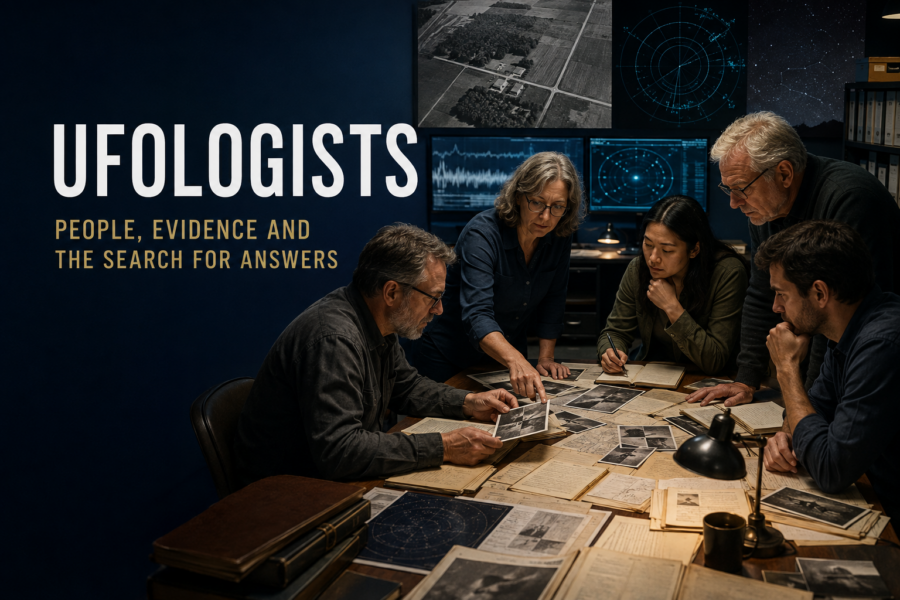
Ufology has no single founder, institution or agreed conclusion. It was built by people who preserved reports, questioned official explanations, interviewed witnesses, searched archives, tested materials—and sometimes disagreed profoundly about what the phenomenon means.
The history of UFO and UAP investigation is inseparable from its investigators. Astronomers brought knowledge of the sky. Pilots and aviation specialists examined flight reports. Journalists recovered documents and testimony. Historians reconstructed government programs. Psychiatrists listened to experiencers. Scientists tested alleged physical evidence. Independent researchers pursued questions that established institutions often avoided.
That diversity is the field’s strength and one of its greatest difficulties. Expertise in one area does not establish expertise in every other area, and a respected résumé does not automatically validate a person’s UAP conclusions. Conversely, institutional distance does not make an investigator wrong. The proper unit of evaluation is the documented claim, not the reputation attached to it.
Three principles for reading this page
- Inclusion is not endorsement. A person may be historically important even when some claims remain disputed or unsupported.
- Contribution and conclusion are different. Preserving testimony or opening records can be valuable even if an investigator’s interpretation is uncertain.
- No authority ends the inquiry. Government, academic, journalistic and independent sources should all be examined critically.
What Makes Someone a Ufologist?
Ufologist is an informal description rather than a protected professional title. It may refer to a scientist who studies a narrow class of anomalous observations, a field investigator who interviews witnesses, an archivist who preserves records, a journalist who develops sources, a historian who reconstructs institutions, or an advocate seeking disclosure or contact.
These roles require different skills. A physicist may assess a propulsion claim without being qualified to interpret trauma. A psychiatrist may study reported experiences without being able to authenticate radar data. A journalist may verify that a source made a statement without proving that the statement is true. A former official may know a compartment of government while lacking access to the whole picture.
For that reason, this page does not rank people from “most credible” to “least credible.” It identifies their principal contribution, the lens they bring and the questions readers should continue asking.
How to Evaluate an Investigator
| Question | Why it matters |
|---|---|
| What is the original source? | A document, raw file or firsthand interview carries different weight from a retelling. |
| Can others inspect it? | Public methods, provenance and data allow independent challenge or confirmation. |
| Is observation separated from interpretation? | A strange event does not by itself identify its cause. |
| Are corrections acknowledged? | Intellectual reliability includes revising conclusions when evidence changes. |
| What incentives are present? | Attention, access, ideology, institutional loyalty and income can influence every side. |
Credentials matter when they are relevant to the question. They are evidence of training—not proof of a particular conclusion. The same standard applies to a military officer, university professor, documentary filmmaker, meditation teacher or independent witness.
Foundational Investigators
Donald Keyhoe: Public Accountability
Donald Keyhoe, a former Marine Corps aviator and author, became one of the most influential early public advocates for serious UFO investigation. Through his writing and leadership of the National Investigations Committee on Aerial Phenomena, he pressed for government transparency and argued that the subject had national and scientific importance. His work helped establish the disclosure-oriented tradition in civilian ufology.
Continuing value: pressure for records, organized reporting and public accountability. Continuing question: whether his extraterrestrial conclusions sometimes advanced beyond what the public evidence could establish.
J. Allen Hynek: From Consultant to Critic
Astronomer J. Allen Hynek served as a scientific consultant to the U.S. Air Force’s UFO investigations, including Project Blue Book. He began from a conventionally skeptical position but became dissatisfied with dismissive explanations and inadequate investigation of stronger cases. His close-encounter classification gave researchers a practical way to describe reports without first deciding their origin.
Project Blue Book recorded 12,618 reports between 1947 and 1969, with 701 listed as unidentified in the Air Force’s published accounting. Those numbers do not prove an extraordinary origin, but the surviving files show why preservation and case-by-case analysis matter.
Continuing value: classification, field investigation and the willingness to revise one’s position. Continuing question: how later popular use of the close-encounter system has blurred Hynek’s original CE1–CE3 categories with nonstandard extensions.
Jacques Vallée: Beyond a Single Hypothesis
Astronomer and computer scientist Jacques Vallée challenged the assumption that UFO reports must be understood only as spacecraft visiting from another planet. He compared modern cases with folklore, religious experience and reports of anomalous events across cultures. His work introduced information, social effects and possible consciousness-related dimensions into the discussion.
Vallée’s extensive papers—field notes, correspondence, case material and research files—have been donated to Rice University’s Archives of the Impossible. The collection itself illustrates an important principle: durable research depends on records that can outlive the researcher.
Continuing value: comparative analysis, archival discipline and resistance to premature explanation. Continuing question: how hypotheses involving control systems, folklore or other dimensions could be translated into falsifiable investigation.
Stanton Friedman: The Nuclear Physicist as Advocate
Nuclear physicist Stanton Friedman became a prominent defender of the extraterrestrial hypothesis and a major researcher of Roswell and alleged government secrecy. He brought technical literacy, energetic public debate and extensive document work to a field often excluded from mainstream discussion.
Continuing value: persistence, archival research and forcing disputed questions into public examination. Continuing question: whether some historical conclusions rely too heavily on contested testimony or disputed documents.
Records, Journalism and Historical Reconstruction
Leslie Kean: Witnesses, Documents and Public Legitimacy
Investigative journalist Leslie Kean helped bring pilot accounts, official records and international government cases to a wider audience. Her work emphasizes credible witnesses and cases with supporting documentation, and it contributed to a shift in major-media treatment of UAP.
Continuing value: careful presentation, source development and attention to official records. Continuing question: how to prevent the credibility of a witness or institution from being transferred automatically to an interpretation.
Linda Moulton Howe: Field Reporting at the Controversial Edge
Journalist and documentary producer Linda Moulton Howe has investigated animal mutilations, alleged government secrecy, experiencer testimony and possible nonhuman intelligence for decades. She has preserved accounts and pursued witnesses whom conventional media often ignored.
Continuing value: sustained field reporting, witness access and preservation of unconventional claims. Continuing question: how anonymous sources, extraordinary allegations and uncertain provenance should be independently verified before becoming conclusions.
Richard Dolan: Secrecy as History
Historian Richard Dolan approaches the UFO subject through government records, national-security structures, political history and patterns of secrecy. His work asks how classification and institutional power shape what the public can know.
Continuing value: historical synthesis and analysis of secrecy as a system. Continuing question: where documentary reconstruction ends and broader inference begins.
Documentation is not the same as confirmation
A genuine government document confirms that an institution created or possessed that document. It does not automatically confirm every allegation quoted within it. Classification may conceal important facts, but missing information is not permission to fill the gap with certainty.
Encounters, Experiencers and Consciousness
John E. Mack: Listening Without Premature Diagnosis
Harvard psychiatrist John E. Mack studied people reporting abduction and encounter experiences. His work did not establish that every account described a literal extraterrestrial event, but it challenged the assumption that unusual testimony could be dismissed through diagnosis alone. He emphasized the transformative, traumatic and worldview-altering character of many reports.
Continuing value: respect for experiencers and attention to psychological and spiritual meaning. Continuing question: how to distinguish a profound human experience from claims about an independently verified external cause.
Steven Greer: Disclosure and Human-Initiated Contact
Physician and disclosure advocate Steven Greer founded projects focused on government and military witnesses, alleged classified programs and human-initiated contact practices commonly called CE5. His work has encouraged witnesses to speak publicly and has connected UAP investigation with meditation, consciousness and nonviolent intentions toward possible nonhuman intelligence.
This is an area where testimony, personal experience and philosophical interpretation often overlap. Meditation can be studied as a human practice, and contact reports can be documented; neither alone identifies the source of an observed event.
Continuing value: witness mobilization, disclosure advocacy and exploration of consciousness-based contact. Continuing question: whether specific program, technology and contact claims can be supported by independently accessible evidence.
Experience and explanation must remain distinct
An experience can be sincere, psychologically consequential and worthy of respect even when its ultimate cause remains uncertain. Neither materialism nor spiritual interpretation should be imposed before the evidence and the experiencer’s own account are carefully understood.
Contemporary Scientific Inquiry
Garry Nolan: Materials, Biology and Better Questions
Stanford professor Garry Nolan is an accomplished biomedical scientist whose established research includes immunology, cancer and advanced analytical methods. His public engagement with UAP has included interest in alleged materials, biological effects and the need for serious scientific attention. His participation is significant because it demonstrates that studying a stigmatized question need not require abandoning laboratory standards.
Continuing value: analytical expertise, scientific legitimacy and willingness to investigate. Continuing question: which UAP-related findings have sufficient provenance, controls and independent replication to support broader conclusions.
Richard Haines: Aviation and Pilot Reports
NASA research scientist and aviation-safety specialist Richard Haines studied pilot observations and reports in which unidentified phenomena appeared to interact with aircraft operations. His work helped frame some UAP events as an aviation-data and safety problem rather than solely a question about extraterrestrial life.
Continuing value: human-factors expertise, aviation context and systematic attention to pilot testimony. Continuing question: how much original sensor information is available to corroborate retrospective reports.
Avi Loeb and Instrument-Led Search
Harvard astrophysicist Avi Loeb’s Galileo Project represents a newer approach: build instruments, collect openly analyzable data and search for unusual objects without depending entirely on inherited case literature. This method does not assume that anomalous objects are extraterrestrial; it tries to improve the observations available for testing competing explanations.
Continuing value: purpose-built instruments, transparent data goals and testable inquiry. Continuing question: whether observations will reveal genuinely anomalous phenomena rather than familiar objects measured under difficult conditions.
Why Ufologists Disagree
Researchers often work from different evidence pools. One may prioritize military sensor cases, another historical documents, another close-encounter testimony and another laboratory materials. Their preferred explanations follow partly from what they study and which uncertainties they consider most important.
They also disagree about institutions. Some see official participation as a path toward better data and legitimacy. Others see national-security agencies as structurally unable to provide full transparency. Both concerns deserve examination. Government sources can provide primary records and technical capabilities while remaining limited by classification, jurisdiction, institutional incentives or error. Independent investigators can ask questions institutions avoid while also lacking access, funding, peer review or accountability.
Productive disagreement identifies the precise point of separation: the authenticity of a document, reliability of a witness, interpretation of sensor behavior, chain of custody of a sample or assumptions behind a hypothesis. Personal attacks and generalized labels reveal far less.
Building a Responsible Taming Gravity Directory
This page is a map, not a complete encyclopedia. Individual profiles should be created only when there is enough material to answer five questions:
- What did this person actually contribute?
- Which claims are directly documented?
- Which conclusions are interpretations or personal testimony?
- What serious criticisms or alternative explanations exist?
- What remains valuable even if some claims are ultimately wrong?
Future profiles may include additional scientists, historians, field investigators, journalists, experiencer researchers, disclosure advocates and rigorous skeptics. The purpose is not to create heroes and villains. It is to preserve the work, expose the reasoning and help readers follow the evidence for themselves.
Return to the top-level investigative framework.
Review the field, its evidence hierarchy and competing explanations.
Examine the reports that investigators attempt to classify and understand.
Follow official records, testimony and institutional accountability.
Frequently Asked Questions
Is ufologist a scientific credential?
No. It is a descriptive term. Evaluate the person’s relevant training, methods, evidence and transparency rather than relying on the label.
Does appearing on this page mean Taming Gravity endorses every claim?
No. Inclusion recognizes influence or a meaningful contribution. Claims must still be evaluated individually.
Should official investigators be trusted more than civilians?
Not automatically. Officials may have access to better data but operate within classification and institutional constraints. Civilians may be more independent but have less access and oversight. Evidence and methods remain decisive.
Can an investigator be valuable and still be wrong?
Yes. A researcher may preserve crucial testimony, locate records or introduce a productive method while drawing conclusions that later prove incomplete.
Why include consciousness-oriented researchers?
Because some encounter reports include altered perception, telepathy or transformative experience. These claims warrant careful psychological, neuroscientific and philosophical study, but their presence does not by itself establish a nonhuman cause.
Selected Resources
People open doors; evidence decides what lies beyond them.
The history of ufology deserves neither a hall of unquestioned heroes nor a catalogue of ridicule. It deserves accurate biography, preserved records, fair criticism and enough intellectual humility to learn from people whose conclusions may differ from our own.