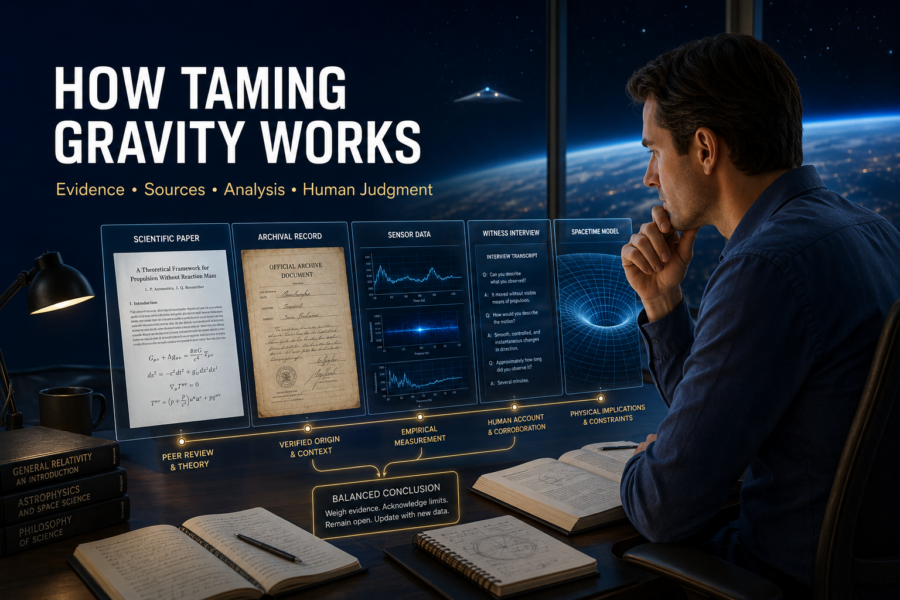
Research, evidence and editorial methodology
How Taming Gravity investigates extraordinary possibilities without turning uncertainty into either belief or dismissal.
Taming Gravity explores subjects that rarely fit inside a single field: gravity science, advanced propulsion, unidentified anomalous phenomena, secrecy, consciousness, extraterrestrial life, ecology and the future of civilization. These subjects combine established knowledge, serious but incomplete research, official records, testimony, disputed interpretations and speculation.
That mixture makes method essential. A compelling claim can be worth investigating without being established. A conventional explanation can be plausible without resolving every case. An official document can prove that an agency recorded or investigated something without proving every conclusion later attached to it.
This page explains how Taming Gravity decides what to examine, how sources and claims are classified, how artificial intelligence assists the work, and what standards a page or post should meet before publication.
The central editorial principle
Represent the evidence at the strength it actually possesses—without lowering the standard because a conclusion is inspiring and without raising it selectively because a conclusion is unconventional.
Three key commitments
- Separate evidence from interpretation: readers should be able to tell what was observed, who reported it, what documentation exists and which conclusions are being proposed.
- Use standards appropriate to the claim: a physics result, historical case, witness account, government record and philosophical argument require different methods of evaluation.
- Keep final judgment human: AI can assist research organization and drafting, but it does not determine the site’s beliefs, verify its own claims or decide what is ready to publish.
Table of Contents
- The Purpose of the Method
- From Question to Publication
- The Evidence Ladder
- How Sources Are Evaluated
- Physics and Engineering Claims
- UAP, Witnesses and Historical Cases
- Secrecy and Institutional Incentives
- Consciousness and Traditional Knowledge
- How AI Is Used
- Curation, Archives and Copyright
- Human Review and Corrections
- How Readers Can Use the Site
- Frequently Asked Questions
The Purpose of the Method
Taming Gravity has a point of view. It was created from a lifelong conviction that reality may be larger than dominant material explanations acknowledge, that some UAP evidence deserves serious investigation and that advanced propulsion could become a civilizational threshold. Pretending the site has no orientation would not make it more objective; it would make its assumptions less visible.
Objectivity here means something more practical:
- Disclose the distinction between the founder’s perspective and publicly established findings.
- Represent competing explanations fairly enough that their advocates would recognize them.
- Apply evidentiary standards consistently, including to claims that support the site’s outlook.
- Acknowledge uncertainty rather than filling evidentiary gaps with confidence.
- Revise conclusions when stronger evidence or better reasoning becomes available.
The goal is not neutrality between every imaginable idea. Unsupported assertions do not deserve equal weight with reproducible results. The goal is proportionality: give each claim the confidence warranted by its evidence, methods, provenance and explanatory power.
Open inquiry is not automatic acceptance. Skeptical examination is not automatic rejection. Both are tools for moving from possibility toward understanding.
From Question to Publication
A Taming Gravity article should move through a visible intellectual process. Not every short news item requires the same depth as a cornerstone guide, but the underlying sequence remains consistent.
Identify what is being claimed and what a reader needs to understand. Avoid building an article around a sensational title whose central terms remain undefined.
Explain the relevant accepted science, known history, official record or documented context before moving into anomalies and interpretations.
Seek primary papers, records and direct statements, then use responsible secondary analysis to supply context and competing views.
Separate measurements, documents, testimony, later recollection, theory, inference and speculation rather than blending them into one narrative.
Examine the strongest conventional and unconventional explanations. Ask what each explains, what it leaves unresolved and what evidence could distinguish them.
Use words such as demonstrated, reported, alleged, proposed, disputed, unresolved and speculative according to the evidence—not for rhetorical effect.
Add internal links to the correct hub, supporting pages and related cases so readers can move both upward and downward through the silo.
Check factual claims, citations, quotations, images, SEO fields, evidence labels and the difference between the site’s analysis and the source’s position.
Publication does not end the process. New records, replications, corrections and better explanations may change an article’s status. Important pages should evolve when the underlying knowledge changes.
The Evidence Ladder
Taming Gravity uses an evidence ladder to prevent unlike forms of information from being treated as if they carry identical weight. The levels are not moral rankings. A witness is not less worthy as a person because testimony differs from instrument data. The ladder describes what a source can establish.
Evidence can move. A preliminary anomaly may gain credibility through replication or disappear after an apparatus problem is found. Testimony can become more significant when contemporary records and independent witnesses emerge. An official claim can weaken if its provenance fails. The classification should follow the developing record.
No stacking weak evidence into false certainty: many repetitions of the same unsourced story do not become independent corroboration. Ten websites repeating one original claim remain one evidentiary source.
How Sources Are Evaluated
A source is evaluated by what it is positioned to know, how directly it connects to the claim and whether its information can be checked. Prestige matters less than relevance, transparency and provenance—although established institutions often provide valuable expertise, methods and archival continuity.
Preferred source order
- Primary scientific and technical material: peer-reviewed papers, data releases, experimental methods, conference proceedings, technical standards and direct research documentation.
- Primary official and historical records: legislation, hearing transcripts, agency reports, authenticated archival documents, court records, patents and contemporaneous correspondence.
- Direct testimony: recorded interviews, sworn statements, first-person accounts and original presentations—with attention to date, context and later changes.
- Responsible secondary analysis: specialist journalism, scholarly histories, scientific explainers and investigators who identify their underlying sources.
- Commentary and community sources: podcasts, independent researchers, YouTube channels, documentaries and advocacy organizations used for perspectives, leads and interviews—not as automatic verification.
A YouTube video can contain valuable primary testimony or an excellent technical explanation. The platform does not determine the evidence quality; the content and sourcing do. A government report can provide authenticated institutional information while still reflecting incomplete data, classification limits or an agency’s interpretation. A scientific paper can be serious yet preliminary, poorly replicated or outside its author’s area of expertise.
Questions applied to important sources
- Is this the original source or a retelling?
- Can the author or institution reasonably know what is claimed?
- Are methods, dates, documents and underlying data available?
- Has the quotation been preserved in context?
- Do independent sources converge without tracing back to the same origin?
- What relevant incentives, restrictions or conflicts should readers know?
- Does the source distinguish what it observed from what it concluded?
- Has later information changed the original account?
Perspective diversity matters. Taming Gravity does not limit external references to military, governmental or conventional institutional sources. Independent scientists, disclosure advocates, experiencers, skeptical analysts and alternative research communities can all contribute—but every source remains responsible for the specific claims it makes.
Physics and Engineering Claims
Gravity and propulsion articles must separate stages that are often collapsed together in popular discussion:
- Mathematical consistency: an equation or spacetime geometry can be described without proving that nature supplies the required conditions.
- Physical possibility: a proposal must be compatible with relevant conservation laws, energy conditions, known interactions and experimentally supported physics—or clearly identify where new physics is proposed.
- Experimental observation: an apparent effect must be measured with controls that address thermal, electromagnetic, mechanical, atmospheric, instrumental and statistical alternatives.
- Independent replication: other investigators must be able to reproduce the effect from sufficiently disclosed methods.
- Engineering feasibility: a real effect must be controllable, scalable, energetically supportable, safe and useful outside the original apparatus.
- Operational technology: performance must be demonstrated under conditions relevant to the claimed application.
A patent establishes that an invention was disclosed and claimed; it does not establish successful performance. A laboratory force does not automatically demonstrate gravity modification. A propulsion concept that works in air may rely on atmospheric momentum exchange and fail in vacuum. A mathematical warp metric is not a vehicle design.
Reproducibility and replicability are central because surprising effects are especially vulnerable to unnoticed apparatus coupling, calibration error, selective analysis and incomplete reporting. An inconsistency can reveal either a mistake or a discovery. Accessible methods and independent verification help determine which.
Respect the experiment; test the interpretation. A measured effect may be real even when its proposed explanation is wrong. Identifying an ordinary mechanism does not make the experiment worthless—it clarifies what was actually discovered.
UAP, Witnesses and Historical Cases
UAP investigation presents a different evidentiary problem. Events may be brief, instruments may be classified, records may be incomplete and witnesses may encounter something without having the information needed to identify it.
Taming Gravity distinguishes:
- Direct sensory observation
- Instrument or sensor records
- Contemporaneous notes and documents
- Firsthand testimony recorded later
- Secondhand accounts
- Researcher reconstruction
- Institutional assessment
- Proposed explanation
- Speculation added through later retelling
A sincere witness account deserves respectful treatment but is not independently verified physical fact. Memory is reconstructive, perception is context-dependent and even trained observers can misidentify unfamiliar events. Those realities do not justify ridiculing witnesses or diagnosing them from a distance.
Cases become stronger when they include independent witnesses, contemporary records, multiple sensor modes, known chain of custody, consistent timing and data capable of excluding common alternatives. Cases remain unresolved when available information cannot discriminate among explanations.
“Unidentified” is not a conclusion about origin. It means the event has not been satisfactorily identified with the available data. Some official cases are resolved as balloons, aircraft, satellites, birds or sensor effects; others remain unresolved because data are inadequate. Neither result should be generalized automatically to every case.
Close-encounter classifications
Historical pages should explain that J. Allen Hynek’s original close-encounter system covered CE1 through CE3. CE4 through CE7 are later, nonstandard extensions used by other writers and communities. They can be documented as part of the subject’s history without being misattributed to Hynek or presented as universally accepted scientific categories.
Claims requiring exceptional care
Allegations involving abduction, injury, death, implants, recovered materials, secret programs, named perpetrators or government interference require careful attribution, privacy awareness and stronger provenance. Contradictions and missing records should be identified without turning uncertainty into ridicule or accusation.
Secrecy and Institutional Incentives
National security can legitimately protect operational capabilities, vulnerable systems, intelligence sources and personnel. It can also restrict scientific review, fragment oversight and prevent the public from evaluating claims made in its name. Both realities can exist simultaneously.
Taming Gravity examines institutional behavior without assuming that every inconsistency proves a single coordinated conspiracy. Relevant incentives may include:
- Protection of classified sensors or collection methods
- Defense and contractor competition
- Bureaucratic reputation and avoidance of embarrassment
- Compartmentalization that prevents participants from seeing the full record
- Political pressure and public-relations concerns
- Commercial incentives surrounding patents, media and access
- Disinformation intended to confuse adversaries—or domestic audiences
- Advocacy incentives that favor dramatic interpretation
An official document establishes that a record exists and that an institution took some action. It may not reveal whether the underlying claim was verified. A denial may be accurate, narrowly worded, compartment-limited or misleading; its meaning must be evaluated through scope and context rather than predetermined trust or distrust.
Scrutiny must run in every direction. Government conclusions, contractor claims, whistleblower testimony, disclosure advocacy and skeptical counterclaims all deserve questions about access, evidence, incentives and uncertainty.
Consciousness and Traditional Knowledge
Consciousness is treated as a legitimate scientific and philosophical frontier, not as an explanation inserted wherever physical evidence is missing. Neuroscience can study relationships between brain activity, cognition and experience. Philosophy examines the nature and implications of subjectivity. Contemplative traditions contribute disciplined first-person practices and long-developed conceptual frameworks.
When modern science and traditional knowledge appear to converge, Taming Gravity asks:
- Are the concepts genuinely comparable or only similar in metaphor?
- Is a traditional description being interpreted accurately in its own context?
- Does the scientific theory actually support the claimed correspondence?
- Can the proposed connection generate a test, prediction or clearer conceptual model?
- Which part is established observation, and which part is philosophical synthesis?
Quantum mechanics does not by itself prove spiritual doctrine, cosmic consciousness or mind-created reality. Traditional insight should not be reduced to modern terminology merely to make it sound scientific. Meaningful dialogue becomes stronger when the differences remain visible.
How AI Is Used
Artificial intelligence assists Taming Gravity with research organization, outlines, comparison of explanations, drafting, editing, formatting, image generation, SEO fields and internal-link planning. It helps turn a large archive and a lifetime of questions into material readers can navigate.
AI is not treated as an authority. It can:
- Invent quotations, citations, names or details
- State uncertainty with misleading confidence
- Repeat errors present in common sources
- Flatten unconventional evidence into conventional assumptions
- Amplify a user’s preferred interpretation without adequate challenge
- Confuse a plausible synthesis with a documented conclusion
For that reason, important factual assertions should be traceable to sources, and the finished page must remain subject to human judgment. The founder supplies the site’s mission, experience, philosophical direction and final publication decision. AI contributes analytical and editorial capacity.
The productive relationship is neither “AI wrote it, therefore it is objective” nor “AI helped, therefore it lacks human authorship.” It is a disclosed collaboration in which the human remains responsible for what is published.
AI publication rule: no fluent sentence receives evidentiary status merely because it sounds informed. Claims must be checked according to their significance, specificity and potential harm.
Curation, Archives and Copyright
Taming Gravity preserves and revisits historical material because today’s debates often lose their documentary context. Archival value does not remove copyright responsibilities.
Curated and archival articles should generally provide:
- Clear identification of the original work, author, publisher and date
- A link to the lawful original or authoritative archive when available
- Limited quotation used for commentary, criticism, scholarship or reporting
- New context, analysis and explanation rather than substitution for the original
- Image rights or provenance appropriate to the use
- Disclosure when an original source is unavailable, incomplete or paywalled
Fair use is case-specific. There is no automatic safe word count or percentage. Purpose, the nature of the source, the portion used and the effect on the market all matter. When uncertainty is substantial, permission, shorter quotation, a bibliographic summary or legal advice may be appropriate.
Historical articles should also separate what was reported at the time from what later evidence or cultural interpretation added. An archive is most useful when it preserves the record without freezing old claims at their original level of certainty.
Human Review and Corrections
Before an important article is scheduled or published, human review should confirm:
- The title describes the content without presenting an unresolved claim as fact.
- The primary category and tags reflect the real subject rather than legacy labels.
- Key quotations and factual claims are traceable to their sources.
- Evidence types and uncertainty are labeled clearly.
- The strongest reasonable competing explanation is represented.
- Images do not falsely depict speculative events as documentary evidence.
- AI-generated or conceptual imagery is described appropriately.
- Internal links connect the article to its hub, parent pages and related supporting material.
- Rank Math information accurately summarizes the page rather than promising more certainty than the content provides.
- Claims involving health, death, criminal behavior, named individuals or dangerous technology receive heightened review.
Corrections should be made when reliable new information reveals a substantive error. Significant updates should ideally state what changed and why. Older material may be preserved for historical value while being labeled, contextualized or linked to a current analysis.
Taming Gravity is built around evolving understanding. Correcting a page is not a failure of the project. Refusing to correct it when the evidence changes would be.
Human review is not ceremonial. It is the point where sources, reasoning, lived perspective, ethical consequences and responsibility for publication come together.
How Readers Can Use the Site
Readers should not have to accept the entire Taming Gravity perspective to benefit from the site. Each major silo provides a different entry point:
Science & Engineering
Begin with established physics and follow the progression through gravity science, metric engineering, experiments and propulsion.
UAP Investigation
Examine official records, historical cases, testimony, disclosure questions and unresolved observations.
Ecology
Consider whether humanity’s social, ethical and ecological maturity can keep pace with transformative capability.
Manifesto
Understand the site’s guiding principles and the larger Species Universe perspective behind the inquiry.
About Taming Gravity
Learn about John J. Zettel’s lifelong investigation and the personal perspective shaping this project.
News & Archive
Follow developing events and revisit historical sources with current context and transparent attribution.
Readers are encouraged to follow links, inspect original sources, identify missing evidence and disagree constructively. A strong inquiry is not one that prevents challenge. It is one that becomes clearer through it.
Frequently Asked Questions
Does Taming Gravity claim that gravity control already exists?
No publicly verified technology has demonstrated controllable gravity shielding, reversal or propulsion. The site examines established gravity science, theoretical proposals, reported experiments and claims of advanced technology while keeping those evidentiary stages distinct.
Is Taming Gravity a skeptical or pro-UAP website?
It is evidence-conscious and open to unconventional explanations. Some UAP reports resolve conventionally; some remain unresolved. The site does not assume that every case is extraordinary or that every unresolved case is extraterrestrial.
Are government and military sources treated as final authorities?
No. They can provide valuable records, sensor information and institutional statements, but they may also be limited by classification, scope and organizational incentives. Independent researchers and alternative sources are included when relevant, with the same attention to provenance and evidence.
Does AI write the website?
AI assists research organization, drafting, editing, formatting, SEO and imagery. John J. Zettel supplies the mission, perspective, accumulated inquiry and final editorial judgment. AI output requires review because it can be incomplete or wrong.
Can an article change after publication?
Yes. Important pages should be updated when reliable new evidence, corrections or better explanations become available. The site treats understanding as an evolving relationship with evidence rather than a fixed collection of conclusions.
Selected References
- National Academies — Reproducibility and Replicability in Science
- AARO — UAP Records and Information Papers
- AARO — Electronic FOIA Reading Room
- U.S. Copyright Office — Fair Use Index
Taming Gravity works by keeping possibility open, evidence visible and conclusions accountable to what the record can support.