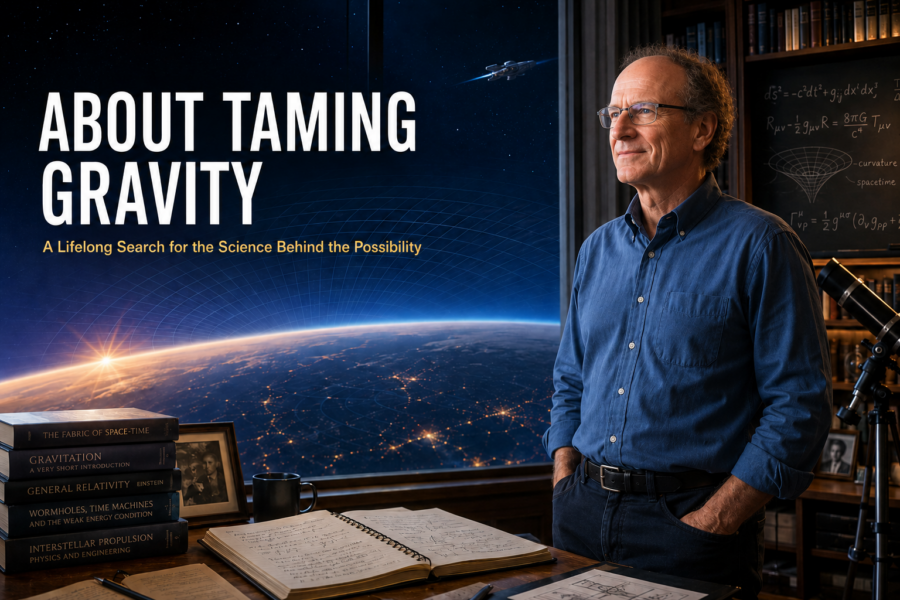
The person, purpose and lifelong inquiry behind this website
Taming Gravity began with a question that has followed me since childhood: if an extraordinary phenomenon is real, what science makes it possible?
My name is John J. Zettel. I created Taming Gravity to investigate the possibility of gravity control, advanced propulsion and unexplained aerospace phenomena without confusing the inspiration of possibility with the discipline of proof.
I am not approaching this subject as someone who became interested after a recent headline. Questions about gravity, consciousness, extraterrestrial life and the deeper structure of reality have shaped my thinking since I was a child. My views have changed considerably during that time. I began by believing almost everything I read. Experience gradually taught me that wonder needs discernment, testimony needs context, theories need tests and even deeply held convictions should remain open to better evidence.
The orientation of Taming Gravity
This site searches for the science instead of the fiction in the possibility of taming gravity. It does not begin by declaring every unconventional claim true—or by declaring the frontier closed before the evidence is examined.
Three things to know about this project
- It is personal: this inquiry grew from a lifelong search to understand gravity, consciousness, unusual phenomena and humanity’s place in the universe.
- It is evidence-conscious: established science, emerging research, official records, testimony, interpretation and speculation are treated as different kinds of information.
- It is future-oriented: the question is not only whether gravity can be engineered, but whether humanity can develop the wisdom to use transformative knowledge responsibly.
Table of Contents
Questions That Began in Childhood
At about ten or eleven years old, I was already reading about reincarnation, near-death experiences and the mysteries of the mind. My father gave me a book on these subjects for Christmas. While other children were discovering ordinary interests, I was wondering what consciousness was, whether it could extend beyond familiar limits and what kind of reality might lie behind extraordinary human experiences.
I experimented with hypnosis with a school friend, fascinated by suggestion and the mind’s apparent ability to alter behavior and performance. I remember the experience as striking, but I do not present a childhood memory as a controlled scientific demonstration. What matters for this story is the question it awakened: if suggestion, perception or consciousness can produce an unusual effect, what mechanism allows it?
That became a recurring pattern in my life. I was interested in what people call esoteric or paranormal, but the fascination was never satisfied by the word mystery. If something actually happens, then it is part of nature. If it is part of nature, it must occur through some lawful relationship—even if our present science does not yet understand that relationship.
The question that stayed with me: What lies beneath an extraordinary report—a genuine but unknown effect, a misunderstood ordinary process, a cultural interpretation, an honest mistake, deliberate deception, or some combination of these?
The Unified Field Question
In sixth grade, I encountered a televised discussion about Einstein’s unfinished search for a unified field theory. The suggestion was that perhaps the answer had resisted discovery because nature required a different conceptual framework—not merely another adjustment to existing ideas.
I remember forming a clear intention: I am going to discover the Unified Field.
That was the confidence of a child, but the underlying question never left me. How do gravity, matter, energy, information and consciousness belong to one reality? Why does our most successful theory of gravity remain unreconciled with the quantum framework used for the other fundamental interactions? NASA’s Physics of the Cosmos program still describes general relativity as enormously successful while widely expected to be incomplete because it lacks a quantum foundation.
In 2011, the double-slit experiment helped quantum mechanics become more intuitive to me. I came to see quantum probabilities and the emergence of definite outcomes as pointing toward a reality less materially self-explanatory than everyday objects make it appear.
My philosophical interpretation is that the physical universe may arise from a level that is not itself an ordinary physical object. This resonates with ideas I encountered through meditation and the Vedic tradition. However, I want to state the distinction carefully: quantum theory does not scientifically prove that the universe comes from metaphysical “nothing,” nor does it by itself prove that consciousness creates physical reality. The quantum vacuum is also not simple nonexistence; it is a physical state described by fields and laws.
The convergence I find meaningful is more modest and more productive: both modern physics and contemplative traditions challenge the naive assumption that ordinary visible objects exhaust the nature of reality. From there, science, philosophy and first-person inquiry may ask related questions while retaining their different methods.
Established science: general relativity and quantum mechanics are extraordinarily successful in their tested domains, but a complete, experimentally established theory of quantum gravity remains absent.
Philosophical interpretation: physical reality may emerge from a deeper order not adequately represented by classical materialism.
Open question: whether consciousness has a fundamental role in nature or emerges from biological organization remains unsettled.
UFOs and the Journey to the Stars
At roughly the same age, news reports and books about UFOs opened another path. I read everything I could find. What captured me was not merely the image of an unusual craft. It was the engineering question behind the report.
If civilizations from other star systems could reach Earth, how would they cross interstellar distances? How might a vehicle accelerate without destroying its occupants? Could it interact with gravity, inertia or spacetime rather than pushing against expelled propellant? What energy source and materials would such a system require?
Those questions connected UFO reports with Einstein’s work. Conventional rockets are remarkable machines, but the scale of interstellar distance makes it reasonable to investigate whether a far older civilization—if one exists and travels—might use principles beyond our present engineering. That is a conditional hypothesis, not a proof that any particular sighting represents extraterrestrial technology.
I have become personally convinced that humanity is not the only technological civilization and that some form of visitation is likely to be real. That conclusion comes from my cumulative reading and interpretation of many decades of reports, testimony, historical records and patterns—not from a single piece of publicly conclusive physical evidence. Readers are not required to begin where I have arrived.
Taming Gravity therefore does not use my conviction as a shortcut. Each case and claim must still be examined on its own evidentiary strength. An unidentified event does not automatically establish an extraterrestrial origin. At the same time, extraterrestrial or otherwise unfamiliar technology should not be excluded solely because it would revise prevailing assumptions.
Learning Discernment
When I first began reading about UFOs, I believed nearly every account. Every light seemed significant; every mystery appeared paranormal. As I grew older—and as practices such as yoga and meditation encouraged greater self-observation—I began noticing how easily excitement can outrun evidence.
The record includes sincere witnesses, careful investigators and genuinely unresolved events. It also includes misidentifications, embellished memories, commercial storytelling, rumors repeated until they appear documented, deliberate hoaxes and government disinformation. Skeptics can overreach, but believers can overreach too.
This did not end my interest. It made the interest more demanding.
I learned to ask:
- What was directly observed, and what was inferred afterward?
- Is there contemporary documentation or only a later recollection?
- Are multiple witnesses genuinely independent?
- What do sensor data show, and what are the instrument’s limitations?
- Does a source have scientific, institutional, political or commercial incentives?
- Has an experiment been replicated under controls capable of excluding ordinary causes?
- Which explanation accounts for the evidence with the fewest unsupported additions?
- What information would allow us to distinguish among competing hypotheses?
Objectivity does not mean pretending I have no perspective. It means disclosing that perspective and refusing to let it decide the evidentiary status of every claim in advance.
Open-mindedness and skepticism are partners. Open-mindedness keeps inquiry from becoming dogma; skepticism keeps possibility from being mistaken for demonstration.
Science Instead of Fiction
The phrase that best defines this website is:
Exploring the science behind the possibility—not the fiction—of gravity control.
Science fiction is valuable. It gives imagination room to explore futures before engineering can build them. But an inspiring story, a plausible diagram, a patent, a mathematical metric, an eyewitness account and a demonstrated device represent different levels of evidence.
Taming Gravity tries to preserve those distinctions:
Findings supported by repeatable measurement, mature theory and sustained scrutiny.
Serious theoretical or experimental work that remains incomplete, preliminary or disputed.
Official records, patents, testimony and historical material whose existence is verifiable but whose interpretation may not be.
A reasoned explanation that must remain distinguishable from the underlying evidence.
A possibility that can inspire questions but cannot serve as proof of itself.
A controllable effect with measured performance, disclosed conditions and independent replication.
This framework applies whether a claim comes from a conventional institution, an independent researcher, a military witness, an experiencer or someone whose conclusions match my own. Authority can guide attention, but it cannot replace evidence. Institutional consensus deserves serious consideration, but it is not infallible. Unconventional claims deserve fair investigation, but being unconventional does not make them courageous truths by default.
Consciousness and Vedic Knowledge
Meditation and exposure to the Vedic tradition have profoundly influenced how I understand consciousness and reality. These traditions do not treat consciousness as an accidental side effect with no significance beyond the individual. They examine awareness directly and describe development toward more integrated states of human experience.
I find meaningful resonances between these traditions and questions raised by modern physics: the contextual nature of observation, the limits of classical description, the relationship between potential and definite outcomes, and the possibility that ordinary appearances do not reveal reality’s deepest structure.
Resonance is not identity, however. A similarity between a traditional teaching and a scientific concept does not prove that ancient language anticipated a modern equation. First-person contemplative knowledge, philosophical reasoning and third-person experimental science provide different forms of inquiry. They can inform one another without being collapsed into a single method.
I remain interested in reported siddhis, extrasensory perception, extraordinary religious experiences and other phenomena associated with saints and contemplative traditions. If such effects occur, calling them paranormal does not explain them. They would require a lawful account of what happened, under what conditions and with what reproducibility. If they do not survive strong investigation, that result also matters.
For me, the larger possibility is that intelligence and consciousness participate in an evolving universe whose living unity humanity has only begun to understand. I call this wider perspective Species Universe. It is a philosophical synthesis guiding inquiry—not a conclusion that every scientific reader must accept.
Conviction, Evidence and Open Inquiry
One of the challenges in writing Taming Gravity is that my personal conclusions sometimes extend beyond what the public evidence can presently demonstrate to everyone else.
I believe extraterrestrial civilizations exist and that some have likely interacted with Earth. I believe reality and consciousness are more extensive than a strictly reductionist worldview allows. I suspect that secrecy, institutional incentives and national-security systems have obscured important information about advanced technology and unexplained phenomena.
These are my views. They should be stated honestly rather than hidden behind false neutrality. But honesty also requires acknowledging their status. Personal conviction may organize a life’s investigation; it does not automatically become public proof.
The site therefore follows a demanding principle:
I can present what I believe, explain why I believe it and investigate evidence that may support or challenge it—but I should not report my conclusion as an established fact when the publicly available record does not yet justify that status.
This is not a retreat from possibility. It is the discipline that may allow people outside the existing “choir” to consider the evidence without feeling that they must first accept an entire worldview.
It also protects the subject. When weak claims are presented with the same certainty as strong ones, failure of the weak claim can discredit everything around it. Clear labels allow serious anomalies and promising research to receive the attention they deserve.
Why I Use AI
My first experiences with artificial intelligence were unimpressive. I saw it as another technology that could produce shallow material faster without necessarily producing understanding. Early AI-generated content often confirmed that concern.
That changed as the tools improved and as I learned how to work with them. I now use AI as a research, organization and writing assistant. It helps me compare explanations, expose missing steps in an argument, find where a claim needs qualification, structure long material and communicate with readers who do not already share my assumptions.
AI does not supply the life behind Taming Gravity. It did not spend decades reading, meditating, questioning, revising beliefs and developing the site’s central perspective. Those are human contributions. AI helps turn that accumulated inquiry into clearer and more accessible writing.
Its use also creates responsibilities:
- AI can generate fluent errors, invented citations and unjustified confidence.
- Its framing can reflect limitations and assumptions in its training and design.
- Output must be reviewed for factual accuracy, fairness, attribution and fit with the site’s purpose.
- Sources should be checked rather than trusted merely because prose sounds authoritative.
- Final editorial responsibility remains human.
I welcome the way AI tempers some of my strongest statements by asking what the evidence can presently carry. At the same time, I do not want it to flatten every unconventional possibility into the safest conventional answer. The productive relationship is a dialogue: my experience, questions and perspective combined with AI’s ability to organize, compare and challenge.
Used this way, AI is not a replacement for thought. It is a tool that can improve inquiry—provided that neither the user nor the system is treated as infallible.
Editorial disclosure: Taming Gravity uses AI to assist with research organization, drafting, editing, formatting and image creation. The website’s mission, personal perspective, topic selection and final publication decisions remain human-directed.
What Taming Gravity Does
Taming Gravity brings several lines of inquiry into one coherent structure:
Science & Engineering
Established gravity physics, unresolved foundations, metric engineering, experimental claims and the path from mathematical possibility to useful propulsion.
UAP Investigation
Official records, sensor observations, testimony, historical cases, disclosure claims and competing explanations examined without predetermined certainty.
Ecology, Ethics & the Future
The environmental, social, political and civilizational consequences that should be considered before transformative technology is deployed.
Manifesto for Species Evolution
The deeper philosophical framework connecting gravity, consciousness, intelligence, extraterrestrial life, artificial intelligence and human development.
The site does not promise that gravity control has been achieved. It asks what is established, what has been observed, what has been claimed, what remains unresolved and what test could move a possibility toward knowledge.
An Invitation to Explore
I have spent most of my life asking questions that do not fit comfortably inside one academic or cultural boundary. What is gravity at its deepest level? Can spacetime become technology? Are some UAP observations evidence of unfamiliar intelligence? What is consciousness? How does an intelligent species mature enough to survive its own capabilities?
I do not claim to possess final answers. I do claim that these questions matter, that available evidence is more interesting than either reflexive dismissal or sensational storytelling suggests, and that humanity needs places where the frontier can be examined responsibly.
Taming Gravity is my contribution to that examination.
Scientists, engineers, witnesses, skeptics, experiencers, philosophers and curious readers are welcome. Agreement is not a condition of participation. What matters is a willingness to distinguish what we know from what we infer, to revise our models when reality requires it and to consider whether growing knowledge can be joined with growing wisdom.
If humanity is approaching a new understanding of gravity—or a larger relationship with intelligence in the universe—the way we approach that threshold may matter as much as what we discover.
Read the Taming Gravity Manifesto →