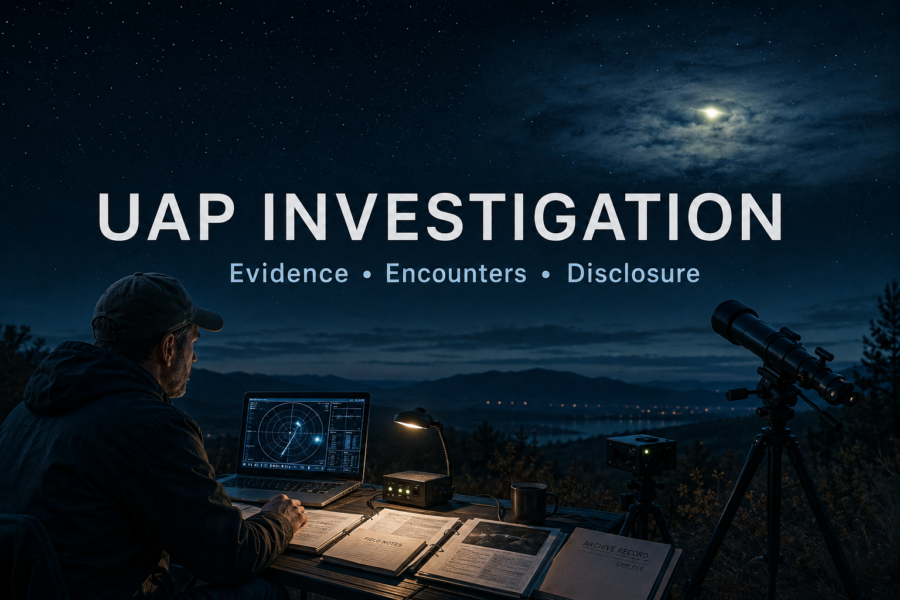
Taming Gravity evidence and inquiry guide
How should we investigate phenomena that are genuinely unresolved—without dismissing testimony, exaggerating evidence or deciding the answer in advance?
Unidentified anomalous phenomena occupy a difficult frontier. Reports may involve unusual observations, military and civilian sensor data, physical-effects claims, government records, whistleblower testimony, close encounters and competing interpretations of what these events might mean. Some cases eventually receive ordinary explanations. Others remain unresolved because the available information is incomplete, inaccessible, contradictory or genuinely puzzling. Taming Gravity approaches this field neither as a campaign for belief nor as an exercise in dismissal, but as a disciplined investigation into what is observed, what is documented, what is inferred and what remains unknown.
Three key takeaways
- Unidentified does not mean extraterrestrial—but neither does it mean unimportant. It identifies a question whose answer has not been established from the information presently available.
- Different evidence supports different levels of confidence. A witness account, a government memorandum, a radar track and a laboratory-tested material sample are all potentially relevant, but they are not interchangeable forms of evidence.
- Good investigation protects uncertainty. It tests conventional and unconventional explanations fairly, records what is missing and resists pressure to manufacture certainty in either direction.
What “UAP” Actually Means
UAP is commonly expanded as unidentified anomalous phenomena. Earlier discussions generally used UFO, meaning unidentified flying object. The newer term is broader. It can include observations reported in the atmosphere, near space, under water or across more than one domain.
The word unidentified describes the status of an observation—not its origin. It does not establish that the phenomenon is extraterrestrial, interdimensional, supernatural, adversarial or technologically revolutionary. It also does not establish that the report is false. It means that an identification has not been reached with adequate confidence from the evidence available to the investigator.
Unknown is a legitimate result
A case can remain unresolved without becoming proof of an extraordinary explanation. “Unknown” may reflect insufficient data, conflicting data, unavailable records or a phenomenon that has not yet been adequately characterized. Preserving that distinction is a strength, not an investigative failure.
Language matters because terminology can smuggle conclusions into the investigation. “Craft,” “vehicle,” “occupants” and “technology” may be reasonable descriptions in a witness’s account, but an investigator should not automatically adopt them as verified facts. Whenever possible, Taming Gravity distinguishes the observation from the interpretation placed upon it.
Why Serious Investigation Matters
Most unusual observations do not require a revolutionary explanation. Aircraft, satellites, balloons, drones, astronomical objects, atmospheric effects, optical artifacts, sensor limitations and errors of perception can all produce surprising reports. Finding an ordinary explanation is useful: it improves identification, protects aviation and teaches investigators how people and instruments respond under difficult conditions.
Yet dismissing every report in advance is no more scientific than treating every report as evidence of visitation. Aviation hazards, foreign surveillance, classified domestic technology, rare atmospheric phenomena, sensor-system failures and previously uncharacterized events are all legitimate reasons to investigate. Even if no extraordinary origin were ever demonstrated, better data collection and analysis would remain valuable.
The deeper question is methodological: Can a stigmatized and politically charged subject be studied without allowing ridicule, authority, secrecy, commercial incentives or personal belief to determine the result?
Serious inquiry is not automatic endorsement
Studying a claim means determining what evidence exists, how it was obtained and which explanations remain viable. It does not require accepting the claimant’s preferred explanation. By the same principle, identifying weaknesses in a case does not justify ridiculing the witness or pretending the underlying experience never occurred.
An Evidence Ladder for UAP Inquiry
Evidence does not arrive in one uniform form. The following ladder is not an inflexible ranking, because the reliability of any item depends on provenance, context and corroboration. It is a practical way to prevent one kind of evidence from silently becoming another.
| Evidence type | What it can establish | Principal limitations |
|---|---|---|
| Contemporary witness account | What a person reports perceiving and experiencing | Perception, memory, viewing conditions, interpretation and missing context |
| Multiple independent witnesses | Possible corroboration of time, location, appearance or behavior | Accounts may not be independent; groups can share assumptions or cues |
| Photograph or video | Recorded appearance and movement within the instrument’s limits | Distance, scale, metadata, compression, optics, manipulation and missing reference points |
| Sensor data | Measurements produced by radar, infrared, acoustic or other systems | Calibration, processing, artifacts, classified capabilities and incomplete data chains |
| Official record | That an agency recorded, discussed, investigated or acted upon a matter | A document can preserve errors, allegations or preliminary assessments; official does not mean infallible |
| Physical trace or material | Potential measurable effects or composition | Chain of custody, contamination, provenance, analytical controls and alternative causes |
| Repeatable instrumented observation | A reproducible phenomenon that can support controlled comparison and model testing | Requires transparent methods, calibrated systems, accessible data and independent confirmation |
Credibility is not proof—but it matters
Training, access, reputation and demonstrated honesty can affect how testimony is weighted. They cannot by themselves verify the interpretation of an event. Conversely, an imperfect witness can still report something real. Investigation should evaluate both the person and the independently recoverable evidence.
The Three Branches of This Silo
UAP & Ufology
Examine observations, cases, sensor records, investigative methods, researchers and competing hypotheses. This branch asks what was seen or detected, what can be independently checked and why some cases resist identification.
Close Encounters & Cases
Study Hynek’s original CE1–CE3 framework, later extensions, historical incidents, physical-effects claims and experiencer testimony. This branch treats human experience respectfully while keeping observation distinct from interpretation.
Disclosure & Secrecy
Investigate official records, secrecy systems, classification, whistleblower claims, public hearings, institutional incentives and disinformation. This branch asks what governments know, what the documentation supports and what remains allegation or inference.
These branches overlap, but they should not collapse into one another. A government document belongs to disclosure research even when it describes an encounter. A witness account belongs to a case record even when the witness proposes a propulsion mechanism. A theoretical model belongs to science or engineering until evidence connects it to an observed event.
Competing Explanations
No single hypothesis explains every report grouped under “UAP.” Different cases may have entirely different causes. A disciplined inquiry therefore evaluates explanations case by case instead of forcing all observations into one universal story.
| Hypothesis family | What it may explain | What must still be demonstrated |
|---|---|---|
| Misidentification or artifact | Aircraft, balloons, satellites, astronomy, optics, software and sensor effects | A match to the timing, geometry, appearance and behavior of the particular case |
| Natural phenomenon | Atmospheric, electrical, plasma, meteorological or astronomical events | A physically adequate mechanism consistent with the complete observation |
| Human technology | Drones, classified systems, electronic warfare, spoofing or foreign surveillance | Technological capability, operational context and case-specific evidence |
| Psychological or sociocultural | Memory effects, expectation, sleep phenomena, social transmission and narrative development | An explanation proportional to the testimony and any independent physical evidence |
| Extraterrestrial technology | Potential visitation by nonhuman civilizations originating beyond Earth | Reliable evidence connecting a phenomenon to a non-Earth origin—not merely unexplained performance |
| Other unconventional models | Interdimensional, ultraterrestrial, consciousness-mediated or other proposed origins | Clear definitions, mechanisms, discriminating predictions and evidence that favors the model over alternatives |
Mystery cannot identify its own cause
Eliminating several familiar explanations does not automatically prove the remaining preferred hypothesis. Investigators must look for evidence that positively discriminates among alternatives—not merely evidence that a case is strange.
Institutions, Secrecy and Disclosure
Governments have legitimate reasons to protect information concerning intelligence sources, sensor capabilities, military operations and national security. Those protections can coexist with institutional self-interest, overclassification, fragmented oversight, bureaucratic error and programs hidden from much of government itself. A serious disclosure inquiry must be capable of examining all of these possibilities.
Official documents are important because they can establish that reports were received, programs existed, officials communicated or resources were directed toward a question. They do not automatically validate every statement recorded within them. A memorandum may contain raw testimony, an untested allegation, a working hypothesis or an assessment later revised.
Whistleblowers can reveal information unavailable through ordinary channels, especially when secrecy prevents public verification. Their testimony deserves accurate presentation and protection from casual character attacks. It also requires corroboration, documentation and clarity about whether the witness is describing firsthand knowledge, secondhand briefings or personal interpretation.
Transparency and skepticism belong together
Public access to records makes competing interpretations testable. Transparency should not be feared because some documents may prove mundane, nor should secrecy be treated as proof that the most extraordinary allegation is true. Both openness and careful evaluation are necessary.
The U.S. National Archives maintains a dedicated UAP Records Collection and continues to add materials received from federal agencies. These records provide primary-source material for historical and institutional research, while their meaning still requires case-by-case analysis.
Close Encounters and Human Experience
Astronomer J. Allen Hynek developed the original Close Encounter categories as a way to organize reports by proximity and reported effects:
- CE1: a close-range observation without reported physical effects or entities.
- CE2: an encounter associated with claimed physical, electromagnetic, physiological or environmental effects.
- CE3: an encounter in which an animate being or “occupant” is reported in association with the phenomenon.
CE4–CE7 are later extensions, and their definitions are not standardized across researchers. Taming Gravity retains these pages because the terms have become part of public and research discourse, but it will identify their later origins and their more speculative evidentiary status.
Experiencer accounts deserve humane treatment. An unusual experience can be psychologically significant regardless of its ultimate cause. Respecting a witness does not require declaring every interpretation physically verified; investigating alternative explanations does not require diagnosing, humiliating or dismissing the person. Cases involving trauma, medical effects, death, alleged abduction or private identity require particular care.
The account and its explanation are different questions
A person may sincerely and accurately describe the experience as remembered while remaining uncertain about its cause. Good case research preserves the testimony, chronology and emotional reality while separately evaluating corroboration and competing interpretations.
The Connection to Gravity and Propulsion
Some UAP reports describe rapid acceleration, abrupt directional changes, unusual hovering, apparent transmedium movement or an absence of familiar propulsion signatures. If measurements eventually established such performance under controlled conditions, the implications for aerospace engineering and fundamental physics could be profound.
At present, however, reported performance is not equivalent to a validated propulsion system. Apparent velocity depends on reliable distance, timing, viewing geometry and sensor interpretation. A video image can appear to accelerate because of camera movement, parallax or processing. A witness can accurately report what appeared extraordinary without possessing the information necessary to calculate physical performance.
The productive connection between UAP study and Taming Gravity is therefore not “UAP prove gravity control.” It is more precise:
- Identify cases with sufficiently reliable data.
- Determine which reported characteristics survive technical analysis.
- Compare those characteristics with known aerodynamics, propulsion and sensor behavior.
- Develop models that generate distinguishing predictions.
- Test those models independently wherever possible.
An observation can motivate physics without proving a mechanism
An anomalous case may inspire questions about inertia, spacetime geometry, plasma, electromagnetic fields or propulsion. The resulting model must still stand on its own mathematics and experimental evidence. Mystery can generate hypotheses; it cannot substitute for testing them.
For the scientific foundations behind those questions, continue to Gravity Science, Metric Engineering and Propulsion & Engineering.
The Taming Gravity Investigative Method
This section evaluates each subject through a repeatable sequence:
1. Preserve the report
Record what was claimed, by whom, when, where and under what conditions without silently rewriting the account.
2. Establish provenance
Trace documents, media, quotations and materials to their earliest recoverable sources and document the chain of custody.
3. Separate layers
Distinguish direct observation, instrument output, testimony, recollection, institutional record, interpretation and speculation.
4. Test alternatives
Steel-man conventional and unconventional explanations, then identify what evidence would distinguish among them.
5. State limitations
Identify unavailable data, contradictions, uncertain assumptions, conflicts of interest and barriers to replication.
6. Calibrate conclusions
Use confidence proportional to the evidence and update the assessment when better information becomes available.
This approach allows Taming Gravity to include perspectives that institutional or military sources may overlook while still applying the same standards of attribution and evidence. A researcher’s independence can reveal neglected questions; institutional access can reveal otherwise unavailable data. Neither outsider status nor official status determines truth.
Understanding must remain capable of evolution
A coherent investigation does not defend a fixed worldview. It preserves useful knowledge, corrects mistakes and allows interpretation to evolve as evidence improves. Openness without standards becomes credulity; standards without openness become dogma.
Explore UAP Investigation
Begin with the branch that best matches your question:
- UAP & Ufology: observations, investigative methods, notable researchers and competing explanations.
- Close Encounters & Cases: Hynek’s classification, later extensions, historical cases and experiencer testimony.
- Disclosure & Secrecy: official records, whistleblower claims, classified systems, disinformation and transparency.
- Science & Engineering: the established physics and developing technologies against which performance claims must be evaluated.
- Taming Gravity Manifesto: the broader principles guiding inquiry, human development and responsible technological evolution.
Frequently Asked Questions
Does UAP mean extraterrestrial spacecraft?
Are eyewitness accounts scientifically useful?
Does an official document prove the claims written in it?
Why examine unconventional researchers and independent media?
How are CE4–CE7 different from CE1–CE3?
Could consciousness play a role in some encounters?
What would constitute a major scientific advance?
Sources and Research Starting Points
No source should be treated as automatically authoritative on every question. These starting points provide different forms of information that should be compared rather than collapsed into a single narrative:
- U.S. National Archives UAP Records Collection — primary government records and historical collections.
- National UFO Reporting Center Databank — a large public collection of civilian reports requiring case-by-case evaluation.
- Scientific Coalition for UAP Studies — civilian scientific analysis and methodological work.
- A Civilian Astronomer’s Guide to UAP Research — strategies for observation and reducing false positives.
- The National Archives of the United Kingdom: UFO Records — historical records and research guidance beyond the United States.
Editorial note
This page separates documented events, witness testimony, official records, scientific analysis, hypothesis and speculation. Its conclusions are intentionally provisional and should evolve when stronger evidence, corrected records or better explanatory models become available.
The unknown does not ask us to abandon reason. It asks us to use reason without closing inquiry prematurely.