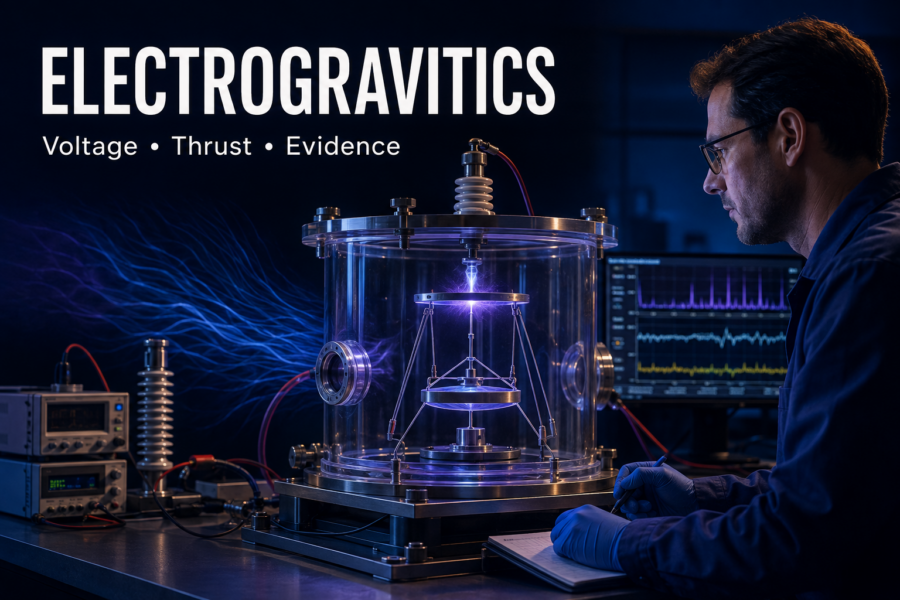
Taming Gravity experimental propulsion guide
High voltage, asymmetric capacitors and the unresolved boundary between ion-driven thrust and proposed gravity effects
Electrogravitics is the historical and experimental investigation of claims that high-voltage electrical systems may interact with gravity, inertia or motion in unconventional ways. Its best-known demonstrations—lightweight asymmetric capacitors that lift through the air—produce a real and measurable effect. The central controversy concerns its cause: established electrohydrodynamic forces explain ordinary “lifters,” while stronger claims of vacuum thrust or gravity coupling have not achieved reliable independent confirmation. This page examines both the demonstrated engineering and the open questions without treating either skepticism or possibility as a substitute for evidence.
Three key takeaways
- High-voltage asymmetric capacitors can produce thrust in air. Corona discharge, ion transport and momentum transfer to neutral gas provide an established electrohydrodynamic explanation for conventional lifters.
- Atmospheric lift is not evidence of antigravity. A genuinely anomalous effect would need to persist in well-characterized high vacuum after electrostatic, electromagnetic, thermal, mechanical and discharge-related forces are excluded.
- The history still deserves careful investigation. Thomas Townsend Brown’s work, aerospace studies, patents, government reports and later testimony form an important research archive—but documentation of interest is not proof of successful gravity propulsion.
Watch: Exploring Electrogravitics
This video introduces the historical claims, experiments and technological possibilities associated with electrogravitics. The written guide below provides updated scientific context and distinguishes demonstrated electrohydrodynamic thrust from proposed gravity-related effects.
Viewing note
Some historical sources and presentations use “electrogravitics,” “antigravity,” “electrokinetics” and “electrohydrodynamics” interchangeably. They do not mean the same thing. A device may move through electrical interaction with surrounding air without altering gravity. Claims about classified aircraft, vacuum thrust or gravity control should be understood as hypotheses unless supported by independently testable evidence.
What Electrogravitics Means
The word electrogravitics was adopted for the proposed production of gravitational or gravity-like effects through electricity. In historical discussions it often refers to high-voltage capacitors, asymmetric electrodes and the work of inventor Thomas Townsend Brown. In broader modern usage it can encompass almost any proposal connecting electric fields with gravity or advanced propulsion.
That broad usage creates confusion because at least three different subjects are involved:
Electrohydrodynamics
Established interactions among electric fields, charged particles and fluids such as air. These interactions can produce thrust without moving mechanical parts.
Electrostatic propulsion claims
Reports of force on high-voltage apparatus that may involve ion transport, interactions with the environment, test fixtures or other ordinary electrical effects.
Electrogravity hypotheses
Proposals that electrical systems directly influence gravitational fields, inertial response or spacetime geometry beyond established electromagnetic mechanisms.
A careful working definition
Electrogravitics is the historical and experimental study of proposed connections among high-voltage electrical systems, gravity and unconventional propulsion. The term identifies a research question; it does not establish that electrical gravity control has been demonstrated.
Thomas Townsend Brown and the Historical Origin
Thomas Townsend Brown began experimenting with high-voltage electrical apparatus during the 1920s. He reported that an electrically charged asymmetric capacitor experienced a force toward its smaller electrode. Brown interpreted the effect as evidence of a coupling between electricity and gravity and later developed devices and patents around what he called electrokinetics or electrogravitics.
The name Biefeld–Brown recognizes both Brown and physicist Paul Alfred Biefeld, under whom Brown studied at Denison University. Historical accounts differ on exactly how much Biefeld participated in the discovery, but the combined name became attached to the observed force.
Brown’s work is important for several reasons:
- It inspired decades of experimentation with asymmetric capacitors.
- It connected high-voltage effects with aerospace and propulsion research.
- It produced patents and a documentary trail that can be evaluated historically.
- It helped establish electrogravitics as a recurring subject in advanced-propulsion and UAP communities.
- It also illustrates how an observed effect and its proposed explanation can become culturally fused before the mechanism is settled.
Brown believed the effect was gravitational and claimed that variants could operate beyond ordinary atmospheric ion wind. Later investigators found that the easily demonstrated force in air is consistent with electrohydrodynamic processes. Whether any smaller residual anomaly remains under carefully controlled conditions is the scientifically relevant question.
Respect the experiment; test the interpretation
Brown did not merely imagine that a device moved—high-voltage asymmetric capacitors do produce observable thrust in air. The dispute concerns why they move and whether the effect survives when the surrounding medium and other conventional interactions are removed.
The Biefeld–Brown Effect
A typical lifter uses a thin wire or sharp electrode separated from a larger, smoother electrode by a lightweight insulating frame. A high voltage creates a highly nonuniform electric field. Near the smaller electrode, the field can ionize nearby gas molecules. Charged particles accelerate toward the opposite electrode and collide with neutral molecules along the way.
The apparatus experiences a force, generally directed toward the smaller electrode. Because the construction can be extremely light, the force may be enough to lift the entire frame.
What is directly observed?
- High voltage is applied to asymmetric electrodes.
- Corona discharge and ionization can occur near the smaller electrode.
- Air or another gas is set into motion.
- The apparatus experiences thrust.
- Performance depends on voltage, polarity, electrode geometry, spacing, pressure and gas properties.
What is inferred?
The commonly accepted interpretation is that charge transport and collisions transfer momentum to the surrounding neutral gas. The resulting electrohydrodynamic flow produces an opposite force on the electrodes. Brown’s interpretation instead attributed at least part of the force to an electrical interaction with gravity.
| Evidence | What it establishes | What it does not establish |
|---|---|---|
| A lifter rises in air | The energized apparatus produces sufficient net force | That gravity changed |
| Airflow is measured | Electrohydrodynamic momentum transfer is present | That it accounts for every reported force in every configuration |
| A patent describes electrogravity | The inventor claimed and legally described the concept | That the gravitational mechanism works |
| A force is reported at reduced pressure | A result requiring evaluation of pressure, discharge regime and apparatus coupling | That thrust persists in true high vacuum |
| A force survives rigorous high vacuum and controls | Potential evidence of an additional mechanism | Its cause until competing interactions are excluded and replication occurs |
Ion Wind and Electrohydrodynamic Propulsion
Electrohydrodynamic propulsion is real engineering. Charged particles transfer momentum to neutral gas, creating airflow and thrust without combustion or mechanically rotating propellers. Researchers have studied the technology for silent aircraft, pumps, cooling and flow control.
“Ion wind” is useful shorthand—but not the entire model
The expression can suggest a simple stream of ions flying ballistically from one electrode to another. In practice, ionization, drift, collisions, space charge, electric-field gradients and neutral-fluid flow interact. Some early estimates understated measured thrust because their models did not capture all charge-transport and plasma behavior.
This matters because showing that a simplistic ion-wind estimate is too small does not automatically establish antigravity. A more complete electrohydrodynamic model may account for the force through ordinary momentum exchange.
Why electrohydrodynamic flight is not space propulsion
An atmospheric thruster relies on surrounding gas as its working medium. As pressure falls, the available molecules, collision rates and discharge behavior change. A device optimized for air cannot be assumed to produce the same thrust in space.
A valuable technology does not need to be antigravity
Solid-state ionic propulsion could still be useful for specialized aircraft, cooling and fluid control. Explaining a lifter through known physics does not make the experiment unimportant; it identifies what the technology actually does and where it can realistically develop.
What Vacuum Tests Tell Us
Vacuum testing is essential because it reduces the surrounding gas that enables ordinary electrohydrodynamic thrust. Yet “vacuum” is not a single condition. Low pressure passes through different discharge regimes, and residual gas, outgassing and electrical breakdown can still produce forces.
Pressure must be reported precisely
A chamber described casually as evacuated may still contain enough gas for ionization, plasma formation or molecular momentum transfer. The applied voltage may also be limited by the changing breakdown behavior of the gas. Meaningful reports specify pressure, gas composition, voltage, current, discharge behavior, geometry and time history.
Null results matter
Detailed investigations of Brown-style electrode configurations have reported no detectable static thrust in high vacuum, although forces associated with electrical breakdowns or other transient events may occur. NASA’s 2004 technical report on asymmetric-capacitor thrusters likewise discussed testing and the difficulty of distinguishing the proposed effect from established interactions.
A null result does not prove that every conceivable electrical-gravity coupling is impossible. It does constrain the particular configuration, voltage, pressure and sensitivity tested. Repeated null results under increasingly sensitive conditions make strong claims about those configurations less plausible.
Positive reports require replication
Some experimenters report residual thrust under reduced pressure or high-vacuum conditions. Such results deserve careful examination, but they become persuasive only when independent laboratories reproduce the magnitude, direction, scaling and control behavior using apparatus designed to eliminate environmental coupling.
“It moved in a vacuum” is not enough
The experiment must show how well the vacuum was characterized, whether electrical discharge occurred, how power reached the device, how force was measured, what controls were used and whether the result followed a prediction that distinguishes gravity coupling from ordinary forces.
Forces That Can Imitate Anomalous Thrust
High-voltage force measurements are unusually difficult because the apparatus can interact with almost everything around it. A trustworthy experiment must measure or suppress multiple pathways simultaneously.
| Possible cause | How it creates apparent thrust | Useful control |
|---|---|---|
| Corona and ion flow | Charged particles transfer momentum to gas | Pressure series, airflow measurement, sealed and high-vacuum tests |
| Electrostatic attraction | The apparatus interacts with chamber walls, ground planes, wiring or nearby objects | Symmetric shielding, distance tests, orientation reversal and field mapping |
| Cable forces | High-voltage leads stiffen, move, heat or couple electromagnetically | Multiple feed designs, battery operation where possible, dummy loads |
| Thermal effects | Heating changes dimensions, center of mass, gas flow or support tension | Thermal monitoring, delayed-response analysis and matched controls |
| Outgassing | Heated or electrically stressed materials eject molecules | Material conditioning, residual-gas monitoring and long-duration vacuum operation |
| Magnetic interaction | Currents interact with Earth’s field, chamber materials or test equipment | Current-path reversal, nonmagnetic construction and magnetic-field monitoring |
| Vibration and acoustic coupling | Power supplies, pumps or discharge pulses move the balance | Isolation, remote equipment, frequency analysis and powered dummy systems |
| Electrical breakdown | Arcs or plasma events produce impulse and contamination | Fast current monitoring, event exclusion rules defined in advance |
An unexplained residual is a beginning, not a conclusion
If a measured force remains after known effects are addressed, the accurate statement is that a residual requires further investigation. Calling it gravity, inertia modification or reactionless thrust requires additional mechanism-specific evidence.
Aerospace, Government and B-2 Claims
Electrogravitics attracted attention during the postwar period when aerospace organizations were exploring many unconventional routes to high-speed flight. Historical reports, patents, conferences and company studies show that gravity control and electrostatic propulsion were discussed seriously enough to receive institutional attention.
That history supports the conclusion that researchers and organizations investigated the subject. It does not establish that they produced operational antigravity technology.
The B-2 bomber allegation
A recurring claim proposes that the B-2 uses electrostatic charging or electrogravitic effects to reduce drag, apparent weight or radar signature. Publicly documented explanations of the aircraft emphasize aerodynamic shaping, materials, controls and conventional jet propulsion. Claims of an additional electrogravitic system remain unverified.
A responsible historical treatment should identify:
- The original person or document making the claim
- Whether the source had direct access to the relevant system
- What observable performance requires an unconventional explanation
- Whether proposed electrical hardware is independently documented
- Whether ordinary aerodynamic, plasma or electromagnetic technologies could explain the description
Classification as possibility—not proof
Classified aerospace programs undoubtedly withhold technical information. That makes some uncertainty unavoidable. It does not allow every missing detail to be filled with the most extraordinary interpretation. Classification can explain why evidence is unavailable; it cannot itself serve as evidence that a particular technology exists.
Historical seriousness and technological success are different claims
Contracts, patents, reports and named programs can prove that people investigated electrogravitics. Only performance data, hardware, reproducible testing or exceptionally strong documentation can establish that the research succeeded.
Could Electricity Couple to Gravity?
Gravity and electromagnetism are both established parts of physics, and electromagnetic energy contributes to stress-energy in general relativity. In that broad sense, electromagnetic fields influence spacetime. The predicted gravitational effect of laboratory-scale electromagnetic energy is extraordinarily small.
The frontier question is whether unusual configurations, quantum states, superconductors, rapidly changing fields or unknown interactions could produce an enhancement beyond ordinary expectations.
What established theory predicts
- Electromagnetic energy gravitates as part of total stress-energy.
- Strong electric fields exert ordinary forces on charges, dielectrics and conductors.
- Moving charge creates magnetic fields and can transfer momentum through fields and radiation.
- None of these facts predicts substantial gravity shielding from an asymmetric capacitor.
Superconductors and gravitomagnetism
Ning Li and others explored theoretical relationships involving coherent matter, rotation and gravitomagnetic effects. This is related to the broader search for gravity engineering but is not identical to the Biefeld–Brown effect. Combining them under one label can make separate hypotheses appear mutually confirming when each requires its own evidence.
Metric engineering
Some theorists propose that electromagnetic structures or metamaterials could influence effective spacetime properties. These ideas belong within Metric Engineering. At present, no experimentally verified bridge connects ordinary lifter thrust to propulsion-strength spacetime manipulation.
Known coupling is not useful control
Electromagnetic energy contributes to gravity, but the expected effect at laboratory energy densities is minuscule. A useful electrogravity technology would require either enormous energy, an amplification mechanism, new physics—or some combination that produces clear testable predictions.
Electrogravitics and UAP Propulsion
Electrogravitics appears frequently in attempts to explain UAP reports because some observations describe hovering, rapid acceleration, unusual luminosity or the absence of visible exhaust. Historical testimony also connects high-voltage systems, gravity-control research and classified aerospace programs.
These connections are worth documenting, but several evidentiary steps remain:
- Establish that the observed object and trajectory are accurately characterized.
- Determine whether conventional aerodynamic, plasma, optical or sensor explanations fit the data.
- Identify a distinctive prediction of electrogravitic propulsion.
- Find corresponding electrical, electromagnetic, gravitational or environmental signatures.
- Separate the propulsion hypothesis from claims about the object’s origin.
Testimony from pilots, engineers, intelligence personnel and other witnesses may preserve important information. It should be attributed accurately and compared with records, physical evidence and independent accounts. Sincerity and professional background strengthen context but do not automatically verify the proposed mechanism.
For one example of the relationship among testimony, energy claims and unconventional propulsion, see Paul LaViolette: Electrogravitics & UFO Propulsion. Its technological conclusions should remain proportional to the evidence available.
Unusual motion does not identify the engine
Even a well-documented anomalous trajectory would establish performance before mechanism. Electrogravitics, metric engineering, plasma effects, advanced aerodynamics and sensor interpretation remain different hypotheses until discriminating evidence is found.
What Would Establish a Genuine Anomaly?
The decisive experiment would not begin by trying to lift a dramatic vehicle. It would define a small predicted effect and test it with enough precision to exclude ordinary interactions.
- Specify the claim. Is the predicted result thrust, weight change, acceleration, local gravitational variation or inertial response?
- Predict scaling. State how the effect changes with voltage, current, polarity, geometry, pressure, frequency and orientation.
- Characterize pressure and discharge. Record residual gas, current spikes, light emission and plasma behavior.
- Calibrate the balance. Apply known forces before and after every run.
- Control external fields. Map electrostatic and magnetic interactions with the chamber, ground and support structure.
- Use null hardware. Operate symmetric electrodes, dummy loads and reversed configurations.
- Blind the analysis. Conceal active and control runs when practical.
- Publish raw data and apparatus details. Allow critics and supporters to test the same result.
- Replicate independently. Use different laboratories, balances and power systems.
- Test mechanism-specific signatures. A gravity claim should correlate with gravitational predictions—not only unexplained force.
What success would look like
A reproducible force that persists in high vacuum, follows a predeclared scaling law, remains after known couplings are excluded and appears across independent apparatus would be scientifically important. Demonstrating that the force is gravitational would require additional evidence, such as effects on separate test masses or local gravitational measurements.
Practical Value and Future Research
Electrogravitics contains two futures that should not be confused.
Electrohydrodynamic engineering
Ion-driven systems may advance quiet flight, flow control, cooling and pumps. Their dependence on a surrounding medium and high voltage limits some applications, but they are real technologies that can improve through materials, electrode design, power electronics and efficiency research.
Fundamental-force investigation
Precision experiments can continue searching for unexpected coupling among electromagnetic systems, inertia and gravity. The probability of finding a large hidden effect may be low under present theory, but well-designed null tests refine limits and protect the field from repeating ambiguous demonstrations.
There is also value in preserving historical records. Electrogravitics sits at the intersection of legitimate research, military secrecy, entrepreneurial optimism, UFO interpretation and popular mythology. Understanding how those strands developed helps modern investigators recognize both overlooked possibilities and recurring evidentiary errors.
Open-mindedness and constraint belong together
A frontier remains open because evidence is incomplete—not because every explanation is equally supported. The most constructive research welcomes unconventional possibilities while designing experiments strong enough to disprove favored interpretations.
Explore Related Taming Gravity Research
Science & Engineering
The broader framework connecting gravity science, experimental evidence and propulsion engineering.
Visit the main hub →
Propulsion & Engineering
From flight-proven propulsion to disputed anomalies and spacetime engineering concepts.
Explore propulsion →
Metric Engineering
Whether spacetime geometry could progress from mathematical description to controllable technology.
Explore metric engineering →
Gravity-Control Research History
The programs, terminology and institutional interest surrounding twentieth-century gravity-control research.
Explore the archive →
Frequently Asked Questions
Is electrogravitics the same as antigravity?
No. Electrogravitics is a historical label for proposed electrical interactions with gravity or unconventional propulsion. Ordinary lifter demonstrations are generally explained through electrohydrodynamic thrust, not cancellation or reversal of gravity.
What is the Biefeld–Brown effect?
It is the force observed on a high-voltage asymmetric capacitor, generally directed toward its smaller electrode. In air, corona discharge, ion transport and momentum transfer to neutral gas provide a well-supported explanation.
Do lifters work in space?
Ordinary ion-wind lifters require a surrounding gas and therefore do not function the same way in space. Claims of residual high-vacuum thrust require rigorous independent confirmation and careful exclusion of discharge, outgassing and apparatus coupling.
Did Thomas Townsend Brown discover gravity control?
Brown discovered or developed important high-voltage asymmetric-capacitor effects and interpreted them as electrogravity. Public evidence does not establish that he demonstrated controllable gravity modification independent of electrohydrodynamic and other conventional forces.
Does a patent prove an electrogravitic device works?
No. A patent documents and legally protects a claimed invention under applicable standards. It is valuable historical evidence of what was proposed, but independent performance testing is required to establish that the claimed mechanism works.
Does the B-2 bomber use electrogravitics?
No publicly verifiable evidence establishes that the B-2 uses gravity-control propulsion. Claims involving electrostatic or plasma systems should be attributed as allegations and distinguished from its documented aerodynamic, stealth and jet-propulsion technologies.
Could classified programs have made greater progress?
Classified research may contain unavailable information, but secrecy cannot verify a specific technical claim. Conclusions should remain limited to evidence that can be documented, corroborated or tested.
What evidence would support a real electrogravity effect?
A reproducible signal in high vacuum, independent of electrostatic, electromagnetic, thermal, mechanical and discharge forces, followed by mechanism-specific gravitational measurements and replication by unrelated laboratories.
Selected References
- Francis X. Canning, Cory Melcher and Edwin Winet — “Asymmetrical Capacitors for Propulsion,” NASA Technical Reports Server
- Thomas B. Bahder and Chris Fazi — “Force on an Asymmetric Capacitor,” U.S. Army Research Laboratory
- Martin Tajmar — “Biefeld–Brown Effect: Misinterpretation of Corona Wind Phenomena,” AIAA Journal
- Reuven Ianconescu, Daniela Sohar and Moshe Mudrik — “An Analysis of the Brown–Biefeld Effect”
- Electroaerodynamic Thruster Performance as a Function of Altitude, AIAA Journal
- Analysis of the Efficiency of Electrohydrodynamic Propulsion Systems
Editorial note
This page distinguishes demonstrated electrohydrodynamic thrust, historical electrogravitic claims, disputed vacuum results, aerospace allegations, UAP interpretations and proposed gravity coupling. Conclusions should be updated when stronger experiments, primary records or independent replications become available.