
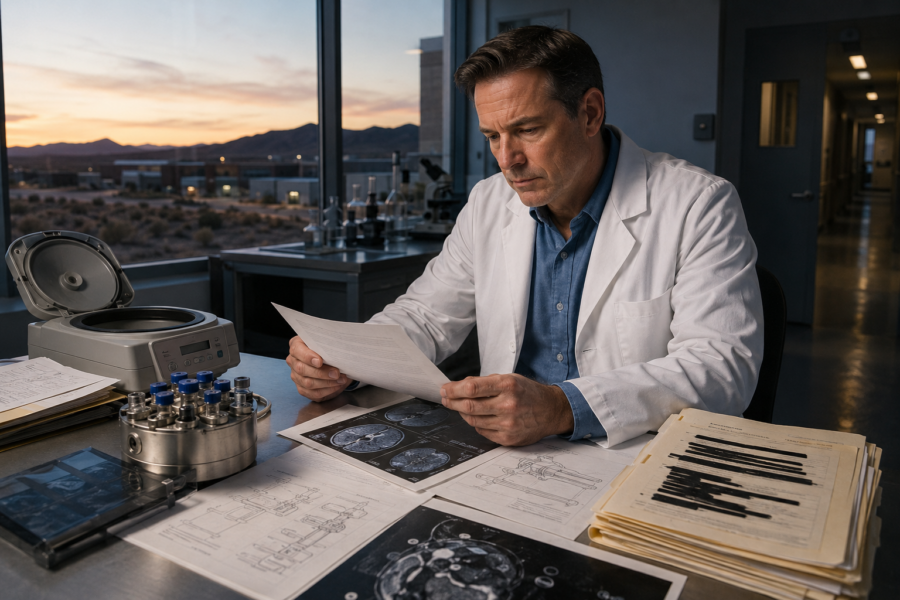
Emery Smith is a former military medical specialist, inventor, media personality, and self-described whistleblower who says he participated in deeply classified programs involving unusual biological specimens and advanced technologies.
His public record presents an unusual mixture. Some parts of his professional background—including medical-device patents and participation in published scientific research—can be independently documented. His most extraordinary claims, however, remain supported primarily by his testimony and by people already associated with UFO-disclosure advocacy.
A fair assessment therefore requires separating three distinct questions:
- Does Smith have a genuine military and medical background?
- Does independent evidence support his work in biotechnology and regenerative medicine?
- Does any public evidence verify his claims about extraterrestrial specimens, underground facilities, or suppressed technologies?
The answers are not the same in all three areas.
Emery Smith’s Background
Smith and his media profiles describe him as a former United States Air Force surgical technologist and surgical first assistant. According to Gaia’s biography, he entered active duty in 1990, trained at Lackland Air Force Base, and later served at other installations, including Kirtland Air Force Base in New Mexico.
Smith says that while performing conventional medical duties, he was recruited for additional work connected with Sandia and Los Alamos national laboratories. In his account, he initially believed the assignment involved organ harvesting or ordinary biological research. He later concluded that he was handling tissue from beings of unknown—and possibly nonhuman—origin.
One geographical detail is independently correct: Sandia National Laboratories’ main New Mexico campus is located primarily on Kirtland Air Force Base. That makes interaction between military personnel, contractors, and laboratory operations plausible in general. It does not, however, verify that Smith participated in a classified biological program. Sandia National Laboratories confirms the location but provides no public confirmation of Smith’s alleged assignment.
Smith subsequently entered the medical-device and regenerative-medicine field. He has appeared extensively on Gaia’s Cosmic Disclosure and related programs, first as a witness and later as a host.
Emery Smith’s Principal Claims
Smith’s major claims include the following:
- He processed or examined thousands of biological tissue samples in secure underground facilities.
- Some samples came from complete or partial humanoid bodies of unknown origin.
- He encountered living nonhuman or human-looking beings associated with classified programs.
- Secret programs possess advanced genetic, regenerative, energy, and propulsion technologies.
- Some technologies attributed to these programs could eventually transform medicine, transportation, and energy production.
- He was subjected to intimidation or surveillance because of what he knew.
These are properly classified as testimonial claims. Smith has described them repeatedly in interviews, but repetition does not constitute independent confirmation.
It is also important to represent his tissue-work claim accurately. He has not always described thousands of full autopsies. In some accounts, many assignments involved processing small pieces of tissue. That distinction makes the claimed workload less obviously impossible, but it does not establish the specimens’ origin.
Supporting Documentation
Medical-device patents
The strongest independent evidence supporting Smith’s conventional professional background is found in the patent record.
The United States patent database identifies an Emery Smith, together with Patrick Pennie and David Buzenius, as an inventor of a centrifuge-tube assembly designed to separate platelet-rich plasma and other biological components. The application was filed in 2002 and became U.S. Patent 6,835,353.
Additional records identify Smith as a co-inventor of:
- U.S. Patent 7,976,796, covering a centrifuge tube for separating and aspirating biological components.
- U.S. Patent Application 2009/0062741, describing a dual-lumen syringe.
These records substantiate meaningful involvement in medical-device development. They do not substantiate extraterrestrial research, zero-point energy, or classified technology.
Smith’s website describes these as “FDA-approved patents,” but this terminology is technically incorrect. The U.S. Patent and Trademark Office grants patents; the FDA clears or approves medical products for specified uses.
FDA records do show that Perfusion Partners & Associates—an assignee associated with Smith’s earlier patent work—received 510(k) clearance for the Secquire Cell Separator. The FDA page lists “E.J. Smith” as its applicant contact. Later, EmCyte Corporation received additional clearances for platelet and bone-marrow concentrating systems, including the PurePRP system.
This evidence supports a legitimate history in blood-component separation and regenerative medical devices. A 510(k) clearance means that a device was found substantially equivalent to an existing legally marketed device. It is not confirmation of sweeping therapeutic claims.
Published scientific work
Smith is also a named co-author of a 2018 peer-reviewed Genome Research paper concerning the small Atacama skeleton known as “Ata.” The paper’s author statement says Smith photographed the specimen, performed MRI, CT, and X-ray work, and surgically removed a rib sample for DNA analysis. The published study concluded that Ata was human and of Chilean ancestry—not extraterrestrial.
This provides independent evidence that Smith possessed practical experience with medical imaging, specimen handling, and surgical sampling. It does not demonstrate that he previously examined nonhuman bodies.
The Ata research also generated criticism. A team of bioarchaeologists and medical specialists questioned its interpretations and raised concerns about consent, provenance, and the ethical treatment of human remains. Their peer-reviewed response argued that several supposedly anomalous characteristics could be explained by normal fetal development and postmortem changes.
Military and classified-program documentation
Smith’s Air Force service is asserted by Smith, Gaia, and other biographical sources. However, no publicly accessible DD Form 214, official personnel record, Air Force occupational history, or independent government confirmation was located for this review.
That does not prove that he did not serve. Military personnel records are not necessarily public, and classified assignments would predictably leave little accessible documentation. Nevertheless, secrecy cannot itself function as evidence. As matters presently stand, his general military background is publicly asserted but not independently documented to the same degree as his patents and scientific participation.
No publicly available document was found confirming that Smith worked as a Sandia or Los Alamos contractor, possessed the claimed security clearances, or handled materials identified as extraterrestrial.
Expert Opinions, Including Dr. Steven Greer
Dr. Steven Greer has had a long professional association with Smith. Smith participated in Sirius, Greer’s 2013 disclosure documentary, and performed the specimen procedure that supplied material for the Ata genetic analysis. The 2018 scientific paper acknowledges Greer and the Sirius team for bringing Stanford researcher Garry Nolan into the investigation.
These collaborations demonstrate that Greer considered Smith sufficiently capable or trustworthy to participate in a sensitive investigation. I did not locate, however, a formal public statement in which Greer presents independently checked military records or declares that he has verified every part of Smith’s account.
Greer has made related claims of his own. In a 2025 interview, he said he had personally seen technology at an underground laboratory near El Paso that could regrow a limb and repair a severed spinal cord. The statement appears in the published American Alchemy interview transcript.
Greer’s statement is relevant testimony, but it is not presently supported by publicly available clinical data, independently examined equipment, named patients, regulatory documentation, or reproducible demonstrations. The National Institutes of Health states that humans cannot presently regenerate complete limbs, while the FDA warns that many marketed regenerative treatments have not been demonstrated to be safe and effective. NIH overview and FDA consumer guidance.
A reader may reasonably give Greer’s judgment personal weight because of his medical training, disclosure work, or connection with Transcendental Meditation. Shared experience in a respected contemplative tradition can contribute to personal trust. Scientifically, however, trust and testimony remain different from independently reproducible evidence.
Analysis of Credibility
Smith should not be dismissed as someone with no documented technical background. His patent history and participation in the Ata investigation establish real experience with medical devices, biological separation systems, imaging, and specimen collection.
The evidence can be summarized as follows:
Well documented
- Co-inventor status on medical-device patents.
- Professional involvement with blood and biological-component separation.
- Participation in the Ata specimen investigation.
- Work as a UFO-media presenter and collaborator with Greer.
Plausible but incompletely documented
- Air Force service and surgical-technologist training.
- Conventional work at or around Kirtland Air Force Base.
- Contract work involving Sandia or Los Alamos.
Unverified
- Handling extraterrestrial or nonhuman biological specimens.
- Encounters with living nonhuman beings.
- Access to deeply classified underground biological programs.
- Knowledge of technologies capable of regrowing human limbs or completely repairing severed spinal cords.
- Claims involving suppressed propulsion or energy systems.
Smith’s documented biomedical experience makes him more professionally grounded than a witness with no relevant background. But expertise in one area does not automatically verify extraordinary claims in another.
The most defensible conclusion is therefore neither that Smith has been proven truthful nor that every part of his history has been fabricated. Public evidence supports portions of his conventional career while leaving the central UFO allegations unconfirmed.
Conclusion
Emery Smith presents a genuine evidentiary puzzle. Patent records and peer-reviewed publication history demonstrate credible involvement in medical-device development and specimen-related research. Those facts deserve acknowledgment.
At the same time, no public evidence currently bridges the gap between that documented career and his most extraordinary assertions. Greer’s collaboration and apparent confidence provide supporting testimony, but not independent verification. The claims about nonhuman remains, underground programs, and revolutionary medical technologies should therefore remain classified as unresolved allegations.
The most objective position is to keep the question open while applying a consistent standard: military records, employment confirmation, contemporaneous documents, named corroborating witnesses, independently testable materials, or reproducible demonstrations would materially strengthen Smith’s case.














Leave a Reply