
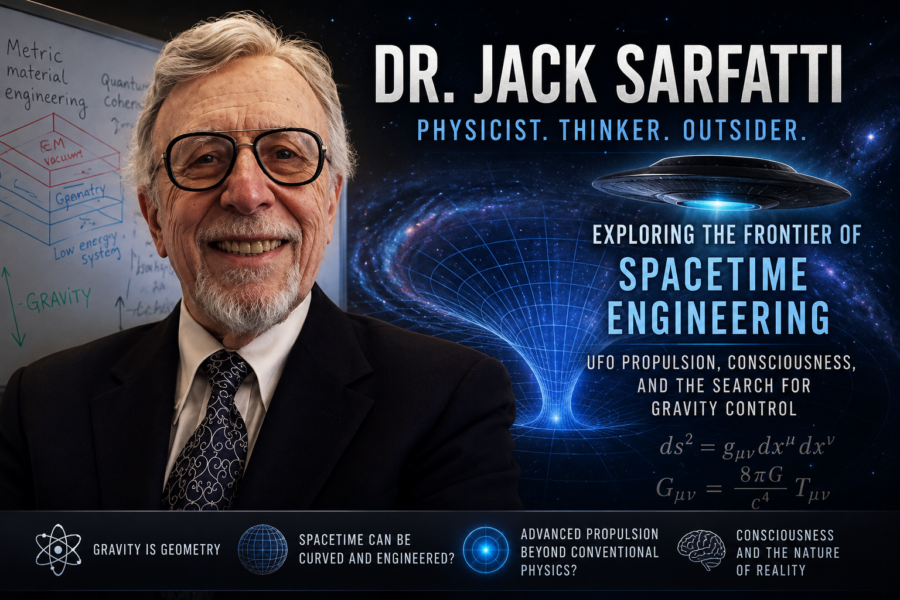
Editor’s Note: This article is a curated analysis of The Why Files episode on Dr. Jack Sarfatti. The purpose is not to endorse any specific claim, but to explore the scientific, historical, and philosophical questions raised by the episode while carefully distinguishing established physics from theoretical and speculative ideas.
Watch the Video
Why This Video Matters
Few figures in modern physics occupy a more unusual position than Dr. Jack Sarfatti.
For more than half a century, Sarfatti has explored questions that many physicists consider too controversial, too speculative, or simply too difficult to investigate. These include the possibility of gravity engineering, advanced propulsion systems, consciousness-related interpretations of quantum mechanics, and whether unidentified aerial phenomena (UAPs) might represent technologies operating beyond conventional aerospace principles.
The Why Files episode presents Sarfatti’s remarkable story through its trademark combination of humor, storytelling, and investigative research. It examines his unusual childhood experiences, his connections to government-funded consciousness research, his work with physicists and researchers studying psychic phenomena, and his proposals for how advanced craft might manipulate spacetime itself.
Whether viewers ultimately agree with Sarfatti’s conclusions is almost beside the point. The episode raises a deeper question:
If some UAP observations are accurately reported, what kind of physics would be required to explain them?
That question lies directly at the heart of TamingGravity.com’s mission.
The Physics Behind the Discussion
Before discussing UFOs, consciousness, or government programs, it is important to begin with established science.
Established Physics
According to Einstein’s theory of General Relativity, gravity is not a force in the traditional sense. Instead, mass and energy curve spacetime, and objects move along those curved geometries.
This idea has been experimentally verified countless times through:
- Gravitational lensing
- GPS satellite corrections
- Gravitational wave detection
- Time dilation measurements
- Planetary orbital dynamics
Gravity and spacetime geometry are inseparable.
This is not speculation.
This is one of the most successful theories ever developed.
Emerging Physics
What remains uncertain is whether spacetime can be engineered technologically.
Researchers have explored concepts such as:
- Metric engineering
- Vacuum energy manipulation
- Warp-drive mathematics
- Advanced electromagnetic interactions
- Metamaterials
These areas remain highly theoretical, but they are legitimate subjects of scientific inquiry.
The Why Files highlights Sarfatti’s argument that advanced materials could potentially alter how matter interacts with spacetime. The episode discusses his idea that sufficiently advanced metamaterials might enable a craft to modify local spacetime geometry rather than push through space using conventional propulsion.
Whether such technologies are physically achievable remains unknown.
What The Why Files Gets Right
One of the strengths of this episode is that it presents Sarfatti as a genuine scientist rather than a caricature.
The show correctly notes several verifiable facts:
Sarfatti Is a Real Physicist
He earned advanced degrees in physics and studied under highly respected scientists. His academic credentials are not in dispute.
Government Interest in Consciousness Research Was Real
Programs investigating remote viewing and psychic phenomena did exist.
Projects involving researchers such as Hal Puthoff and Russell Targ are documented historical facts.
Gravity and Time Are Connected
The episode correctly explains that gravity affects the passage of time.
Stronger gravitational fields produce measurable time dilation effects. This is a direct consequence of General Relativity.
Advanced Propulsion Likely Requires New Physics
If any reported UAP observations involving extreme acceleration, apparent inertial suppression, or trans-medium movement are genuine, conventional aerospace engineering may be insufficient to explain them.
That conclusion is reasonable.
Where Caution Is Required
One reason TamingGravity.com exists is to separate different categories of knowledge.
The Why Files does an admirable job of presenting possibilities, but viewers should keep four distinct categories in mind.
1. Established Physics
These ideas have experimental support.
Examples include:
- General Relativity
- Time dilation
- Electromagnetism
- Quantum mechanics
- Materials science
These form the foundation of modern technology.
2. Observational Data
These include:
- Military pilot reports
- Radar observations
- Sensor recordings
- UAP investigations
The observations may be real even when their explanation remains unknown.
An unexplained observation is not automatically evidence of extraterrestrial technology.
3. Theoretical Proposals
These include:
- Metric engineering
- Warp-drive concepts
- Artificial gravity systems
- Advanced metamaterial applications
Such ideas may be mathematically plausible while remaining technologically unproven.
4. Speculation
This includes claims such as:
- Future humans piloting UFOs
- Conscious spacecraft
- Recovered alien technology
- Time-traveling artificial intelligence
These ideas may be fascinating, but they currently lack publicly available evidence sufficient for scientific validation.
Maintaining these distinctions protects both scientific credibility and intellectual curiosity.
The Most Important Question Raised by the Episode
In many ways, the most significant question is not whether UFOs exist.
It is:
What Powers Advanced Propulsion?
Suppose a civilization develops technology capable of:
- Extreme acceleration
- Apparent inertial control
- Interstellar travel
- Spacetime manipulation
The propulsion challenge may actually be secondary.
The real challenge is energy.
The energy requirements implied by warp-drive calculations are immense.
Even optimistic theoretical models require energy densities far beyond anything humanity currently controls.
This is where Sarfatti’s ideas intersect with broader discussions involving researchers such as:
The unanswered question is not whether unusual spacetime geometries can be described mathematically.
They can.
The unanswered question is whether nature permits practical engineering methods to create them.
That remains one of the greatest open questions in physics.
Consciousness and Technology
Perhaps the most controversial aspect of the episode is its discussion of consciousness.
Sarfatti proposes that consciousness and spacetime may be deeply connected. The Why Files explores the possibility that advanced craft could interface directly with the minds of their operators.
From a scientific perspective, caution is essential.
At present:
- Consciousness remains poorly understood.
- No accepted theory explains subjective experience completely.
- No evidence currently demonstrates that consciousness can directly manipulate spacetime.
However, consciousness does remain relevant to physics in legitimate ways.
Researchers continue investigating:
- Observer-dependent interpretations
- Quantum measurement theory
- Information-based approaches to reality
The boundary between consciousness and physics remains one of science’s deepest unresolved mysteries.
What This Means for Humanity
The Why Files episode ultimately asks a question larger than UFOs.
What happens if humanity eventually learns to engineer gravity?
The implications would be extraordinary.
Potential applications could include:
Space Exploration
Travel throughout the solar system could become dramatically faster and more efficient.
Energy Systems
New approaches to energy generation and distribution might emerge.
Environmental Benefits
Advanced propulsion could reduce dependence on conventional fuel systems.
Scientific Understanding
Our understanding of space, time, matter, and consciousness could undergo a fundamental transformation.
At the same time, any transformative technology would raise profound ethical concerns.
History shows that powerful discoveries can be used for both constructive and destructive purposes.
That is why discussions of gravity engineering should always include ethical considerations alongside technical ones.
Three Key Takeaways
1. Gravity Remains Deeply Mysterious
We understand how gravity behaves remarkably well, but questions remain about its deeper relationship to quantum physics and the structure of reality.
2. Advanced Propulsion Research Is Worth Exploring
Exploring unconventional ideas does not require abandoning scientific rigor.
Many breakthroughs begin with questions that initially seem impossible.
3. Evidence Must Remain the Standard
Open-minded inquiry and healthy skepticism are partners, not enemies.
Extraordinary possibilities deserve investigation, but extraordinary claims still require extraordinary evidence.
Final Thoughts
The Why Files has produced one of the most balanced and entertaining introductions to Dr. Jack Sarfatti’s work that has appeared in recent years.
The episode neither blindly accepts nor automatically dismisses his ideas. Instead, it invites viewers to examine the evidence, consider the possibilities, and think more deeply about questions that remain unanswered.
Whether Sarfatti ultimately proves correct about gravity engineering, consciousness, or advanced propulsion may not be the most important issue.
The more important issue is that he continues asking questions many others avoid.
And throughout the history of science, progress has often begun with individuals willing to explore the boundaries between what is known, what is possible, and what remains to be discovered.
For readers interested in gravity engineering, advanced propulsion, and the future of human exploration, that conversation is far from over.
I was particularly pleased to see this episode produced because I had previously suggested Dr. Jack Sarfatti as a topic in the comments section of an earlier Why Files video discussing secrecy, breakthrough technologies, and the military-industrial complex. Whether coincidence or not, it was rewarding to see one of the most unconventional figures in gravity research receive this level of attention.
Regardless of where one stands on Sarfatti’s conclusions, his willingness to explore questions surrounding gravity, consciousness, spacetime, and advanced propulsion has helped keep important scientific conversations alive. As humanity continues searching for a deeper understanding of gravity and its relationship to the universe, voices willing to challenge assumptions remain valuable contributors to the discussion.














Leave a Reply