
How Bob Lazar’s Claims of Alien Propulsion, Element 115, and Gravity Amplification Sparked a Scientific Awakening and Continue to Challenge Our Understanding of Space-Time Engineering

An artistic representation of Bob Lazar’s gravity-propelled sport model UFO manipulating space-time—introducing the concept of engineered gravity fields.
When Bob Lazar came forward in 1989 with sensational claims about working on reverse-engineered alien spacecraft at a secret base (S-4) near Area 51, he described a propulsion system unlike anything known on Earth. According to Lazar, these flying discs were powered by a “gravity wave amplifier” fueled by Element 115, a mysterious substance that could bend space-time itself. In his telling, the craft’s reactor didn’t burn chemical fuel or expel jets of plasma; it generated gravity waves that warped space – essentially creating its own space-time bubble for propulsion. At the time, such talk of engineering gravity and warping space sounded like pure science fiction.
Yet, over three decades later, Lazar’s once-outlandish narrative is viewed in a new light. Modern physics and aerospace research are inching toward concepts eerily reminiscent of what Lazar described. In the late 2010s, for example, the U.S. Navy quietly filed patents for a “craft using an inertial mass reduction device,” essentially a vehicle that uses high-frequency electromagnetic fields to reduce inertia and manipulate gravity – in other words, a rudimentary warp drive. Scientists have published theoretical papers on warp bubbles and gravity propulsion, and even NASA laboratories have experimented with space-time distortion at small scales. This raises a provocative question: Was Lazar – long dismissed as a crank by skeptics – actually onto something? How is it that a self-proclaimed Area 51 whistleblower described physics in 1989 that wouldn’t be theorized by academics until years later?
This article takes a deep dive into “The Lazar Effect” – the idea that Bob Lazar’s sport model UFO and its gravity-based engine might illustrate principles that mainstream science is only now grappling with. We’ll explore the exotic fuel Element 115, the mechanics of gravity amplification as Lazar alleged, the timeline of scientific acceptance (from ridicule to serious research), and connections to real-world scientists like Dr. Jack Sarfatti and Dr. Ning Li who have worked on gravity propulsion concepts. It’s a journey bridging fringe lore and frontier physics – one that treats Lazar’s story with an open mind, examining where it aligns with known science and where it remains controversial.
Before diving in, it’s worth noting that Lazar’s credibility has been hotly debated. He claimed degrees from MIT and Caltech that no records substantiate, and he faced legal troubles in the 1990s. Prominent skeptics have called him a hoaxer, pointing to discrepancies in his background. While these issues cannot be ignored, we will focus here on the technical side of Lazar’s assertions – evaluating the physics and engineering concepts he put forward and how they compare to today’s understanding. After all, even the wildest story can contain kernels of truth. And as we’ll see, some of Lazar’s statements no longer sound as far-fetched in 2025 as they did in 1989.
So, what exactly did Bob Lazar say about bending space-time with gravity, and how is modern science (perhaps unknowingly) catching up? Let’s start with the infamous fuel at the heart of the story: Element 115.
Element 115 – Alien Fuel or Fantasy?

Element 115 – Theoretical fuel for gravity propulsion, once speculative, now a verified superheavy element named Moscovium.
One of Lazar’s central claims was that the alien craft – specifically a disc he nicknamed the “sport model” – ran on a stable isotope of Element 115. Back in 1989, the periodic table officially ended at element 109, so the notion of an element 115 (temporarily dubbed “ununpentium” by chemists) was truly exotic. Lazar asserted that this element (which does not occur naturally on Earth) was used as reactor fuel to generate gravity waves. He even said the U.S. government had managed to procure about 500 pounds of it from extraterrestrial origins. According to Lazar, you couldn’t synthesize such a heavy element on Earth – it had to come from a star system where elements heavier than uranium could form naturally. In Lazar’s story, just a small amount of Element 115 (he mentioned a piece about the size of a golf ball, roughly half a pound) could fuel the craft indefinitely by releasing tremendous energy and gravitational effects.
Skeptics scoffed at this “alien element” in 1989, but a curious thing happened in 2003. A team of Russian and American scientists at the Joint Institute for Nuclear Research in Dubna actually synthesized Element 115 for the first time. Years of experiments culminated in 2015 with confirmation of several new superheavy elements – including element 115, now officially named Moscovium (Mc) on the periodic table. This development gave Lazar’s tale a jolt of publicity. After all, he had spoken of Element 115 a decade before science knew it existed. Could this be vindication? In truth, the Moscovium produced in labs bears little resemblance to Lazar’s description. The isotopes created were extremely unstable, with half-lives measured in milliseconds. The most stable Moscovium isotope known (Mc-289) decays in under a second, meaning you can’t accumulate macroscopic quantities or use it as fuel – it vanishes almost as soon as it’s made. This seems to contradict Lazar’s claim of a stable 115 powering alien reactors.
However, Lazar anticipated this objection. In a 2014 interview, he acknowledged that the isotopes synthesized were short-lived, but expressed confidence that a stable isotope of Element 115 would eventually be found. “They made just a few atoms,” he told journalist George Knapp. “We’ll see what other isotopes they come up with. One of them, or more, will be stable and it will have the exact properties that I said”. In other words, Lazar maintains that the aliens had a stable version of Element 115, with an atomic configuration (number of neutrons, protons, etc.) that falls into a theoretical “island of stability” – a range of superheavy nuclei predicted to have much longer lifetimes.
Illustration of the theoretical “island of stability” for superheavy elements, which some physicists predict around atomic numbers 114–126. Known isotopes of Moscovium (element 115) are extremely short-lived (yellow/red), but on the far right is a projected island (circled) where certain isotopes could be far more stable. This concept suggests that if an isotope like Moscovium-299 or similar could be synthesized (with many more neutrons than currently possible), it might have a half-life of years or longer. Lazar’s claim assumes the aliens obtained Element 115 in that stable form, allowing it to be used as a practical fuel.
Interestingly, the idea of relatively stable superheavy elements is not pure fantasy. Nuclear physicists have long theorized an “island of stability” at the high end of the periodic table. While every element above uranium decays rapidly, calculations indicate that a few magic combinations of protons and neutrons (for example, around 114 protons and 184 neutrons) could produce a nucleus with much greater stability. Flerovium (element 114) and Moscovium (115) sit near this hoped-for island. Scientists like Yuri Oganessian (for whom element 118 is named) have been searching for these longer-lived superheavies. So far, we haven’t reached the true island center – each step closer (e.g. Mc-290) has lived a bit longer than the previous isotope, but still not stable. It’s possible that isotopes beyond our current reach (due to limitations in how we create such elements) might cross the threshold from a half-life of milliseconds to minutes, days, or more. If an isotope of Element 115 could exist with, say, hundreds of years of half-life, it would revolutionize physics – and perfectly fit Lazar’s story.
To be clear, mainstream science has not found any stable or long-lived version of Moscovium yet. All isotopes we know decay almost instantly. But Lazar’s assertion is that extraterrestrial scientists (or nature in an exotic stellar environment) did produce a stable 115, which was then used as fuel. It’s a bold claim, and one that remains unproven. At minimum, Lazar deserves credit for pointing attention to Element 115 well before its official discovery. Whether by lucky guess or inside knowledge, he essentially “named” an element that would be added to the periodic table 25 years later. And his conviction about a stable isotope keeps the discussion alive. Even some physicists now muse: if we could access a chunk of superheavy matter that doesn’t fly apart in milliseconds, might it exhibit extraordinary properties like fueling a gravity propulsion system?
That brings us to the crux of Lazar’s story: the gravity-control engine allegedly powered by this Element 115 fuel. How did he claim it worked, and does it violate known physics?
Gravity Amplification: Engineering Space-Time

A visual representation of gravity amplification: the UFO emits focused energy fields that distort space-time for propulsion.
According to Bob Lazar, the alien craft he studied didn’t fly like a plane or rocket – it manipulated gravity itself to move. The craft’s reactor, fueled by Element 115, purportedly generated a unique gravity field termed the “Gravity A-wave.” Lazar said this is not gravity as we normally understand (the pull of Earth, which he called “Gravity B”); rather, Gravity A is a microscopic gravitational field emanating from the atomic nucleus – essentially a force akin to the strong nuclear force, but able to be harnessed at a macro scale. This Gravity A-wave could be amplified and directed by advanced technology.
In Lazar’s description, the saucer housed three gravity amplifiers on its underside. During operation, these devices would focus the gravity A-waves produced by the reactor. By pointing the amplifiers at a target direction, the craft could “bend” the fabric of space-time in front of it. Imagine placing a heavy bowling ball on a mattress – it creates a depression. Lazar said the disc would do something analogous: create a warp or distortion ahead of it, essentially pulling the destination closer. Space itself, he claimed, was made to fold or curve toward the craft, and the craft would ride that distortion like a surfer on a wave. The oft-used analogy is that this mode of travel doesn’t involve moving through space so much as moving space around the vehicle.
This concept is remarkably similar to a theoretical idea in relativistic physics known as a warp drive. In fact, the way Lazar described the craft’s propulsion in 1989 bears a striking resemblance to the Alcubierre warp drive metric proposed in 1994 by physicist Miguel Alcubierre. An Alcubierre drive involves contracting space ahead of a ship and expanding space behind it, allowing the ship to effectively travel faster than light without locally breaking the speed of light (since the ship itself sits in a “bubble” of undistorted space). That is almost exactly what Lazar was alluding to: the disc creates a local distortion (gravity well in front, repulsive hill behind) and falls into the dent in space. Notably, Lazar even sketched diagrams of the craft’s engine and gravity fields that, years later, resemble published schematics of warp-field propulsion. It’s either an uncanny coincidence or, as some UFO enthusiasts argue, evidence that Lazar really did have insight into exotic propulsion.
Simplified depiction of a warp field (Alcubierre drive concept). Space-time is contracted (pulled inward) in front of the craft and expanded (pushed outward) behind it, creating a wave that carries the craft forward. Bob Lazar’s description of the sport model UFO’s flight is remarkably similar – he said the craft would “tilt belly forward” and project a gravity field to “fold space” in its direction of travel. This would allow potentially incredible speeds without conventional thrust. In the 1990s, physicists developed the math for such warp drives, though they require exotic matter or negative energy to work – something Lazar claimed Element 115 could provide.
Lazar’s explanation for how Element 115 powered this system is intriguing. He claimed that inside the reactor, a piece of Element 115 was bombarded in a way that causes it to release antimatter (the exact mechanism is not confirmed, but presumably nuclear transmutation to Element 116 which decays, emitting antimatter). The antimatter would react with matter in a controlled annihilation, releasing enormous energy converted directly into a high-frequency gravity wave that was then amplified. In essence, the reactor was a combined matter-antimatter reactor and gravity-wave generator. This is far beyond our technology, but it doesn’t blatantly violate physics laws. We know antimatter releases huge energy (per Einstein’s E=mc²), and we know from General Relativity that energy can warp space-time (energy and mass are equivalent in their gravitational effect). So if – and it’s a big if – one could efficiently convert mass to a gravity wave, you could indeed create local warping of space. Lazar asserted that the alien reactor achieved exactly that, with almost 100% efficiency and no dangerous byproducts (all radiation was contained by the craft’s design, according to him). The output was a directed gravity beam.
To a physicist, this raises many questions. Gravity waves (as in gravitational radiation) are normally extremely weak; even merging black holes produce barely-detectable ripples by the time they reach Earth. How could a tabletop device generate a strong, coherent gravity distortion? Lazar’s answer was that by amplifying the Gravity A-wave (which originates at the quantum level), the system could produce a controlled space-time distortion on demand. It’s speculative, to be sure. But notably, the U.S. military and NASA have shown interest in related concepts in recent decades. NASA’s Eagleworks lab, for example, conducted tests to see if high-power electromagnetic fields could produce tiny space-time curvature, essentially attempting an infant warp drive on the bench. They reported no conclusive results, but the research wasn’t entirely shut down either – meaning it wasn’t deemed crackpot; it was considered worth continuing quietly.
Modern physics also tells us that a warp drive (like Alcubierre’s design) would require some form of exotic matter or negative energy to stabilize the warp bubble. In mainstream proposals, this could be something like negative energy densities produced by quantum effects – notoriously difficult to obtain in useful amounts. The energy requirements for a naive warp drive are astronomical, potentially on the order of the mass-energy of Jupiter. However, theorists have been revising those figures downwards with more clever designs. Notably, one way to ease the energy demand is to have a super-dense, high-energy material to begin with – something beyond our usual chemical or fission fuels. In the words of one futurism article, “the energy cost would be astronomical — **unless we had a stable exotic material (like, say… a stable isotope of Element 115?)”. That tongue-in-cheek reference highlights a fascinating point: if a stable superheavy element could provide an energy-rich mass or novel gravitational effect, it might be the shortcut to making a warp field possible.
So, Lazar’s theory in a nutshell: Element 115 (stable form) → yields antimatter and immense energy → amplified into gravity waves → focused by emitters to warp space. This allowed the craft to perform feats of flight that fighter pilots described as “like a ping-pong ball in a funnel” – instant acceleration, right-angle turns, hovering with no visible means of lift. Indeed, the extraordinary maneuvers of UFOs (as reported in numerous sightings) would make a lot more sense if the craft are technologically manipulating gravity/ inertia rather than fighting against it with normal engines. Lazar claimed that inside the sport model, when the reactor was active, you couldn’t even touch the device because it was enveloped in a gravity field that repelled your hands. He also mentioned that during operation, the craft would orient belly toward the target destination and pulse the gravity amplifiers, creating an oscillating distortion that the craft fell into. This mode was used for long-distance or “rapid” travel. For short-range or low-speed flight, the craft could emit a weaker field to bob around (Lazar referred to a “delta configuration” for hovering, and “omicron configuration” for moving, in some accounts).
It must be emphasized that no peer-reviewed scientific evidence yet exists that such gravity propulsion is achievable with our current understanding. Lazar’s descriptions remain unverified. However, the concepts he described are not as crazy as they once sounded. In fact, they align with emerging “black projects” and theoretical research. A series of Navy patents by aerospace engineer Salvatore Pais between 2016–2019 detailed a high-frequency gravitational wave generator, an inertial mass reduction craft, and other exotic technologies. The patents read like something out of Lazar’s briefing files: they describe using electromagnetic fields to create a space-time curvature that reduces a vehicle’s inertia (thus allowing high acceleration with little G-force). One patent diagrams a cone or hull with microwave emitters and a resonant cavity – vaguely reminiscent of the “amplifiers” Lazar said were in the alien saucer’s underside. Navy officials even admitted that one patent was initially rejected for seeming like science fiction, but then it was approved after an appeal citing that China was likely pursuing similar technology. It’s as if the military is slowly testing the waters of public disclosure, patenting pieces of gravity-control propulsion – perhaps to secure intellectual property or to lay groundwork for future breakthroughs.
All told, what Lazar called the “gravity-propulsion system” of the sport model can be thought of as a warp drive in disguise. He used layman terms like “amplifiers” and “gravity lensing,” but in physics speak he was talking about metric engineering – the deliberate warping of space-time for transport. In 1989 this was unheard of outside of speculative fiction. By the late 1990s, scientific papers on metric engineering had appeared, and by the 2010s, defense researchers were referencing them in serious studies. The journey from fringe to framework is remarkable, and it’s the topic of our next section.
Timeline of Acceptance: From Fringe to Fact

A timeline tracing the path from Bob Lazar’s 1989 claims about gravity propulsion and Element 115 to key scientific developments that echo his narrative.
When Lazar’s story broke in 1989 on Las Vegas TV, the reaction from scientists was skepticism bordering on ridicule. The Cold War had ended and interest in UFOs was at a low ebb in official circles. Gravity control? Element 115? It all sounded like fantasy or a hoax. Throughout the 1990s, Lazar’s claims were largely confined to UFO enthusiast circles and sporadic media coverage. Mainstream science did not engage with the notion of gravity propulsion – except in science fiction. If you had mentioned “warp drive” at a physics conference in 1995, you might get some chuckles. Gravity, according to conventional wisdom, was not something you could engineer; it was a given, a fixed curvature of Earth. And faster-than-light travel was dismissed by citing Einstein’s prohibition.
However, on the theoretical side, cracks in that dismissiveness had already appeared. In 1994, Miguel Alcubierre published a serious paper in the journal Classical and Quantum Gravity outlining a solution of Einstein’s equations that allowed FTL travel via a warp bubble. This was a seminal moment – it put warp drives on the map as a topic worthy of calculation (even if purely hypothetical). Over the late 90s and early 2000s, a handful of physicists (like Chris Van Den Broeck, Richard Obousy, Harold “Sonny” White) explored modifications of the Alcubierre metric to reduce energy requirements or find more practical schemes. What was once science fiction was now a niche (but legitimate) field of theoretical physics. We can mark this as the first step of “catching up” to Lazar: physicists publish warp-drive theory in the 1990s, just a few years after his gravity-propulsion claims.
Moving into the 2000s, NASA and the Department of Defense showed quiet interest in such concepts. In the early 2000s, Ning Li and others were funded to investigate gravitomagnetism (more on her in the next section), and NASA’s Breakthrough Propulsion Physics program looked at emerging ideas including negative energy and warp metrics. By 2008–2010, Dr. Sonny White at NASA’s Johnson Space Center had begun Eagleworks Laboratories, which conducted experiments like the White-Juday Warp Field Interferometer – an attempt to produce and detect a microscopic warp bubble using ring resonators. While those experiments didn’t detect anything publishable, just the fact that NASA was funding a warp field interferometer shows how far we’d come from the 1980s mindset. The 2000s saw NASA and others exploring gravity control in the lab (even if results were inconclusive).
A major turning point in acceptance – or at least curiosity – came in the late 2010s. In 2017, the U.S. government (through the Pentagon’s AATIP program) publicly acknowledged that it had been studying UFO encounters, and several Navy pilots came forward with accounts of “Tic Tac” shaped craft displaying extraordinary acceleration and maneuverability. Suddenly, the topic of advanced propulsion was back on the table in mainstream discourse. Around 2019, the Navy patents by Salvatore Pais became public, as mentioned earlier, describing inertial mass reduction and gravity wave generators. Those patents were widely reported in technology news – some experts were skeptical of their feasibility, but the fact that they existed suggested the Navy was either building something or trying to. Around the same time, Vice Motherboard ran a long article revisiting Bob Lazar, noting how some of the cutting-edge research echoed his old claims. Lazar himself re-emerged into public consciousness thanks to a 2018 documentary “Bob Lazar: Area 51 & Flying Saucers” and an interview on the Joe Rogan Experience podcast, introducing a new generation to his story.
By the 2020s, the idea of gravitational or warp propulsion had crept from fringe theory into something the U.S. Congress would ask about. In 2021 and 2022, Congressional hearings on Unidentified Aerial Phenomena (UAPs) included questions about the capabilities of observed craft. While no official admitted to having alien technology, the mere fact that high-ranking officials seriously discuss objects that exhibit “instantaneous acceleration, hypersonic velocity with no sonic boom, and transmedium travel” shows a shift in mindset. These are exactly the kind of feats Lazar said were possible with gravity control. In parallel, peer-reviewed papers continued to refine warp drive calculations. In 2021, physicist Erik Lentz even proposed a theoretical model that, he claims, could create a warp bubble without exotic negative energy (though it still requires tons of energy). The gap between theoretical possibility and practical engineering is still enormous, but it’s perceptibly narrowing.
To summarize this timeline of acceptance in milestone form:
- 1980s: Lazar alleges gravity-based propulsion at S-4; widely dismissed as pseudoscience.
- 1990s: Scientists publish formal warp drive metrics and serious discussions of FTL under general relativity. UFO lore about gravity engines persists, but little mainstream support.
- 2000s: NASA and DoD quietly fund experiments on gravity modification (Podkletnov replications, Ning Li’s project, etc.) and consider breakthrough propulsion; detection of gravitational waves (2015) proves space-time distortions are real (though not yet controllable).
- 2010s: Navy’s Salvatore Pais patents mirror Lazar-esque tech; Pentagon UFO research becomes public; mainstream outlets cautiously discuss “could UFOs be advanced craft?”; Lazar’s Element 115 is confirmed in the periodic table (though unstable).
- 2020s: UAP reports and hearings lend credence to the possibility of advanced propulsion existing; theoretical research into warp fields continues to progress. Some military and aerospace figures openly speculate that if UFOs are real, gravity-control is the only thing that fits the flight data. In short, Lazar’s core claim – that gravity can be engineered for propulsion – is no longer unthinkable in scientific circles.
One striking point raised by UFO researchers is: If Lazar was a fraud, how did he manage to be so ahead of the curve on multiple points of physics? He talked about a warp-like drive before Alcubierre. He highlighted Element 115 before it was synthesized. He described tiny alien pilots and seamless craft construction, details which, though unverified, resonate with later whistleblower stories. Of course, one might argue it’s all coincidence or that Lazar was well-read in science fiction and merely extrapolated cleverly. Skeptics favor that explanation. Others suggest Lazar could have been a pawn in a “controlled disclosure,” drip-feeding advanced concepts to acclimate the public. And the most straightforward believers think he simply told the truth – and that science has been playing catch-up ever since.
Whichever interpretation you lean toward, the timeline shows that Lazar’s “crazy” ideas aren’t so crazy anymore. Gravity propulsion has moved from taboo to tantalizing. In the next section, we’ll look at two real-world figures whose work intersects intriguingly with what Lazar claimed: Dr. Jack Sarfatti, who has formulated a modern theory for a UFO-like warp drive, and Dr. Ning Li, who pursued the dream of an anti-gravity device back in the 90s.
Connection to Sarfatti and Ning Li

Dr. Jack Sarfatti and Dr. Ning Li—two pioneers in theoretical and experimental gravity research whose work echoes themes from Lazar’s gravity propulsion narrative.
It’s not only anonymous “alien scientists” in Lazar’s account who purportedly worked on gravity control – a number of earthly scientists and engineers have dedicated their careers to exploring similar ideas. Here we highlight two of them: Jack Sarfatti, a theoretical physicist with an unconventional approach to warp physics, and Ning Li, an experimental physicist who made headlines for her anti-gravity research in the 1990s. While neither of these individuals directly validates Lazar’s story, the concepts they’ve pursued make Lazar’s descriptions feel a bit more plausible.
Jack Sarfatti’s Warp Drive Theory
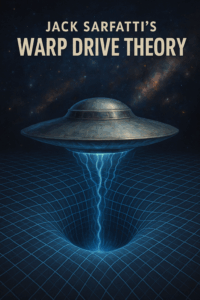
An artistic visualization of Jack Sarfatti’s warp drive theory, depicting a spacecraft manipulating the curvature of space-time with advanced gravitational fields.
Dr. Jack Sarfatti is a Ph.D. physicist known for his work on “metric engineering” – the science of bending space-time intentionally. In recent years, Sarfatti has openly discussed how advanced metamaterials (artificially engineered materials with unique electromagnetic properties) might enable a low-power warp drive. He was struck by the capabilities of the Tic Tac UFO observed by Navy pilots (2004 USS Nimitz incident) and has attempted to reverse-engineer a theoretical model that could account for such performance. His proposal? That the hull of a craft made of specific metamaterials could be pumped with electromagnetic energy to create local distortions in the gravitational field. Essentially, Sarfatti theorizes that a metamaterial spacecraft could “shape space-time” around itself as a means of field propulsion. This is very much in spirit what Lazar described – using a material (in Lazar’s case, Element 115) to generate gravity effects for propulsion.
Sarfatti’s work gets highly technical, invoking quantum field theory and general relativity. In one presentation, he explained that by tuning the phase between electromagnetic signals and the induced gravitational response in a metamaterial, one could induce either an attractive gravity field (a warp well) or a repulsive field (warp hill) at will. He even suggests that the Tic Tac UFO’s notable “nose-down, tail-up” orientation (similar to Lazar’s sport model tilting belly forward) could be explained by having a gravity well generated toward the nose and an anti-gravity (expanding space) region at the tail. In other words, the craft compresses space in the direction it wants to go and expands it behind – exactly the warp drive mechanism. Sarfatti’s equations introduce a concept of an “S-field” susceptibility of space, essentially a measure of how much the presence of the metamaterial amplifies the stress-energy tensor (source of gravity). If |S| is made very large at resonance, the effective gravitational field is magnified tremendously, enabling significant curvature from a modest energy input.
While Sarfatti’s papers and talks are on the cutting edge (and not without controversy in the physics community), they demonstrate that serious thinkers are actively figuring out how a craft could create a warp/gravity field in practice. Notably, Sarfatti and colleagues cite the need for an exotic material – in their scenario, a layered room-temperature superconductor or meta-surface – that can withstand and respond to huge electromagnetic flux. This is reminiscent of Lazar’s exotic fuel element or the idea that you need a special medium to achieve these effects. The specifics differ (Lazar spoke of a solid heavy element, whereas Sarfatti talks of meta-material lattices), but the theme is the same: technology might manipulate gravity by amplifying quantum effects in matter.
Sarfatti’s theories have not been experimentally verified at this point. However, he reportedly has been in communication with Pentagon and aerospace officials interested in UAP technology. If someday a Tic Tac-like craft is built by humans, it will likely owe more to metamaterial science and directed energy – but conceptually, it would validate what Lazar claimed to have witnessed in the 80s: a gravity engine warping space-time. In short, Sarfatti provides a modern physicist’s roadmap to achieve what Lazar said the aliens had already done. As one slide in a 2020 talk of his succinctly put it: “Jack Sarfatti has theorized that metamaterials used on board the Tic Tac could enable it to shape space-time as a source of field propulsion.” It’s hard not to hear an echo of Lazar in that statement.
Ning Li and the Quest for Anti-Gravity

Dr. Ning Li conducting a superconductive anti-gravity experiment, illustrating her pioneering work on gravity modification through rotating systems.
Turning the clock back a bit, we find the story of Dr. Ning Li, a Chinese-American physicist who in the 1990s garnered significant attention for claiming to have built a working anti-gravity device. Ning Li’s approach was quite different from Lazar’s in detail – she wasn’t dealing with alien reactors or element 115, but rather high-temperature superconductors. While at the University of Alabama-Huntsville (UAH) in the early 90s, Ning Li and her colleague Douglas Torr published papers proposing that a spinning superconductor could create a vertical gravity disruption. In essence, they theorized that within a superconducting disk, lattice vibrations could produce a **force field that “neutralizes” gravity above the disk. By 1993, they had drawn enough interest to invite Popular Mechanics magazine to see their setup: a 12-inch superconducting disk that, when fully energized and rotated, was supposed to cause a small object (like a bowling ball) to lose weight or levitate above it. Li claimed that using about 1 kilowatt of input power, her device could cancel out gravity in a region about one foot above the disc, extending upward indefinitely (at least in theory).
If this sounds incredible, it certainly was treated as such. Popular Mechanics ran a story in 1995 about Ning Li’s project, dubbing it potentially a “Gravity Shield.” The science was based on the idea of gravitomagnetism – just as moving electric charges create magnetic fields, moving masses (or certain configurations in a superconductor) might create a gravitational analog. Ning Li reported anomalous results: in some experiments, objects above the spinning disk appeared to lose a fraction of their weight. These results were contentious, not easily replicated by others (a similar claim by Russian scientist Eugene Podkletnov in 1996 also reported 2% weight reduction over a spinning superconductor, but subsequent attempts by NASA and other labs failed to reproduce a clear effect). Still, Ning Li’s work was taken seriously enough that in 1999 she left academia to form a company, AC Gravity, with backing from the Department of Defense. The DoD awarded her a $448,000 contract in 2001 to develop a prototype “gravity generator” or gravity-modification device. The fact that the U.S. Army was willing to put nearly half a million dollars into this research speaks volumes – gravitational propulsion was no longer just sci-fi; it was a strategic technology pursuit.
What happened next is something of a mystery. Ning Li became increasingly private about her work. She reportedly delivered some progress reports and continued experiments, even presenting at a conference in 2003 about the “measurability of AC gravity fields” with Army officials present. One of her last communications was an email in May 2003 claiming she had observed an “11 kilowatt output effect” (perhaps meaning her device produced 11 kW of power or lift in some test). After that, she published nothing further. AC Gravity, her company, kept renewing its business license until 2018 but public information about its work never emerged. Ning Li herself largely vanished from public view, giving rise to rumors that her research went black project (classified) or that she met some unfortunate end (her family later clarified she simply lived a quiet life and sadly passed away in 2021).
For our purposes, the Ning Li saga shows that the U.S. government was actively exploring gravity control technology around the same time Lazar’s claims were percolating in pop culture. While Ning Li’s approach (superconductor disks) was different, the goal was the same: reduce or nullify gravity’s pull, and eventually harness that for propulsion or lift. She even used the term “AC Gravity” referring to an oscillating gravitational field, which interestingly parallels Lazar’s mention of “Gravity A-wave” being a focused, controlled gravitational emanation. One can imagine a scenario where if Ning Li’s device had fully worked, it could lead to a machine that creates a local gravity well above it – perhaps not as advanced as an alien warp drive, but conceptually a stepping stone.
It’s also notable that Dr. Li’s work garnered mainstream press and then disappeared into potential secrecy, which is the sort of thing that fuels belief in Lazar’s story. If a relatively conventional scientist could be quietly tucked away after making progress on gravity tech, might the same have happened (on a larger scale) with any truth behind Lazar’s revelations? Lazar himself has claimed that the U.S. government is jealously guarding extraterrestrial technology, sequestering it in projects with extreme secrecy. The fate of Ning Li’s research – one day on magazine covers, the next a mystery – is at least consistent with the pattern of intense classification in this arena.
Besides Sarfatti and Ning Li, there are others who have intersected with “gravity engineering” research: physicist Hal Puthoff has written about metric engineering for warp and wormholes (he also briefed the U.S. government on UFO propulsion possibilities), Dr. Salvatore Pais as mentioned, and pioneers like Burkhard Heim in Germany had gravity theories, though those remained speculative. The common thread is that a segment of the scientific community – often working at the edge of accepted theory – has long believed that general relativity does not forbid gravity control or FTL travel, it only sets very high bars to achieve it. Those bars might be overcome with the right breakthrough in materials or quantum physics.
For Bob Lazar believers, each of these scientists is seen as converging on what Lazar already knew. For example, the island of stability idea suggests a path to stable Element 115; Sarfatti’s metamaterials suggest how a craft could amplify gravity waves; Ning Li’s experiments suggest governments are indeed searching for gravity tech. To skeptics, of course, Lazar simply latched onto emerging science fiction and physics ideas and built a narrative that happened to age well as those ideas gained traction. We may never know for sure – until the day a gravity-propelled craft built by human hands is revealed. But as we’ll conclude next, the gap between Lazar’s story and our reality keeps shrinking.
Conclusion

Final depiction of the Lazar Effect—an alien craft manipulates gravity and space-time in a remote landscape under the stars.
Bob Lazar’s tale of “engineering space-time with gravity” straddles the boundary between incredible and absurd. For decades, he has been a polarizing figure: hailed by some as a whistleblower who pulled back the curtain on extraterrestrial technology, dismissed by others as a fraud peddling pseudoscience. This skyscraper analysis has examined Lazar’s key claims – a gravity warp drive powered by Element 115 – against the backdrop of modern science and aerospace developments. The verdict? While we still lack concrete evidence to validate Lazar’s account, many of its components no longer look as implausible as they once did.
Let’s recap the striking correlations:
- Element 115, mocked as “unreal” in 1989, is now officially on the periodic table (Moscovium). It’s not stable in known form, but Lazar’s prediction that a stable form could exist aligns with theoretical nuclear physics (the island of stability). The idea of using a superheavy element as an energy source doesn’t violate physics – it’s speculative, but not magic.
- Gravity wave propulsion, which sounded like technobabble, is conceptually similar to an Alcubierre warp drive – a legitimate solution in general relativity. Lazar’s description of contracting space ahead of the craft and “falling forward” is basically a warp bubble narrative in layman’s terms.
- The ability to amplify gravity locally was completely outside mainstream experimentation in 1989. But by the 2000s, both government labs and private researchers were attempting exactly that (e.g. Ning Li’s work, Podkletnov’s claims, NASA’s torsion pendulum tests). To date, no verified “gravity shield” exists, but the pursuit itself lends some credence that the physics isn’t entirely fanciful.
- Lazar spoke of metamaterials without using that word – the craft’s hull and internal components allegedly performed functions (wave guides, field amplifiers) that go beyond normal materials. Today, metamaterial science is a cutting-edge field, and Sarfatti’s warp drive ideas show that an engineered material could be the key to creating gravitational effects.
- Lazar’s overarching scenario – government secrecy around recovered alien tech – remains unproven. But notably, in 2023, a whistleblower named David Grusch testified under oath that the U.S. has “non-human craft” and has been working to reverse-engineer them (claims still unconfirmed, but taken seriously enough by Congress to discuss). If even a fraction of that is true, Lazar’s story would move from lone-wolf allegation to part of a larger pattern of concealment, which he asserted all along.
None of this definitively proves Bob Lazar worked on alien gravity engines. Extraordinary claims require extraordinary evidence, and much of Lazar’s evidence is anecdotal or vanished (e.g. he says his educational records were erased, and the element 115 sample he supposedly once had is gone). Healthy skepticism is warranted. But on the flip side, the evolution of science and military research over the last 30 years has trended in Lazar’s direction, not away from it. Concepts that once elicited eye-rolls – wormholes, warp drives, zero-point energy – are now discussed at academic conferences and even appropriated into Navy patent filings. Real-world physics is, in a sense, catching up to Lazar’s narrative.
In the end, we are left with an intriguing possibility: perhaps Lazar was essentially correct about the physics, if not all the details. He may have misinterpreted some things or embellished others, but his portrayal of a gravity-based propulsion is looking less like pure fantasy. Whether he learned it from alien hardware or dreamed it up is a separate question. As experimental gravity research and UFO disclosures progress in the coming years, we may finally get answers. If a breakthrough in gravity control is announced by scientists or an exotic craft is unveiled by the government, Bob Lazar will either be vindicated as someone who told the truth ahead of its time – or else he’ll have been like a stopped clock that just happened to be right about a few things by accident.
For now, Lazar remains a fascinating case study at the intersection of fringe claims and frontier science. His sport model UFO and its “Lazar Effect” on popular imagination have undoubtedly inspired many to look at the stars (and at physics textbooks) with fresh wonder. After all, the idea that we might engineer space-time – folding distance and perhaps reaching distant stars in a flash – is the stuff to inspire generations of scientists and dreamers. And if one of those dreamers finally cracks the code of gravity propulsion, humanity’s path to the cosmos will open in ways we can barely imagine.
In Lazar’s own somewhat wistful words from recent years, reflecting on why he came forward: “The technology I saw was so far beyond anything we have. It’s a crime it’s kept secret from humanity”. Real or not, that sentiment resonates. As we stand on the cusp of potentially game-changing physics, it’s worth recalling that yesterday’s absurd idea can become today’s breakthrough. Gravity control might be the next such breakthrough – and if so, we’ll all witness “The Lazar Effect” in action, turning science fiction into science fact.
Sources:
- Bob Lazar’s 1989 claims and interviews as summarized in George Knapp’s reporting and later account – YouTube.com
- Analysis of Element 115 (Moscovium) discovery and properties – Wikipedia
- Futurism article on gravity wave propulsion drawing parallels between Lazar’s description and modern patents – Vocal.Media
- U.S. Navy patents on inertial mass reduction and warp technology – Patents.Google.com
- Theoretical warp drive physics by Alcubierre (1994) and White/NASA (2010s) – Wikipedia
- Jack Sarfatti’s warp drive/metamaterial theory as described in APEC Conference materials – Altpropulsion.com
- Ning Li’s anti-gravity research and DoD involvement – Huntsvillebusinessjournal.com
- Vice/Motherboard interview with Bob Lazar (2019) and other retrospectives – Vice.com
- HowStuffWorks article on Bob Lazar (2023) – Science.howstuffworks.com
- Wikimedia Commons (CC BY-SA) – Diagrams of Alcubierre warp bubble and Island of Stability for superheavy elements – Commons.wikimedia.org














Leave a Reply