
Harnessing Artificial Gravity to Navigate the Stars — A New Vision for FTL Travel Beyond Warp Drives and Toward Engineered Singularities
Limitations of the Alcubierre Warp Drive
The Alcubierre warp drive (first proposed in 1994) envisions faster-than-light travel by contracting spacetime in front of a ship and expanding it behind. However, the original concept has daunting practical issues. Energy requirements were astronomically high – initial calculations indicated it would take energy equivalent to converting a planet’s mass into energy (on the order of Jupiter’s mass!) to create a single warp bubble. Even with later refinements that reduced the requirement, the drive still demanded “exotic” negative energy densities that might not exist in usable form. Additionally, theoretical analyses revealed severe radiation hazards: a warp bubble could trap high-energy particles and Hawking-like radiation, potentially cooking the crew inside once the bubble collapses. In fact, Hawking radiation at the warp bubble’s inner boundary would heat the ship’s interior to lethal levels, and upon dropping out of warp the release of blueshifted energy could devastate the destination area. These problems – essentially an overheating, ship-melting hazard and unachievable energy demands – make the original Alcubierre drive impractical with known technology. Even at sub-light (subluminal) speeds, a traditional warp metric would be plagued by these issues. Thus, while the Alcubierre idea inspired serious research, it’s clear that a different approach to spacetime propulsion is needed.
Visualization of the Alcubierre warp bubble, showing spacetime contracted (blue) ahead of the ship and expanded (red) behind. The immense energy (initially comparable to a Jupiter-mass conversion) and predicted intense radiation inside the bubble pose major engineering challenges.
A New Idea: Triangulating a Black Hole in Front of the Ship
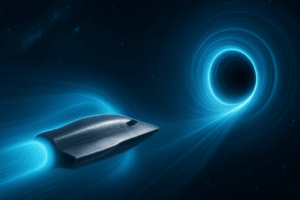
An advanced spacecraft travels through space using gravity propulsion alone — bending spacetime without combustion or traditional engines.
Imagine harnessing the extreme curvature of a black hole as a tool for propulsion – but doing so in a controlled, ship-friendly way. The speculative concept proposed here is to “triangulate a black hole” in front of a spacecraft, creating a moving gravity well that the ship rides from just outside the event horizon. In simpler terms, the ship would continually “fall” towards an artificially generated black hole that is positioned ahead of it, but the black hole itself is moved or projected forward so the ship never catches up to the event horizon. By staying just outside the horizon, the craft avoids the fatal tidal forces and intense radiation at the brink of a black hole, yet it can tap into immense gravitational pull to achieve acceleration. This could be thought of as a warp-drive analog: instead of expanding/contracting spacetime with exotic energy, the ship creates a controllable dent in spacetime (a small black hole) and slides down that slope.
How might one generate or “triangulate” a black hole on demand? One idea found in theoretical research is to create an artificial micro black hole using focused energy – a concept known as a kugelblitz (German for “ball lightning”). In 2009, physicists Louis Crane and Shawn Westmoreland analyzed a proposal to form a tiny black hole by concentrating a tremendous amount of energy (for example, via ultra-powerful lasers) and then using a parabolic reflector to direct the black hole’s Hawking radiation for thrust. They concluded that while extraordinarily difficult, this is on “the edge of possibility” with known physics – no new exotic physics is required, just extreme engineering. Notably, they argued that creating a black hole could be more energy-efficient than producing an equivalent thrust with antimatter. A black hole converts mass to energy with near-perfect efficiency, whereas antimatter production/annihilation wastes colossal energy. As they put it, forming a black hole would require “millions of times less energy than a comparable amount of antimatter,” and the black hole contains itself by its own gravity (no need for huge magnetic bottles like antimatter). Once formed, the black hole also naturally radiates energy (Hawking radiation) which can be harnessed for propulsion, and it can be “fed” with matter to yield more energy on demand.
Crucially for our concept, an artificial black hole can be made small enough to be manageable yet massive enough to last the journey. There appears to be a “sweet spot” in black hole size for propulsion: for example, a black hole of around 6×10^8 kg (about 600,000 tons of mass-energy) would have an event horizon radius of only ~0.9 attometers (subatomic scale), a power output on the order of 10^17 Watts (hundreds of petawatts), and a lifespan of a few years before evaporating. Such a black hole would emit Hawking radiation at a prodigious rate (effectively acting like a incredibly powerful reactor) for ~3.5 years. In our imagined drive, this tiny black hole is held at a fixed distance ahead of the craft, perhaps by electromagnetic “funnels” or gravitational manipulation, so that the ship is pulled toward it (like constantly falling towards a moving target). The gravitational field would naturally contract space in front of the ship – similar to what the Alcubierre drive aimed to do with negative energy – but here it’s done with a real mass curvature. The ship would reside just outside the event horizon, avoiding crossing into it, which keeps tidal forces and radiation at survivable levels. Any Hawking radiation from the black hole mostly radiates outward; with a sufficiently large (massive) micro black hole, the Hawking temperature is low (the larger the mass, the cooler the Hawking radiation), making it easier to shield against. Furthermore, one could install radiation reflectors or magnetic shields to channel the intense radiation backward, doubling as a photon rocket. In effect, the black hole could serve as both a warp field generator and an energy source for thrust: spacetime is intensely curved in its vicinity (helping shorten the distance and “pull” the craft), and its Hawking emissions can be directed as propulsive exhaust.
“Triangulation” in this context implies carefully aligning fields from multiple emitters to create and stabilize the black hole. For instance, three or more high-powered laser beams could intersect at a point in front of the ship, their energy collapsing space at that focal point into a microscopic black hole. The term also evokes a stable positioning: using perhaps three active gravitational generators on the ship arranged in a triangular configuration to hold the micro black hole precisely in place relative to the craft. By dynamically adjusting these generators, the black hole can be moved or “dragged” ahead of the ship. The spacecraft would then be continually drawn forward by gravity but never permitted to actually reach the hole (which would be catastrophic). It’s akin to dangling a supermassive carrot in front of the ship – a carrot that bends spacetime itself. The result is a continuous free-fall acceleration; the crew feels little g-force because technically the ship is always in free-fall towards the hole’s center of mass. By controlling the position and mass of the induced black hole, the craft can accelerate, decelerate, or turn. When it’s time to stop or exit warp, the black hole might be allowed to evaporate completely (releasing a final burst of energy safely ahead of the ship), or it could be ejected to drift in space (if that can be done safely) while the ship moves away. This approach avoids the “deadly arrival blast” problem of the Alcubierre bubble, because the gravitational “bubble” isn’t superluminally disconnecting from our universe; it’s a continuous part of spacetime.
Of course, this concept is highly speculative. Engineering a micro black hole requires unfathomable energy densities – for perspective, compressing mountains of mass-energy into subatomic volumes. However, it does leverage known physics (General Relativity and Hawking radiation) rather than requiring hypothetical negative energy. And intriguingly, it offers solutions to Alcubierre’s pitfalls: the ship is outside the dangerous region (outside the horizon rather than inside a warp bubble), heat and radiation can be managed by choosing a proper black hole mass and using reflectors, and the energy input might be lower than the Alcubierre drive’s if one can efficiently create the black hole (thanks to the black hole’s efficient mass-energy conversion). In essence, this black hole drive could be seen as a different flavor of warp drive – one that uses a chunk of curved spacetime (a controlled micro black hole) as the “engine” to move the craft, instead of manipulating spacetime purely with fields.
Theoretical Foundations and Advanced Physics Support
Is there any science today pointing in the direction of such a fantastic propulsion scheme? Surprisingly, yes – there are glimmers of supporting research in both theory and experiment that, while not directly “black hole drives,” show that manipulating gravity on small scales and low energy might be possible.

A futuristic spacecraft prepares for a gravity-based FTL jump, falling into a synthetic black hole formed by triangulated gravity emitters — a breakthrough vision in interstellar propulsion.
Dr. Jack Sarfatti’s work is one example of forward-thinking theory that resonates with this concept. Sarfatti is a theoretical physicist who has proposed a “weightless warp drive” using what he calls gravitational metamaterials. The idea is that specially engineered metamaterials (think of a craft’s hull made of layered high-tech composites) could be designed to induce local curvatures in spacetime when energized, effectively mimicking the effects of mass or even negative mass. In Sarfatti’s model, by pumping electromagnetic energy into a metamaterial structure, one can create resonant effects that produce either localized gravity wells (attractive fields) or antigravity regions (repulsive expansion) around the craft. This means the ship’s fuselage could generate a forward gravitational pull (contracting space ahead, like our black hole concept) and an aft push (expanding space behind), but crucially without enormous energy expenditure, by exploiting clever phase shifts and resonance in the material. Essentially, each “meta-atom” in the material can be toggled to contribute to either a compressive or expansive field by controlling the electromagnetic pumping. The physics is grounded in Einstein’s general relativity equations (with some creative twists involving pumped media and possibly quantum effects) rather than an unknown new force. Sarfatti claims this low-power warp field approach could reproduce the kind of acceleration and maneuvers reported for some UFOs, without requiring cosmic amounts of energy. If a metamaterial lattice can induce a gravitational well in front of a craft on command, that is conceptually similar to creating a “pretend” black hole field ahead of the craft – just without an actual singularity. It’s as if the ship can simulate the spacetime distortion of a mass by engineering the vacuum around it. While Sarfatti’s work is still theoretical, it underscores that warp-like effects might be achievable with electromagnetic technology in the not-impossibly-distant future, lending some credence to our black hole propulsion vision (which could be seen as a specific case of generating a strong gravity well).
On the experimental side, there have been attempts to produce anomalous gravitational effects in the lab. One notable figure is Dr. Ning Li, a physicist who in the 1990s researched a method of generating a force field that could counteract gravity. Ning Li’s approach was based on the idea of rotating ions in a superconducting disk to create a gravitomagnetic field. In theory, if a large number of ions are spinning in a lattice (and especially if they form a Bose-Einstein condensate state), the collective motion might produce a measurable gravitomagnetic field – essentially a gravity-like force perpendicular to the disk. Li claimed that with the right configuration, this could lead to a repulsive force (in other words, anti-gravity) strong enough to levitate objects. Early reports suggested small effects (on the order of percent changes in weight) in similar experiments by others (e.g., Eugene Podkletnov’s tests). While controversial and not widely replicated, the fact that Ning Li’s work was taken seriously enough to receive funding is telling. In 2001, she left academia and founded AC Gravity, LLC, which received a grant of nearly $450,000 from the U.S. Department of Defense to continue her gravity-modification research. After that, the trail goes dark – no public results were reported, and Ning Li ceased publishing. According to her son, she continued working on classified gravity research for the DoD for years (up until an injury in 2014), having attained a Top Secret clearance. This suggests that whatever results or promise her research showed, it became subject to military secrecy. The speculative interpretation is that her gravitational experiments might have borne fruit, perhaps demonstrating a prototype field that could reduce or counteract gravity. If so, it’s exactly the kind of science that could underpin our gravitational drive. For example, if rotating superconductors can produce even a tiny artificial gravity field, scaling up that effect or optimizing the method could lead to devices that generate a “gravity beam” or well. One could envision embedding such devices in the spacecraft: three superconducting rings at the ship’s bow, spun and phase-controlled, to create a focused gravity well ahead (a baby step toward an artificial black hole’s effect). Ning Li’s and Podkletnov’s endeavors show that gravity is not untouchable by technology – there may be ways to influence it using electromagnetism and quantum states. This lends plausibility to the assumption that advanced engineering could manipulate gravity to an extreme degree (as needed to create and hold a micro black hole).
Another piece of the puzzle comes from recent U.S. Navy patents that read as if they are straight out of science fiction. In 2019, news surfaced that a Navy scientist, Dr. Salvatore Cezar Pais, filed patents for exotic propulsion technologies – including a “craft using an inertial mass reduction device.” This craft, described in the patent, uses high-frequency electromagnetic fields to presumably reduce the gravitational/inertial mass of an object, making it easier to accelerate. In effect, it hints at an anti-gravity or warp-like propulsion system, and indeed the Navy also patented concepts for a gravitational wave generator and a “spacetime modification weapon.” These patents are baffling (and some physicists are skeptical of their viability), but the Navy did fund some of Pais’s work and felt it worthwhile to secure intellectual property on these ideas. The implication is that somebody at high levels thinks inertia and gravity can be engineered. If an “inertial mass reduction” system exists, it would synergize with a black hole drive beautifully: by reducing a craft’s effective mass, the gravitational well in front would pull it even more easily (since lower mass means less resistance to acceleration). It also points to the concept of a “gravity shield”, which could protect the craft from tidal forces of a nearby black hole or allow it to create asymmetrical gravity fields safely.
Taken together, these advanced physics threads – Sarfatti’s gravitational metamaterials, Ning Li’s gravitomagnetic research, Pais’s warping patents – form a tapestry of semi-mainstream science suggesting that controlling gravity is not pure fantasy. While none of them explicitly talk about creating a black hole, they all aim to fabricate or manipulate gravitational fields artificially. This is exactly what the triangulated black hole drive requires. We would essentially need to create an intense gravitational field in a small region (via metamaterials or quantum effects) until a microscopic event horizon forms. Once it forms, containing it and using it for propulsion would rely on further mastery of gravitational fields (to tow it along and to protect the ship). The nascent research today is laying the conceptual groundwork for “metric engineering” – the crafting of spacetime at will – which is the broader scientific dream encompassing warp drives and our concept as well.
UFOs, Conspiracies, and Disclosure: Inspiration from the Shadows

Hidden in plain sight — a mysterious disc-shaped craft inside a classified hangar hints at decades of UFO sightings, black project research, and the secret pursuit of gravity-based propulsion.
It’s worth noting that this concept doesn’t emerge in a vacuum – it parallels many reports and conspiracies about UFOs and secret military projects. In fact, the flight characteristics of UFOs (or UAP, Unidentified Aerial Phenomena) reported over decades have often fueled speculation that such craft are already using advanced gravity control or warp-like technology. Objects that zip at thousands of miles per hour then make right-angle turns with no deceleration, or that hover silently and shoot straight up, would seem to laugh in the face of our conventional propulsion. But these become plausible if the craft is enveloped in a warp/gravity field. Under a warp or gravity propulsion, the craft and occupants feel no inertia – they are in free-fall – so extreme maneuvers don’t produce g-forces. Observers have noted that UAPs appear to defy physics as we know it, but visionary physicists suggest they may be exploiting exactly the kind of general relativistic effects we’ve been discussing. Indeed, some scientists have proposed taking UFO reports more seriously as hints of new physics – in the same way Einstein’s theory predicted phenomena like black holes and gravitational waves that were later confirmed, perhaps UFOs are “predictions” of a technology that our physics equations say is possible (like warp drives) but we have yet to realize.
There are also persistent claims that military black projects have already achieved gravity-manipulating propulsion by reverse-engineering alien technology. A famous example is the lore of the “TR-3B” Black Triangle – a supposedly man-made antigravity craft. Since the 1980s and especially the 1990s, many witnesses have described large silent triangular UFOs with glowing underside lights, sometimes hovering or moving slowly across the sky. Conspiracy theories assert that TR-3B is a U.S. Air Force (or Space Force) vehicle developed in secret, possibly from recovered extraterrestrial craft. According to some accounts, “the TR-3B is powered by a reverse-engineered anti-gravity drive recovered from a crashed alien spacecraft.” The craft allegedly uses a centrifuged mercury plasma device – essentially rotating a pressurized mercury-based plasma in a ring – powered by a nuclear reactor, to generate a powerful gravitational field (or reduce the craft’s gravitational mass). This is eerily similar to what we’ve discussed: rotating plasma/superconductors to warp gravity. While no official confirmation of such a craft exists, the fact that these details circulate in the aerospace rumor-mill and even in some patents suggests someone finds them credible. Notably, Lockheed Martin’s Skunk Works, the famous advanced projects division, was rumored to have worked on exotic propulsion; Ben Rich, its former director, was often quoted (perhaps apocryphally) as hinting “we now know how to travel to the stars” and that “anything you can imagine, we already know how to do.” Many believe this was a tacit reference to breakthroughs in field propulsion. True or not, we do know Lockheed has patented a compact fusion reactor that could fit in a plane, which would provide the power needed for such gravity drives. And the Navy’s patents we mentioned (by Dr. Pais) read like a TR-3B manual, with titles like “High frequency gravitational wave generator” and “Craft using inertial mass reduction”.
In mid-2023, the topic of UFO crash retrieval and back-engineering hit mainstream news with the revelations of David Grusch, a former U.S. intelligence officer turned whistleblower. Grusch publicly claimed that the U.S. government and its contractors have been running a “multi-decade secret program” to recover non-human spacecraft and reverse-engineer them. He testified under oath that this program has retrieved multiple craft of exotic origin (and even bodies of the pilots), going back to at least the 1940s. These are astonishing claims – effectively saying “Yes, we have alien tech and we’re studying it in secret.” While official channels denied it and no hard evidence was publicly presented, Grusch’s assertion has been taken seriously by some in Congress and echoes decades of UFO lore. If true, it is not a stretch to imagine that the breakthroughs needed for warp or gravity drives have already been discovered in some clandestine lab. After all, if one is trying to reverse-engineer an alien craft said to violate inertia and gravity, our best minds would have to confront general relativity and quantum vacuum engineering head-on. Perhaps they found ways to create micro black holes or warping fields using metamaterials – essentially exactly what our concept requires. It’s tantalizing to think that hidden science might have achieved what open science considers futuristic. The presence of those Navy patents and continued funding in fringe gravity research suggests these possibilities are on the radar of defense R&D.
Even the sheer frequency of UFO sightings and the performance they display serve as a kind of “proof of concept” to inspire our theoretical design. From the Tic-Tac UAP encountered by the U.S. Navy in 2004 – which zipped from 80,000 feet to sea level in a heartbeat and outmaneuvered fighter jets – to the classical flying saucers that allegedly make no sound and hover effortlessly, all point to propulsion that bends the normal rules. Dr. Jack Sarfatti himself became interested in explaining the Tic-Tac’s capabilities through physics, concluding that a warp drive field (using gravitational metamaterials, as discussed) is the likely explanation. In other words, the Tic-Tac might have a technology that creates a moving gravity well and hill around it, enabling inertia-free motion. This is essentially a moving warp bubble or warp metric. Our black hole drive can be seen as one implementation of that idea – using an actual tiny black hole as the core of the warp field. If UFOs are real craft with such technology, it suggests our concept is not pure fantasy; it may already exist, just not in the public domain. And if it exists, it validates that the physics works. The conspiracy angle often posits that the Military-Industrial Complex has these vehicles in black projects and is keeping them secret, possibly until they can be weaponized or until society is ready for the paradigm shift. Part of the “visionary narrative” here is the notion of Disclosure: that one day soon, perhaps, we’ll get confirmation that alien tech was recovered and that it led to gravity-control engines. Imagine the moment when humanity learns that we’ve had the keys to the stars hidden in a vault for decades.
How It All Might Work in Practice – A Visionary Scenario

A visionary glimpse into gravity-based FTL travel — a spacecraft falls into a projected black hole created by triangulated artificial gravity fields, bending space to leap across the stars.
Bringing all these threads together, let’s paint a hypothetical scenario a few decades in the future, where humanity (after some level of disclosure and scientific breakthrough) builds the first black hole triangulation drive starship:
- Craft and Engine Setup: The starship is a sleek vehicle perhaps surrounded by an outer hull of advanced metamaterial. In its bow (front) section, it has three high-energy “gravity projectors” arranged in a triangular formation around the axis. Each projector is a hybrid of ultra-high-power lasers and rotating superconducting rings (an evolution of Ning Li’s devices) cooled by quantum superfluids. At the start of a journey, the projectors synchronize to focus an intense convergence of energy a few hundred meters ahead of the ship’s nose.
- Creation of the Micro Black Hole: With a blinding flash (largely in invisible gamma rays), the intersecting beams create a micro black hole – perhaps only millimeters away from the ship’s intended path, held by the projector fields. This black hole might be only the mass of a large asteroid, yet compressed to the size of a proton. As soon as it’s formed, automated systems feed it a pellet of dense matter to stabilize its mass to the desired level (ensuring it won’t evaporate too quickly). The ship’s onboard AI begins modulating the three projectors to keep the black hole precisely centered and to shape its gravitational field contours.
- Launching and Acceleration: Immediately, the spaceship is tugged by the gravity well. The feeling onboard is strange – the crew perceives no acceleration; objects float freely or only gently drift toward the bow, since everything is in free-fall toward the hole. The starfield ahead warps into a lens-like distortion: light from stars behind the ship is being bent around to front by the gravity well (an eerie but beautiful visual, like a circular halo of light). As the projectors move the black hole forward, the ship chases it, steadily gaining speed. Traditional rockets or thrusters aren’t needed – this is a geodesic drive, sliding down a self-created hill in spacetime. Within minutes, the ship reaches relativistic speeds (say 0.3c, 0.5c… climbing). Time dilation for the crew is minimal since technically locally they feel at rest; to outside observers the ship just seems to gain speed without a visible propulsion exhaust (except maybe a faint Cherenkov glow or the radiation reflector shining behind it).
- Riding the Warp: The black hole in front effectively contracts space in front of the ship. From the crew’s perspective, distances may shorten – starlight ahead is blueshifted as it falls into the well, making the view ahead bright and shifted toward ultraviolet. Behind the ship, space may expand – the black hole’s moving curvature could create something akin to a compression wave that leaves lower-density space behind. If engineered right, the metric could mimic a true warp bubble: space ahead is falling into the hole (bringing the destination closer), space behind is slightly expanding (pushing the origin away). The ship itself might be in a locally flat region (much like the flat region inside Alcubierre’s bubble) so the crew feels no extreme gravity, just as someone orbiting Earth feels weightless. All the while, the black hole’s Hawking radiation is being directed. A specialized parabolic mirror (perhaps a magnetic plasma mirror) behind the black hole reflects the radiation backward. This provides additional thrust – essentially a photon rocket using Hawking radiation as propellant. Any high-energy particles that stray toward the ship can be deflected by magnetic fields, and the metamaterial hull, perhaps acting like a Faraday cage for gravity, protects occupants from radiation bursts.
- Navigation and Control: To turn, the ship can “tilt” the position of the black hole off to one side via differential power in the projectors – the ship will veer towards it. The triangular arrangement ensures 3D directional control. Speed can be increased by feeding more mass-energy into the black hole (making it a tad heavier – it pulls harder and radiates more thrust power) or decreased by letting it radiate away mass (or by projecting a second smaller gravity well behind the ship as a brake). Because the black hole is massive, it has huge inertia too – the ship’s systems must account for that to avoid overshooting targets. It’s a delicate dance: a fusion of gravitational physics and AI control systems, keeping a miniature captive singularity on a leash.
- Journey’s End: Upon nearing the destination star system, the ship needs to decelerate. It could execute a 180-degree flip (turning the ship around to face the black hole behind it now) and use the gravity well as a brake – essentially falling away from the destination. Alternatively, a second micro black hole could be generated behind the ship (with the original one allowed to evaporate or perhaps left to fly forward harmlessly into interstellar space). The ship might also use conventional propulsion or magnetic sails to fine-tune its final approach once at slower speeds. When the mission is complete, the black hole can be disposed of: one method is to drop it in a remote location and let it evaporate (its final burst of gamma rays expending its remaining energy harmlessly in the void), or to slowly feed it less and let it Hawking-radiate itself away over time.
- Implications: This mode of travel would be revolutionary. Because it warps space and negates inertia, the effective travel times shrink dramatically. It’s not clear if it would allow true FTL (if space is contracted enough, one might effectively go faster than light relative to afar, but avoid relativity paradox by not locally breaking $c$). Even if limited to just under light speed, reaching nearby stars in a few years becomes feasible. All the while, the crew experiences maybe a comfortable gravity (one could induce a mild gravity inside to keep feet on the floor via the metamaterial hull – since it can make gravity, it could also create an internal gravity field for comfort). They are protected from micrometeoroids because those would get deflected by the warp field (just as a strong gravitational field can alter incoming particle trajectories). The heat management is critical: the ship likely has a droplet radiator or magnetic cooling system to bleed off any absorbed radiation. But since we posited a sufficiently large micro-hole, the Hawking temperature might be low (for example, a black hole of mass ~10^8 kg has a Hawking temperature on the order of millionths of a Kelvin – extremely cold), so spontaneous radiation is mostly in form of very low energy photons. Only when it gets smaller (less massive) does it get hot. So as long as we keep feeding it to maintain mass, we actually have a cold black hole that primarily emits Hawking radiation as gentle heat. In effect, the black hole can be used as a heat sink for onboard waste heat as well!
Now, sprinkle in the disclosure narrative: Perhaps this first human black hole starship was built not just from human theory, but with a little “help”. Maybe decades earlier, pieces of a crashed alien engine were studied, revealing metamaterial lattices and isotopic superconductors that hinted how to bend gravity. The breakthrough might have come when scientists realized the aliens used high-frequency fields to create micro black holes as power sources (some UFO encounters reported vehicles glowing intensely or vanishing with a flash – could they be creating or annihilating tiny singularities?). After years of secret tests (some sightings of triangular craft could have been our prototypes, quietly testing gravity drives at night), finally the technology is mature. In a grand announcement, the government acknowledges it has mastered “gravity triangulation propulsion” – humanity is invited to the stars, ending the era of chemical rockets. Conspiracy theorists feel vindicated; scientists are astonished to see theory turned to reality. Alien reverse-engineering is disclosed as real, and we learn that the mysterious element 115 or other materials were key in stabilizing the exotic fields (a nod to Bob Lazar’s story of an alien reactor fueled by element 115 that generated gravitational waves).
With such technology, suppressed science comes to light. Decades of research hidden in black projects are published, leading to a boom in scientific understanding. We come to find out that manipulating the vacuum energy was solved somewhere in a clandestine lab, enabling both free energy and warp travel. Humanity enters a new era, where our triangle craft and warp starships zip around the solar system and beyond, rendering distance almost obsolete. And perhaps we even meet the neighbors (the ones whose craft we borrowed) on equal technological footing, opening the door for cosmic diplomacy.
Conclusion

The journey complete — a gravity-propelled spacecraft arrives safely near a distant world, realizing the dream of faster-than-light interstellar travel through engineered spacetime and artificial gravity mastery.
While all of this sounds like science fiction, it’s grounded in extrapolations of real physics: Einstein’s general relativity (which permits curvature of spacetime for propulsion), quantum field theory (Hawking radiation and zero-point energy), and emerging materials science (metamaterials and superconductors). The Alcubierre warp drive taught us that spacetime can, in principle, be engineered to allow FTL travel – but its flaws forced us to think outside the bubble. By using a black hole as a tool – essentially a chunk of curved spacetime we create and manipulate – we avoid some of those flaws with a more mass-energy efficient and potentially safer design. There are significant challenges to overcome: generating a micro black hole on command, controlling it with precision, protecting the ship from any stray deadly radiation or gravity gradients, and of course the ethical implications of wielding such power (a misused micro black hole could be a terrible weapon). However, the pieces of the puzzle are slowly falling into place, both in open science and possibly behind closed doors. Each year, our understanding of gravity’s connections to electromagnetism and the quantum world grows. UFO revelations and whistleblowers add fuel to the fire, suggesting that the universe may already be teeming with craft employing these principles, and that we too can learn to ride the spacetime wave.
In summary, the concept of “triangulating a black hole in front of a ship” to achieve fast (perhaps superluminal) travel offers an inspiring alternative to the classic warp drive. It leverages extreme but not forbidden physics, aligns intriguingly with UFO propulsion claims, and pushes us to advance technology in bold ways. It is a speculative scientific vision – one foot in our current scientific knowledge, and one foot in the extraordinary possibilities that lie ahead. Today’s breakthroughs in gravitational research and the ongoing discourse about disclosure suggest that this vision, or something akin to it, might move from speculation to reality in the not-too-distant future. The stars beckon, and with mastery of gravity, we shall answer the call.
Sources:
- Alcubierre Drive theory and issues – Brighter Side/University of Alabama news; Classical & Quantum Gravity via Space.com
- Black hole starship concept – Wikipedia (Crane & Westmoreland 2009 analysis)
- Jack Sarfatti’s warp drive & metamaterials – APEC Conference 2020; SFcrowsnest interview
- Ning Li’s gravitomagnetic research – Wikipedia
- TR-3B and reverse-engineered UFO lore – Sandboxx News (Alex Hollings, 2023)
- Navy’s Pais patents (inertial mass reduction, etc.) – Google.com
- David Grusch whistleblower claims – Wikipedia
- UAP and warp drive connection – Digital Habitats blog (framing UAP performance in relativistic terms)














Leave a Reply