
Exploring the Frontier of Gravity Propulsion: How Artificial Gravity Enables Seamless Travel Across Space, Air, and Water
Artificial gravity opens the door to unified travel across space, sky, and sea.
Imagine a spacecraft that can lift off silently, accelerate at tremendous speeds, or even dive under the ocean – all without traditional engines or rocket fuel. This is the tantalizing promise of gravity propulsion. Instead of pushing against air or expelling mass as rockets do, a gravity-propelled craft would generate an artificial gravitational field in front of itself and literally fall forward in the direction of travel. By continuously “pulling” itself along with its own localized gravity well, such a craft could move effortlessly through space, air, or water. In theory, the surrounding medium becomes irrelevant – the ship and everything within its influence are simply in free-fall, experiencing little or no G-forces even during rapid acceleration.
Recent breakthroughs and bold theories by pioneering physicists have inched this sci-fi concept toward the realm of plausible science. In particular, the research of Dr. Ning Li on rotating superconductors and Dr. Jack Sarfatti on electromagnetic metamaterials has reinvigorated the dream of gravity propulsion. Both scientists approach the challenge from different angles – one from observed gravitomagnetic effects in superconductors, the other from advanced theoretical formulations of spacetime engineering – yet their work converges on a common vision: machines that generate gravity-like force fields to propel vehicles in any direction. This article explores their contributions in depth, explains how artificial gravity propulsion would work, and examines the challenges ahead. Along the way, we will see how a gravity drive could enable seamless travel across different mediums and why mainstream physics remains skeptical but intrigued by these ideas.
Understanding Gravity Propulsion: “Falling” Forward into Space
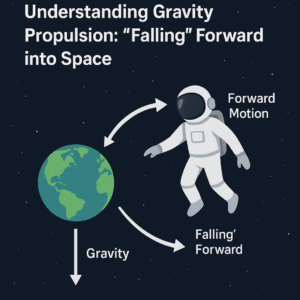
Gravity propulsion explained: objects in orbit are constantly falling forward around a planetary body.
To grasp gravity propulsion, it helps to contrast it with conventional propulsion. A rocket or jet moves by expelling mass or pushing against a fluid – action and reaction. In space, a rocket pushes exhaust backward to go forward; in air or water, aircraft and submarines push against the medium. Gravity propulsion, by contrast, pulls the vehicle from the front. The vehicle generates a gravitational field just ahead of itself, essentially creating a slope in spacetime that it continually falls down. As the craft and its local environment “slide” into this gravity well, the field generator moves along too, always staying ahead and pulling the craft onward in a self-perpetuating fall.
This concept is analogous to placing a bowling ball on a mattress and then continuously deforming the mattress in front of the ball – the ball rolls toward the depression. In space, the craft’s field generator warps spacetime or creates a gravity-like force in the desired direction of travel. In atmosphere or underwater, the same method would work: the craft doesn’t need to push against air or water; instead, everything in its vicinity is compelled to move with it due to the artificial gravity gradient. The result is minimal friction or drag. For example, air around the craft would be pulled along in its gravity field rather than rushing over the hull, preventing the massive heating and shockwaves that normally occur at high speeds. In principle, occupants would feel continuous free-fall weightlessness or only mild acceleration forces, even as the vehicle darts around with agility that would smash ordinary aircraft.
Perhaps the best-known depiction of this idea in pop culture is the trope of a ship projecting a gravity beam or force in front of it and chasing that field. In practice, achieving this means finding a way to generate a localized gravitational field on demand. Gravity is a weak force and normally requires planetary masses to have noticeable effects. However, our two featured scientists, Dr. Ning Li and Dr. Jack Sarfatti, have spent decades investigating how advanced materials and quantum physics might allow relatively small devices to produce gravitational effects. Their work suggests that gravity can be tamed or “engineered” – either by harnessing rotation in superconductors or by exploiting electromagnetic properties of exotic metamaterials – to yield a new kind of propulsion that operates on spacetime itself.
Dr. Ning Li’s Contribution: Rotating Superconductors and A/C Gravity
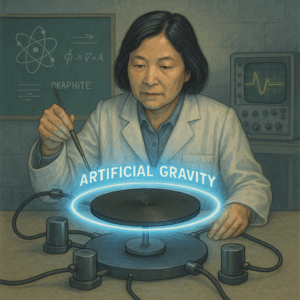
Dr. Ning Li demonstrates her artificial gravity research using a spinning graphite disk and electromagnetic coils, a concept rooted in her groundbreaking work on gravitational frame dragging.
One of the early modern pioneers of gravity research is Dr. Ning Li, a physicist who in the 1990s proposed a method to generate a gravitational-like force using high-temperature superconductors (HTSC). Dr. Li’s work centered on an effect predicted by Einstein’s general relativity: moving mass or moving electrical charges can induce a gravito-magnetic field analogous to the magnetic field induced by moving electric charges. In other words, a spinning mass or certain dynamic mass configurations might produce faint gravitational fields. The Earth itself, for example, creates a tiny frame-dragging field as it rotates, though it’s far too small to notice in daily life (NASA’s Gravity Probe B experiment later confirmed this frame-dragging effect as predicted by Einstein). Dr. Li wondered if a superconductor – a material in which electrons move in a highly coherent way – might amplify or harness gravito-magnetic effects, especially if ions in the material could be made to spin in unison.
Working with physicist Douglas Torr, Ning Li published a 1991 paper outlining how a superconducting disk could produce a measurable gravitomagnetic field. She theorized that if ions locked in a superconductor’s lattice were made to rapidly rotate, each ion would act like a tiny spinning mass, generating a minuscule gravitational field. Normally these tiny effects cancel out randomly, but if all the ions spin together in phase, their gravitational microfields should align and add up. A superconductor offers a unique medium to achieve this synchronization: in the right conditions (akin to a Bose-Einstein condensate state), the matter can behave as if it’s one coherent atom. Li predicted that applying a time-varying magnetic field to a specially fabricated superconducting disk would pump energy into lattice ions, causing them to precess or spin uniformly. Each ion’s gravito-magnetic field, though extremely weak individually, could collectively form a larger gravity-like field perpendicular to the disk.
By the late 1990s, Dr. Li and her colleagues in Huntsville, Alabama had built a 12-inch diameter high-Tc superconducting disk to test this idea. In a 2000 Popular Mechanics article appropriately titled “Taming Gravity,” reporter Jim Wilson described Li’s device in action. The ultimate goal was to create what Li called an “AC Gravity” generator – a machine not that cancels gravity, but that produces a new gravitational force field that can be modulated (hence AC, like alternating current) and pointed in any direction. NASA scientist Jonathan Campbell, who worked with Li, explained that it wouldn’t be an antigravity shield per se (it doesn’t negate gravity uniformly like a sci-fi force field). Rather, it adds a gravitational-like force that can attract or repel matter in a target region. In effect, it could pull up or push down on objects. If such a field is superimposed on Earth’s gravity and tuned correctly, you could cancel out gravity in a region (making objects weightless) or enhance it.
The proof-of-concept demonstration Li’s team envisaged was dramatic: once their machine was complete, a bowling ball placed above the energized superconducting disk would hover in mid-air, suspended by the disk’s gravity-like field. This field would act on all matter, much like gravity does. In fact, Li emphasized it acts on all atoms and objects in its influence, not just certain materials – a true gravitational analogue. Using roughly one kilowatt of input power, Li claimed the device could neutralize gravity above a disk one foot in diameter, projecting a columnar region of reduced weight that extends from the disk upward through the atmosphere into space. If that sounds unbelievable, consider that gravity is extremely weak – to cancel Earth’s 1g gravitational pull even in a small zone is no small feat. Yet Li’s calculations suggested the cumulative effect of billions of spinning lattice ions could do just that, given the incredible speeds of ion rotation achievable (on the order of quadrillions of rotations per second in a lattice, vastly outpacing the slow rotation of Earth).
Li dubbed it “AC gravity” to highlight that the field could be alternated or directed. “It’s a gravity-like force you can point in any direction,” Campbell explained, envisioning uses such as generating a protective gravity field in space to deflect meteoroids from a spacecraft. By vectorially adding or subtracting from Earth’s gravity, the device could produce lift or downward push. Essentially, if placed on a vehicle, such a gravity generator could provide propulsion by creating a directional pull. Tilt the field forward and the vehicle would continuously “fall” in that direction; orient it upward and the vehicle would levitate.
The boldness of Ning Li’s work drew both excitement and skepticism. On one hand, it passed peer review in theoretical papers and garnered enough interest that the U.S. Department of Defense awarded her startup company (aptly named AC Gravity, Inc.) a research grant in 2001 for nearly half a million dollars. She left her university position at UAH to pursue this research, along with colleagues like Dr. Larry Smalley (then the physics department chair) who believed in its potential. By 2003, Li was reportedly working with the Army on measuring these AC gravity fields, and she even hinted at an experiment that produced an “11 kilowatt effect” (though the meaning of this result remains mysterious). On the other hand, reproducible experimental evidence has been scarce. Earlier claims by a Russian researcher, Evgeny Podkletnov, in 1992 that a spinning superconductor could reduce weight by a few percent, had failed to be conclusively replicated and were met with controversy. Li’s own experiments were conducted largely behind closed doors after the initial media blitz. NASA’s attempt to replicate Podkletnov’s findings in the early 2000s was never completed, and a well-known 2006 replication by physicist Martin Tajmar yielded only transient signals that were later considered likely experimental error. In short, while Li and Podkletnov both claimed experimental success, mainstream verification has been elusive. This has kept many physicists skeptical.
Despite the lack of publicly disclosed results, Ning Li’s research provided a crucial foundation for gravity propulsion: it suggested that electromagnetism and matter at quantum scales could be orchestrated to produce gravitational fields. By using superconductors and clever physics, she attempted to break the age-old truism that gravity can only be generated by huge masses. If her “force-field machine” could be realized, it would essentially be a gravity engine. A spacecraft equipped with such a device might hover and maneuver with the ease of a magic carpet, all by shaping gravitational fields around it. While we still await public demonstration of Li’s gravity disk stopping a bowling ball in mid-air, her work remains a landmark in the pursuit of gravity control. It showed that serious scientists were willing to challenge conventions – and it hinted that gravity, like electricity, might someday be harnessed for transport.
Dr. Jack Sarfatti’s Contribution: Post-Quantum Metamaterials and Metric Engineering

A conceptual spacecraft levitates using artificial gravity beams, representing Dr. Jack Sarfatti’s theory of using post-quantum fields and metamaterials to induce gravitational propulsion.
Taking gravity propulsion from concept to interstellar speeds requires not just experimental hints, but also a robust theoretical framework. This is where Dr. Jack Sarfatti comes in. Dr. Sarfatti is a theoretical physicist known for his work on what he calls “post-quantum” physics and metric engineering – essentially, engineering the fabric of spacetime itself. While Ning Li focused on tangible superconducting disks, Sarfatti’s approach is more abstract but could complement and greatly extend the gravity control toolkit. His recent research delves into how specially designed materials (metamaterials) and electromagnetic fields might induce gravitational and warp drive effects via something called quantum back-reaction.
At the heart of Sarfatti’s concept is the idea that electromagnetism can be coupled to gravity in new ways by using engineered materials. Metamaterials are artificial structures with sub-wavelength features that give them extraordinary electromagnetic properties – for example, a negative index of refraction, which can bend light in the opposite direction of normal materials. Sarfatti’s early insight was that a negative refractive index metamaterial could simulate the effect of negative energy density as seen in general relativity. In Einstein’s equations, gravitational fields (and exotic phenomena like warp drives or wormholes) typically require either enormous amounts of mass-energy or negative energy (which is not readily available in nature). However, metamaterials offer a clever hack: by slowing down light and manipulating electric and magnetic response (permittivity ε and permeability μ) inside a material, one can effectively change the relationship between energy and spacetime. If light can be slowed to a crawl (say a few centimeters per second) in a material, the equations suggest the “stiffness” of spacetime could be reduced, making it easier to bend space or create a gravity well with far less energy than normally required.
Dr. Sarfatti points out that if you can dramatically slow the speed of light within a material (as has been done in Bose–Einstein condensates and other lab setups) and also create regions of negative permittivity (ε) and permeability (μ) – essentially tricking the electromagnetic field into behaving as if there’s negative energy – the effect on spacetime curvature can be profound. In one rough calculation, Sarfatti suggests that slowing light to 3 cm/s inside a metamaterial with certain electromagnetic properties could amplify the coupling of energy to gravitational field by an astonishing factor on the order of 10^60. In essence, the metamaterial would “soften” spacetime by 60 orders of magnitude, making a modest electromagnetic input behave as if it were the mass-energy of a star. This extraordinary conjecture, if borne out, would indeed break what Sarfatti calls the “space-time stiffness barrier” that prevents us from manipulating gravity with small amounts of energy.
How would this enable propulsion? The idea is akin to the famed Alcubierre warp drive metric but potentially achievable at lower energy. In Alcubierre’s concept, spacetime is contracted in front of a vessel and expanded behind it, allowing the vessel to ride a “warp bubble.” The huge catch has always been the energy requirement – on the order of Jupiter’s mass converted to energy – and the need for negative energy. Sarfatti’s approach is to use metamaterials as a kind of amplifier or intermediary: instead of directly warping space with raw energy, you pump electromagnetic energy into a metamaterial structure (such as the hull of a craft), and the metamaterial’s internal quantum dynamics amplify and convert this into a gravitational field. The process involves quantum back-reaction, meaning the quantum fields of the material feed back on the spacetime geometry. In normal quantum theory, the vacuum and fields usually don’t gravitate significantly (especially electromagnetic fields in a linear medium won’t just curve spacetime arbitrarily). But Sarfatti and colleagues like Prof. Keith Wanser have been developing an extended theory where an additional scalar field S(x)S(x) represents the local coupling between the electromagnetic field and the curvature of space. By making this coupling variable and resonant inside a material, they aim to achieve what is essentially a gravity-modulating material.
In practical terms, Sarfatti envisions using high-frequency electromagnetic pumps (lasers or microwaves) to excite a metamaterial lattice. The metamaterial’s meta-atoms (tiny engineered structures, possibly superconducting circuits or other resonators) would then re-radiate a gravitational field. By adjusting the input frequency, phase, and material properties, each meta-atom could be made to generate either an attractive gravitating region (analogous to a localized stretch or contraction of space, a kind of “gravity well”) or a repulsive region (analogous to expanding space or antigravity). The key lies in exploiting the dissipative phase shift between the input electromagnetic field and the output response of the material. In a resonant metamaterial, the oscillating charges can lag behind the driving field; this phase lag, especially if tuned around absorption resonances, effectively means energy is being sucked from the EM field and deposited into the curvature of space (or vice versa). Sarfatti realized that these phase lags (imaginary parts of the susceptibility) are even more important than just having negative index. They create conditions similar to the negative energy needed for warp metrics, leading to a blue-shifting of vacuum energy and an expansion of space in the lab frame. In simpler terms, by controlling how the metamaterial dissipates energy, one could toggle between creating a localized gravity well (attractive field) or a hill (repulsive field). If you line a craft with such metamaterial panels, you can project a gravity well in front of the craft or a repulsive “hill” behind it, achieving the push-pull of warp drive with minimal energy.
Crucially, Sarfatti emphasizes this can be a low-power process. Traditional thinking holds that generating noticeable gravity requires astronomical energies. But by cleverly leveraging quantum materials, “we can make low-power warp drive fields using resonances in the metamaterial fuselage”, Sarfatti writes, describing the hypothetical technology behind the famous “Tic Tac” UFOs observed by the US Navy. He proposes that those objects (if indeed advanced craft) might utilize a layered metamaterial hull as a giant superconducting quantum vacuum system, where an onboard AI dynamically controls the electromagnetic pumping of the hull’s meta-atoms. Each section of the hull could be switched to generate either an attractive redshifted field (pulling that side of the craft in) or a repulsive blueshifted field (pushing that side away), essentially shaping a warp bubble on the fly. This would allow extreme maneuvers – for instance, creating a gravity well in the direction of travel to accelerate, while creating a repulsive field behind or below to negate Earth’s gravity or drag. If this sounds like science fiction, Sarfatti would remind us that it’s rooted in the established physics of General Relativity and quantum field theory, but extended with new concepts of post-quantum back-reaction and emergent gravity from materials.
One technical point in Sarfatti’s theory involves accounting for quantum vacuum fluctuations. In quantum theory, even a vacuum is boiling with “virtual particles.” Normally, these average out and have no classical effect, but in strong acceleration or gravity (like Hawking’s black hole radiation or the Unruh effect), what is virtual for one observer becomes real for another. Sarfatti argues that to properly engineer gravity, one must include both real and virtual charge contributions in the equations. This is a fancy way of saying the quantum vacuum itself can act as a source or sink of energy when you manipulate spacetime at small scales. It’s part of his post-quantum framework that marries quantum mechanics with general relativity in a pragmatic, engineering-focused way. If all that is a bit mind-bending, the takeaway is that Sarfatti’s research is establishing a theoretical backbone for gravity propulsion, identifying what new physics or materials would be needed to make it work.
Importantly, Sarfatti’s vision doesn’t require impossibilities like free-floating negative mass or breaking the speed of light in vacuum. The craft itself wouldn’t violate relativity locally; it would effectively ride spacetime distortions. His focus is on subluminal but rapid travel – for example, a craft that can zigzag through Earth’s atmosphere at thousands of miles per hour, or potentially achieve relativistic speeds in space without time dilation issues by bending its geodesic path. By using metamaterials to reduce light speed locally and achieve ultra-strong gravitational fields, he aims to bring the concept of a warp drive from the realm of enormous cosmic energy down to the scale of maybe kilowatts or megawatts of power. In fact, he first presented these ideas in 2011 at the DARPA/NASA 100-Year Starship Symposium, underscoring that major agencies are interested in the possibility of metric engineering. Since then, his formalisms have evolved with input from other physicists, and while still considered speculative by the mainstream, they offer concrete formulas and experimental approaches (e.g. testing metamaterial cavities for anomalous weight changes or frame dragging effects) that can be explored.
In summary, Dr. Jack Sarfatti’s contribution is a roadmap for gravity propulsion through advanced physics: use metamaterials with tailored electromagnetic responses to effectively create regions of curved spacetime on demand. If Ning Li’s work is about generating a gravity field with a spinning superconductor, Sarfatti’s work is about amplifying and shaping such fields into a warp bubble using the tools of quantum optics and materials science. The two approaches are not mutually exclusive – one could envision a future gravity engine that uses a superconducting metamaterial (combining Li’s and Sarfatti’s principles) to maximize the effect. In fact, Sarfatti notes the importance of high-temperature (or even room-temperature) superconductors to get strong quantum coherence and resonances in the metamaterial. The idea would be to create what he calls a Frohlich condensate: a state of coherently vibrating charges at possibly ambient temperature by driving the system out of equilibrium with a pump field. Achieving that could make the dream of a low-power gravity propulsion system not just theoretical, but technologically within reach.
Toward Practical Gravity Propulsion: Combining Insights

Let me know if you’d like a wide version or both infographic styles side-by-side.
With the theoretical and experimental groundwork laid by scientists like Li and Sarfatti, how might an actual gravity propulsion system be realized? While no publicly acknowledged craft yet uses gravity as propulsion (barring speculative UFO reports), we can extrapolate a conceptual design that marries these insights:
- Gravity Generator Core: At the heart would be a device or material that can produce a controlled gravitational field. Ning Li’s rotating HTSC disk is one prototype of a gravity generator. It showed that with the right magnetic stimulation, a superconductor could emit a force field affecting mass above it. A practical craft might use an array of such superconducting gravity modules. They could be arranged along the hull or as a flat projection plate that the craft “falls” toward. Advances in superconducting materials (perhaps using layered metamaterials as Sarfatti suggests) could greatly amplify the output. The core idea is to have a tunable gravity beam or wave emanator.
- Metamaterial Shell: Surrounding the craft or integrated into its structure could be a metamaterial casing. This shell, possibly composed of meta-atoms like split-ring resonators, nano-scale circuits, or superconducting films, would serve multiple purposes. It could act as a waveguide for the gravity field, shaping and directing it. It might also simultaneously provide electromagnetic cloaking or radiation shielding (as a bonus, many metamaterials can bend radar or light). Critically, if built according to Sarfatti’s prescriptions, the metamaterial shell would reduce the effective speed of light and impedance in its vicinity, amplifying the gravity field from the core and allowing fine control of the spacetime curvature. The hull becomes an active participant in the gravity propulsion, not just a passive structure.
- Quantum Control System: Both Li and Sarfatti’s approaches imply the need for precise control. In Li’s case, you need to modulate magnetic fields to spin ions coherently. In Sarfatti’s case, you might need a fast-feedback system to modulate pump lasers and material states. A likely component is a quantum computer or AI-driven system that monitors the field and adjusts parameters in real-time (Sarfatti even mentions meta-atoms acting as qubits in a quantum computer-like control scheme). This system would effectively “shape” the gravity field around the craft, ensuring stability and guiding the craft’s motion. If one side of the craft’s field needs strengthening to turn or if turbulence in the quantum vacuum is detected, the control system adapts the fields accordingly.
- Power Supply: While gravity propulsion could be low-power compared to rockets, it’s not zero-power. The craft would need a robust energy source – perhaps a compact fusion reactor, advanced batteries, or even harnessing zero-point energy if that becomes possible. Dr. Ning Li’s design was surprisingly modest in power needs (~1 kW for a small effect), but a full-fledged vehicle likely needs orders more magnitude power to create a warp bubble large enough to encompass it. The metamaterial’s amplification factor helps a lot, but some baseline energy is required to drive the fields.
In operation, such a craft might take off by projecting a strong gravity field upward above it, causing the Earth’s gravity below to be effectively canceled or even reversed in that region. The craft would then rise – essentially falling upward into the sky. To accelerate forward, the gravity field is tilted or moved in front of the craft, so it now falls forward. Need to stop? Project a gravity field behind you to decelerate by falling backwards (or create a repulsive field in front to push against). Want to dive underwater? Just keep the gravity bubble around the craft and descend; the water offers no more resistance than air because the craft isn’t really “pushing” through water, it’s carrying its immediate environment with it in a frame of free-fall.
An interesting implication is that a gravity-propelled vehicle could perform extreme maneuvers without subjecting the occupants to crushing inertia. In a conventional fighter jet or rocket, if you accelerate too fast or turn too sharply, the internal forces can injure or kill a human (or smash the craft itself) because different parts of the craft experience different forces (the rear vs. the front, the pilot’s body vs. the seat, etc.). In a curved spacetime bubble, however, everything within that bubble follows the same geodesic – essentially the whole region is in free-fall together. Occupants feel as if they are stationary in a gravitational field, much like astronauts in orbit feel weightless even as their capsule hurtles around Earth. Thus, a gravity propulsion system could in theory accelerate at hundreds or thousands of g’s as seen by an outside observer, while inside the crew feels little to nothing. This is one way to reconcile credible reports of unidentified aerial phenomena making instantaneous right-angle turns or huge jumps in velocity that no known human craft can survive. If those reports are accurate, such craft might be using gravity/warp propulsion, validating Sarfatti’s suggestions about the Tic Tac UFO. In his words, controlling meta-atoms in a fuselage could let a craft “generate a locally confined attractive gravity redshift (pull) or repulsive antigravity field by modulating phase shifts,” enabling agile maneuvers that look like science fiction.
From Space to Sky to Sea: Seamless Travel Across Mediums

True gravity propulsion will allow seamless transition from space to atmosphere to ocean depths
One of the most exciting prospects of gravity propulsion is its seamless operation in any environment. Because it doesn’t rely on combustion or pushing against air/water, a gravity-propelled craft could move equally well in a vacuum, atmosphere, or even underwater. Let’s paint a picture:
Artist’s concept of a future gravity-propelled spacecraft in flight. By warping spacetime around it (similar to a warp bubble), the craft could traverse cosmic distances or planetary atmospheres with ease. In such designs, large ring structures or metamaterial panels might serve to generate the necessary gravitational fields (concept image credit: Mark Rademaker).
In space, a gravity drive would free us from the tyranny of the rocket equation – no need to carry vast propellant for thrust. A spaceship could continuously accelerate as long as its gravity generator has power, perhaps achieving relativistic speeds and then decelerating by simply flipping the gravity well to pull it the opposite way. Interplanetary travel times could shrink dramatically. For interstellar journeys, a more advanced warp bubble (using the same principles but pushed further) could even allow superluminal travel if the physics permits, by effectively contracting distance (this remains speculative, but the foundation is what Sarfatti’s metric engineering addresses).
In the sky, a gravity craft would appear to defy aerodynamics. It could hover silently – since it doesn’t need lift from wings or hot exhaust, it might simply float as if buoyed by an invisible force. There would be no sonic booms from breaking the sound barrier because the craft isn’t actually forcing air out of the way; the air moves with it, or the craft slips through space created ahead of it. This elimination of drag and shock could allow hypersonic speeds in atmosphere without the usual plasma heating. Imagine crossing the Atlantic in a few minutes, with no sonic boom or heat trail – gravity propulsion makes that conceivable.
Underwater, the advantages are similarly profound. A gravity-propelled submersible wouldn’t push against water with propellers or jets (which at high speed create cavitation and immense stress). Instead, it could fall forward underwater just as it does in air, effectively bringing its own pocket of gravity-manipulated space along. It would experience almost no hydrodynamic drag and could maneuver rapidly in three dimensions, perhaps even oscillating its gravity field to push water aside gently. This could explain reports of certain UAPs transitioning from air to sea with no loss of performance. For military or exploration vehicles, this means being able to dive into the ocean to evade detection or travel through water as freely as through vacuum.
Another benefit across all mediums is stealth and energy efficiency. Without bright exhaust plumes, loud combustion, or propeller noise, a gravity craft could be very quiet and hard to detect (aside from whatever electromagnetic signatures its generator emits). And because it doesn’t continuously throw away reaction mass, it can be more energy-efficient once in operation. The primary energy cost is in shaping the gravity field. If that can be done resonantly (as Sarfatti proposes, using matter’s natural frequencies), then maintaining a warp or gravity bubble might require surprisingly low power. Dr. Sarfatti’s notion of low-power warp drive suggests that the craft might get an assist from physics itself: by exploiting the quantum vacuum and spacetime elasticity, you let nature do most of the work while you just provide the trigger.
To be clear, these scenarios, while grounded in known physics principles, are still speculative. We have yet to demonstrate a craft that can seamlessly fly in space, air, and water with a self-generated gravity field. But the pieces are coming together. As noted in a 2025 summary by aerospace engineer Gary Stephenson, “for over 30 years, dozens of PhD physicists and engineers believed that Type-II YBCO superconductors could be used to control gravity”, and many experiments were conducted. Both Ning Li and Eugene Podkletnov claimed positive results, even if others like Tajmar did not replicate them. The ongoing efforts – including a new replication attempt by former NASA scientist Glen Robertson as of 2025 – suggest that science hasn’t given up on gravity control. Meanwhile, Sarfatti’s work is part of a broader trend of serious inquiry into UAP technologies and metric engineering, involving reputable scientists and even some support from defense organizations. The fact that the U.S. DIA commissioned a 2010 report titled “The Role of Superconductors in Gravity Research”, and that DARPA and NASA have shown interest, indicates that this is no longer a topic relegated to the fringe.
Challenges and Mainstream Skepticism

Skepticism remains high as gravity propulsion challenges conventional scientific thinking.
With such extraordinary possibilities, it’s important to address the challenges and skepticism surrounding gravity propulsion. The mainstream physics community, while intrigued, maintains a healthy skepticism rooted in the very real hurdles that must be overcome:
- Energy Requirements: Gravity is an extremely weak force. The amount of energy needed to produce a noticeable gravitational field in classical terms is staggering. Early calculations for warp drives, like Alcubierre’s, required energy equivalent to the mass of a planet or star, including exotic negative energy. Physicist Sean Carroll famously remarked that a warp drive would likely require negative energy densities “which can’t be strictly disproven but are probably unrealistic,” and that the total energy might equal the mass-energy of an astrophysical object. He estimated the likelihood of building a true warp drive in the next century at less than 0.01%. Those numbers represent the conventional view: without some new physics, gravity control seems far-fetched. Sarfatti’s and Li’s work is precisely about finding the loopholes in these requirements (via metamaterial enhancement or quantum coherence), but until a working device is shown, many physicists will assume these schemes might be overlooking some fundamental constraints.
- Experimental Verification: Thus far, definitive, independently verified experiments showing gravity modulation in the lab are lacking. Ning Li’s and Podkletnov’s experiments were groundbreaking if valid, but they were not conducted openly for the community to scrutinize thoroughly. Podkletnov’s 1990s claims of weight reduction and a later “gravity impulse beam” that could allegedly dent metal have never been reproduced under controlled conditions. Ning Li’s project became opaque after receiving military funding, so we don’t have published data of her results post-2001. Martin Tajmar’s careful tests in the mid-2000s, which initially seemed to detect tiny anomalies, were later explained by mundane causes and he became a cautious skeptic. The JASON defense advisory panel in 2008 reviewed the field of High-Frequency Gravity Waves (HFGW) – which is related to these fast gravitomagnetic effects – and concluded there was no imminent threat of a “gravity weapon,” essentially downplaying the claims. Until new experiments (like the one planned by Robertson, or perhaps Chinese research by Dr. Fangyu Li, etc.) show clear, reproducible gravity fields generated in the lab, the mainstream will remain doubtful.
- Theory Gaps: While general relativity allows for frame dragging and exotic solutions, a full theory uniting quantum mechanics and gravity (quantum gravity) is still elusive. Sarfatti’s post-quantum theories, involving things like back-reaction of the quantum wavefunction and emergent spacetime, are not yet part of the accepted canon. They extend beyond both Einstein and the Standard Model, and as such, they face the burden of proof that all new theories do. Critics could argue that until these theories make testable predictions that are confirmed, we should be cautious. It’s also possible that even if metamaterials create some gravitational effect, there could be unknown limits – perhaps decoherence, unexpected feedback instabilities, or energy loss mechanisms – that prevent a useful propulsion effect. In other words, nature might have hidden pitfalls we haven’t calculated yet.
- Engineering Complexity: Let’s assume the physics is sound – even then, engineering a gravity propulsion device is an enormous challenge. We would need materials that combine superconductivity, extremely high-frequency responses, and robustness to enormous stresses (imagine the stresses of a localized warp field – theoretically it could tear apart a craft if not perfectly controlled, much as early warp drive analyses warned about tidal forces). The metamaterial structures Sarfatti describes are highly sophisticated: layered meta-surfaces with possibly thousands of unit cells, each acting like a tiny accelerator of gravity. Manufacturing these to atomic precision and aligning them is a tall order. The cooling might be an issue as well – unless Sarfatti’s vision of room-temperature Frohlich condensates comes true, we may need cryogenic systems for superconductors, which adds complexity. Additionally, controlling the gravity field without causing harm is vital. A mis-aimed or excessive gravitational beam could be destructive (imagine accidentally exerting 10 g on your own crew or nearby structures). The safety and shielding of such a device would have to be addressed so that only the intended volume is affected.
- Ethical and Societal Impact: Though not a “physics” challenge per se, it’s worth noting that if gravity propulsion is achieved, it could be game-changing in military and civilian contexts. This raises questions: Would it be kept classified? How to prevent misuse (like gravity weapons)? What about the economic disruption when vehicles no longer need fossil fuels or runways? Historically, transformative technologies bring upheaval – nuclear energy being a prime example. Gravity control might be even more profound, touching transportation, energy, even the balance of power globally. These factors mean there might be secrecy or disinformation around it. Indeed, some speculate Ning Li’s sudden quietness after 2002 and the continued renewal of her company’s registration until 2018suggest work may have continued privately. All this to say, the path to public, mainstream acceptance of gravity propulsion may be nonlinear.
Despite these challenges, incremental progress is likely to continue. Each piece of the puzzle – high-temperature superconductors, metamaterials, quantum control systems – is an active area of research on its own. We are seeing advances in quantum materials (for example, new superconductors and Bose-Einstein condensates), in metamaterial fabrication, and in understanding gravity at quantum scales (with experiments like LIGO detecting gravitational waves, and theoretical work on semi-classical gravity). The intersection of these fields, where gravity propulsion lies, might yield surprises. Skeptics are correct to demand evidence and caution, but history has shown that today’s impossibilities (flight, electricity, splitting the atom) can become tomorrow’s commonplace realities with the right insights.
Conclusion: The Road Ahead for Gravity Propulsion
The future of gravity propulsion begins with today’s insights and tomorrow’s breakthroughs.
Gravity propulsion sits at the tantalizing edge of science and engineering – a frontier that could revolutionize human civilization if unlocked. Thanks to the contributions of Dr. Ning Li and Dr. Jack Sarfatti, among others, we now have a clearer direction for how such a breakthrough might be achieved. Ning Li demonstrated that gravitational fields can potentially be produced in a lab using clever arrangements of matter (spinning ions in a superconductor) and that this force can mimic gravity’s effects on any mass. Jack Sarfatti expanded the theoretical landscape, suggesting that by manipulating light and matter at the quantum level, we can bend spacetime on demand and perhaps create warps and gravity fields with far less energy than previously thought.
The next steps on this road will likely involve rigorous experimentation and convergence of these ideas. We may see hybrid approaches – perhaps a new generation of experiments spinning superconducting rings at high frequency inside metamaterial cavities, marrying Li’s and Sarfatti’s concepts. Government or private aerospace labs might take a keen interest, especially given the defense implications of vehicles that can outperform anything on conventional propulsion. In parallel, peer-reviewed research will need to validate the theoretical models. For instance, Sarfatti’s predictions about slowed light and negative permittivity boosting gravity could be tested with tabletop experiments measuring minute changes in weight or spacetime curvature in metamaterial samples.
If gravity propulsion is achieved, the benefits would be historic. Space travel would no longer be restricted by rockets and fuel; we could launch large habitats or ships without gigantic boosters, opening the path to true space infrastructure and rapid transit between planets. High-speed terrestrial travel could bypass the limits of air resistance and energy inefficiency, potentially allowing near-instantaneous travel point-to-point on the globe (imagine “falling” from New York to Tokyo in minutes). Undersea exploration could extend to the deepest trenches with vessels as nimble as flying drones. The economic and environmental impacts – virtually eliminating the need for fossil fuels in transport, reducing travel times – would be transformational.
Of course, such optimistic visions assume we solve the science and engineering puzzles. It’s possible that we may find only partial success – for example, maybe we’ll create gravity shields or levitation devices (useful in their own right) but not full warp-capable craft. Even that would be a huge leap: a world where heavy objects can be made weightless or where we can cancel gravity at will would upend architecture, construction, and space launch entirely. The journey has been long and is not over – Ning Li’s initial papers were over 30 years ago, and the progress has been incremental. But as we stand today, in the mid-2020s, interest in gravity control is resurging. Credible scientists are talking openly about concepts that once were relegated to science fiction conventions. Reputable publications, and even the US military, have acknowledged unexplained aerial vehicles with capabilities that hint at gravitational or inertial manipulation.
In closing, the quest to tame gravity is a bold example of human curiosity pushing against the limits of known physics. It attracts visionaries who are willing to risk their reputations on ideas that challenge the status quo. Dr. Ning Li and Dr. Jack Sarfatti are two such visionaries, and their work gives us a glimpse of a possible future where the ancient dream of “effortless flight” – flying carpets, warp drives, and all – might be realized through science. The gravity propulsion revolution may or may not happen in the next few decades, but if it does, the groundwork laid by these researchers will have been vindicated. As Dr. Li’s story illustrates, success could change the world unimaginably – “to say her work, referred to as ‘taming gravity,’ could change the world is an understatement”, as one Huntsville journalist wrote. Indeed, taming gravity would not just change our world, it would open entire new worlds to us, quite literally allowing humanity to fall freely toward the stars.
References:
- Wilson, Jim. “Taming Gravity.” Popular Mechanics, 2000 – Archive at TamingGravity.com (Dr. Ning Li’s description of a 1-foot diameter HTSC device neutralizing gravity with ~1 kW power; introduction of “AC gravity” as gravity-like force field).
- Wilson, Jim. “Taming Gravity.” Popular Mechanics, 2000 – Archive at TamingGravity.com (Quote from NASA’s Jonathan Campbell: “It’s a gravity-like force you can point in any direction,” illustrating directional gravity field for protection or propulsion).
- Logan, Noah. “Uncovering the mystery of Huntsville’s brilliant anti-gravity scientist.” Huntsville Business Journal, July 30, 2023 (Summary of Dr. Ning Li’s HTSC gravity research: her claims of a force field lifting a bowling ball, DoD grant in 2001 to develop AC Gravity device; mystery surrounding results).
- Ventura, Tim. “Superconductors & Gravity Control: Research Timeline & Resources.” Medium, July 2025 (Overview of 30 years of gravity-superconductor research: multiple scientists involved; Podkletnov and Ning Li claimed success; Tajmar’s replication yielded negative results; NASA’s replication incomplete, highlighting mixed outcomes and ongoing efforts as of 2025).
- Alternative Propulsion Engineering Conference (APEC). Profile of Dr. Jack Sarfatti, altpropulsion.com (accessed 2024) (Description of Sarfatti’s metamaterial-based warp drive concept: negative index metamaterials creating negative energy density, enabling low-power metric engineering for warp drive; Sarfatti’s explanation that resonant metamaterial “meta-atoms” can generate localized attractive or repulsive gravity fields by modulating phase shifts).
- Sarfatti, Jack. “Is Low Power Warp Drive Possible? Breaking the Space-Time Stiffness Barrier.” (Preprint, 2022) (Calculation and theory: slowing light to 3 cm/s in a medium with negative EM susceptibility could amplify gravitational effect by ~10^60, suggesting a path to overcome spacetime rigidity with metamaterials; introduction of the concept that extreme refractive properties can drastically reduce required energy for warp fields).
- Creighton, Jolene. “Impossible Physics: Meet NASA’s Design for a Warp Drive Ship.” Futurism, March 2018 (Includes commentary by physicist Sean Carroll on why warp drive is likely unfeasible with known physics: need for unrealistic negative energy, huge energy mass requirements, and destructive tidal forces, reflecting mainstream skepticism of gravity manipulation).
- Wilson, Jim. “Taming Gravity.” Popular Mechanics, 2000 – Archive at TamingGravity.com (Explanation of Dr. Ning Li’s theory: time-varying magnetic field causes lattice ions in a superconductor to spin and each generates a tiny gravitational field, which in a coherent state can combine into a measurable gravity-like force).
- Wilson, Jim. “Taming Gravity.” Popular Mechanics, 2000 – Archive at TamingGravity.com (Details on why a superconductor’s ions can compensate for small mass by extremely high spin rates, and how in a Bose-Einstein condensate state their gravito-electric fields align rather than cancel, allowing a cumulative field to emerge).
- APEC (Jack Sarfatti profile) (Sarfatti’s elaboration on the importance of dissipative phase shifts in metamaterials: how the phase difference between input electromagnetic waves and output response can create effective “negative energy” conditions – the key to generating warp fields and gravity-like effects in a low-power scenario).














Leave a Reply