
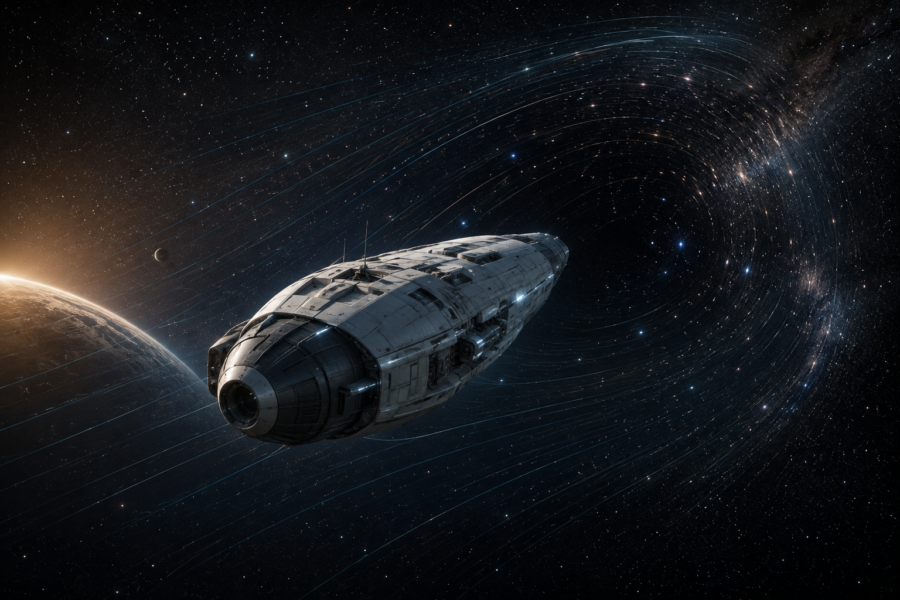
Gravity propulsion is often described as a spacecraft continually “falling forward” into a gravitational field of its own creation. The image is intuitive: instead of pushing exhaust backward, the vehicle would alter the geometry or fields that determine its path. General relativity makes dynamic spacetime scientifically real. What has not been demonstrated is a machine capable of producing a strong, controllable and propulsion-ready distortion of that geometry.
This article distinguishes established physics from theoretical possibility, experimental uncertainty and technological speculation. A valid equation does not by itself identify a material capable of producing the required geometry. A patent, government report or funded project documents interest; it does not independently demonstrate that the proposed device works.
What “Falling Forward” Means
Objects in orbit are already falling forward. The Moon continually falls toward Earth, but its sideways motion causes it to keep missing. A satellite does the same thing closer to Earth. Neither requires a motor to maintain an ideal orbit; each follows a path determined by its motion and the surrounding spacetime geometry.
Gravity propulsion extends this picture into a hypothetical technology. Imagine that a craft could create a gravitational gradient just ahead of itself. The vehicle would accelerate toward the lower gravitational potential. If the gradient moved with the craft, the vehicle might continue accelerating without expelling conventional propellant.
This mental picture explains the attraction of the concept, but it immediately produces a deeper question: what creates and moves the gravitational gradient? If a field generator must continually remain ahead of the craft, its operation cannot be explained by saying that the craft is merely falling toward it. The generator, field source, energy system and complete craft-field configuration must be analyzed as one physical system.
The important scientific problem is not whether an object can fall through curved spacetime—it can. The problem is whether a finite device can generate, shape, move and safely control the required curvature.
Gravity as Geometry—not an Ordinary Pulling Substance
In Newtonian physics, gravity can be represented as a force between masses. General relativity provides a deeper description: matter and energy influence spacetime geometry, and freely moving matter and light follow paths through that geometry.
This is why astronauts in orbit feel weightless even though Earth’s gravity remains strong. They and their spacecraft are accelerating together along neighboring free-fall paths. Their shared motion removes the supporting force that people ordinarily experience as weight.
A proposed gravity drive must therefore specify what it changes. Possibilities might include:
- the local gravitational field;
- gravitomagnetic components associated with moving or rotating mass-energy;
- the distribution of stress-energy surrounding a vehicle;
- the effective geometry through which the vehicle travels;
- or a new interaction not contained in presently verified gravitational theory.
These possibilities cannot be treated as synonyms. An experiment showing an unusual force near a rotating superconductor, for example, would not automatically demonstrate an Alcubierre-type warp geometry. It would first be necessary to establish exactly what changed and eliminate electromagnetic, mechanical, thermal and instrumental explanations.
Did a balance reading change? Did an object accelerate without contact? Did a gyroscope precess? Did local gravitational acceleration change? Was momentum transferred to an electromagnetic field or surrounding apparatus? “Gravity changed” is not a sufficiently precise experimental result.
Falling Through an Existing Gravitational Field
Using an existing gravitational field for propulsion is well established. Space missions routinely use gravitational assists, orbital transfers and controlled falls toward planetary bodies. These maneuvers exchange energy and momentum with known celestial systems and can be calculated with extraordinary precision.
A spacecraft can also produce gravity-like conditions through acceleration or rotation. A rotating habitat can press occupants toward its outer wall, while a linearly accelerating spacecraft can create an experience locally similar to standing in gravity. These methods do not generate a new gravitational field; they use acceleration to reproduce some of gravity’s effects.
Neither method provides what gravity-propulsion advocates usually mean by gravity control. A gravity assist depends on a pre-existing astronomical mass, while rotational or linear artificial gravity depends on ordinary motion. The more radical proposal is that a craft could create a useful spacetime gradient itself.
| Concept | Physical basis | Present status |
|---|---|---|
| Orbital free fall | Motion through an existing gravitational geometry | Established |
| Gravity assist | Energy and momentum exchange with a moving astronomical body | Operational technology |
| Rotational artificial gravity | Centripetal acceleration | Established in principle |
| Self-generated gravitational gradient | Proposed controlled production of a local gravity field | Not demonstrated as propulsion |
| Warp-drive geometry | Engineered spacetime configuration described through general relativity | Mathematical research |
Could a Craft Create a Field Ahead of Itself?
The simplest gravity-propulsion illustration places an attractive field ahead of a craft. The vehicle falls toward the field, while the field moves forward so the craft never reaches its source. This resembles moving a depression across a flexible surface while an object rolls toward it.
The analogy is useful but incomplete. In ordinary gravity, the source of the field is mass-energy. If the craft carries that source, the internal forces between the source and the rest of the craft cannot accelerate the system’s center of mass without an external exchange. Moving internal components may shift the craft temporarily, but it does not create sustained reactionless propulsion.
A successful theory must therefore explain at least one of the following:
- how momentum is exchanged with an external field or environment;
- how the entire spacetime configuration moves while satisfying the relevant field equations;
- how radiation or another emitted quantity carries compensating momentum;
- or why a presently accepted conservation principle does not apply in the proposed situation.
General relativity permits subtler global behavior than elementary Newtonian mechanics, but it does not make energy and momentum bookkeeping optional. The geometry, matter, fields and boundary conditions must be solved together.
A craft cannot ordinarily pull itself forward by placing a mass at its own nose, just as a person cannot lift a vehicle by pulling upward on its interior. Gravity propulsion requires more than an attractive component located in front of the cabin.
How the Alcubierre Metric Differs
In 1994, physicist Miguel Alcubierre presented a spacetime metric in which a compact region could be transported by expansion behind it and contraction ahead of it. Locally, a passenger inside the region would not need to move through nearby spacetime faster than light. The global geometry would produce the displacement.
The Alcubierre proposal was a legitimate solution constructed within general relativity under specified assumptions. It transformed a science-fiction intuition into mathematics that could be examined and criticized. It did not identify a material, field generator or engineering process capable of building the geometry.
The original model is associated with severe difficulties:
- negative energy density or violations of classical energy conditions;
- immense energy requirements;
- formation and shutdown of the bubble;
- horizon and control problems at superluminal speed;
- stability and radiation concerns;
- causality problems, including possible connections to closed timelike curves;
- and the absence of a demonstrated physical source.
Later researchers have explored alternative shapes, subluminal configurations, soliton-like solutions and methods intended to reduce or avoid particular energy-condition problems. Alexey Bobrick and Gianni Martire developed a broader framework for physical warp-drive spacetimes and emphasized an important limitation: a warp configuration still requires propulsion to accelerate. Erik Lentz proposed hyper-fast soliton solutions sourced by positive energy densities in a particular theoretical construction.
Those proposals generated productive debate rather than a settled engineering pathway. Jessica Santiago, Sebastian Schuster and Matt Visser subsequently argued that physically reasonable warp drives in the examined class still violate standard energy conditions when all relevant observers are considered. This disagreement illustrates real theoretical science: proposed solutions are tested against increasingly comprehensive constraints.
A newer warp-drive paper may improve a mathematical model without producing a machine design. “Positive energy appears in this calculation” and “ordinary matter can build this spacecraft” are not equivalent conclusions.
The Missing Physical Source
Einstein’s field equations relate spacetime geometry to stress-energy. In simplified language, geometry is not chosen freely and then detached from matter. A proposed geometry must be associated with a physically meaningful distribution of energy, momentum, pressure and stress.
This creates an inverse problem for metric engineering:
- Specify the desired motion or geometry.
- Calculate the stress-energy required to produce it.
- Determine whether any known or plausible physical system can supply that stress-energy.
- Test whether the configuration is stable, controllable and compatible with conservation laws.
- Determine whether it can be created and controlled from the craft rather than imposed by an external, already-prepared structure.
The second step is often where an attractive drawing becomes difficult physics. A mathematically definable stress-energy tensor may require negative energy, extreme pressure, enormous energy density or a distribution that cannot be assembled from known materials.
Quantum theory does permit limited negative energy densities in particular contexts, such as certain vacuum-state configurations. However, quantum inequalities constrain their magnitude and duration. The existence of a small quantum effect does not establish that it can be scaled into a macroscopic, stable propulsion field.
A geometry may be mathematically describable but physically unavailable. A physical effect may exist but be too weak to use. A measurable effect may be real but uncontrollable. A controllable effect may still be energetically, thermally or structurally impractical.
Energy and Momentum Accounting
Conventional propulsion makes its momentum exchange visible. A rocket accelerates exhaust backward and receives an opposing momentum change. An ion thruster does the same with electrically accelerated ions. A solar sail exchanges momentum with photons.
A gravity-propulsion proposal may involve more complicated accounting, but it must still identify the complete system. Relevant contributions could include:
- electromagnetic fields;
- gravitational radiation;
- stress in surrounding materials;
- interaction with an external gravitational environment;
- momentum carried by emitted particles or radiation;
- or global changes in the field configuration.
An experiment reporting thrust should be tested for vibration, thermal expansion, magnetic coupling, electrostatic forces, outgassing, cable forces, chamber interactions and instrumental drift. Extremely small force measurements are especially vulnerable because ordinary laboratory effects can be larger than the proposed signal.
Energy efficiency also cannot be inferred merely from the absence of visible exhaust. Producing a field could require vastly more energy than accelerating propellant. The efficiency question can only be answered after the field source, coupling and complete energy budget are known.
What measurable momentum leaves or enters the total system, what energy produces the effect, and does the result persist when the apparatus is isolated, reversed, shielded and independently replicated?
Occupants, Acceleration and Tidal Forces
Gravity propulsion is often imagined as a way to perform extreme maneuvers without crushing occupants. That conclusion is possible only under specific field conditions.
If the craft and everything inside it followed nearly parallel free-fall paths through a sufficiently uniform local geometry, occupants might experience little proper acceleration. This resembles orbital weightlessness: the spacecraft and occupants fall together.
A nonuniform gravitational field creates tidal forces. Different parts of the craft accelerate differently. Strong gradients could stretch, compress or shear the vehicle and its occupants. Producing a large acceleration while maintaining a safely uniform field across the entire cabin would be a major design requirement.
The distinction is therefore between:
- coordinate acceleration observed from outside the craft;
- proper acceleration measured by an accelerometer carried inside;
- and tidal acceleration between separated points in the craft.
A vehicle could appear to change velocity rapidly while occupants experience reduced proper acceleration in some hypothetical geometries. That does not imply that every gravity-control proposal automatically protects its passengers.
“The occupants fall with the craft” is not enough. A viable system must demonstrate acceptable field uniformity, tidal forces, radiation exposure, structural stress and safe failure behavior.
Would the Same Craft Travel Through Space, Air and Water?
A propulsion system that does not require atmospheric oxygen or reaction mass could, in principle, operate in more than one environment. That does not mean the surrounding environment would cease to matter.
A craft moving rapidly through air must address compression, shock waves, heating, drag and interaction with surrounding matter. Underwater travel adds much greater density, pressure, cavitation and fluid displacement. A useful spacetime configuration might alter these interactions, but that result must be calculated rather than assumed.
For a field to carry nearby air or water smoothly with the craft, it would need to establish appropriate motion throughout a surrounding region. The transition at the field boundary could itself produce extreme gradients, turbulence, radiation or pressure changes. Moving a larger volume of surrounding matter also changes the energy and momentum requirements.
| Environment | Primary challenge | What a proposed field must demonstrate |
|---|---|---|
| Vacuum | Propulsion, energy, heat rejection and navigation | Controllable motion with complete momentum accounting |
| Atmosphere | Drag, compression, heating and shock formation | Predicted interaction between the field, craft and surrounding gas |
| Underwater | Pressure, density, cavitation and fluid displacement | Safe movement of the craft-field boundary through dense fluid |
Seamless space-to-air-to-sea travel is therefore a valuable research question, not an established consequence of gravity propulsion.
Superconductors and Gravitomagnetism
General relativity predicts gravitomagnetic effects associated with moving mass-energy, somewhat as moving electric charge produces magnetism. These effects are real but ordinarily extremely weak. Measurements involving Earth and orbiting gyroscopes have tested aspects of frame dragging.
Interest in superconductors arose partly from proposals that coherent quantum states might modify or enhance gravitomagnetic behavior. Ning Li and Douglas Torr published theoretical work examining gravitomagnetic fields in superconductors. Li later became associated with proposed “AC gravity” concepts and efforts to pursue laboratory-scale gravitational effects.
This history contains several different evidence categories:
- peer-reviewed theoretical papers;
- patents and proposed apparatus;
- reported government funding;
- historical accounts of experiments;
- and claims that have not produced a publicly available, independently replicated propulsion system.
The existence of the theoretical work is factual. The conclusion that superconductors can generate useful artificial gravity remains unestablished.
A 2010 Defense Intelligence Reference Document surveyed the historical role of superconductors in gravity research. Its existence shows that the subject received official analytical attention. It should not be interpreted as government verification of a functioning gravity-control device.
“Researchers and government programs examined the possibility” is supportable. “Government interest proves the technology works” is not.
Metamaterials, Quantum States and Metric Engineering
Metamaterials are engineered structures whose collective electromagnetic behavior can differ substantially from that of their component materials. They can manipulate waves in unusual ways and have enabled important advances in optics, antennas and materials science.
This success has encouraged speculation that specially designed media, coherent quantum systems, plasmas or vacuum-state effects might eventually influence gravitational phenomena. Such proposals deserve individual evaluation, but electromagnetic control does not automatically imply gravitational control. In general relativity, electromagnetic energy gravitates, yet producing an appreciable curvature normally requires enormous energy density.
A claim that a metamaterial “amplifies gravity” must therefore supply:
- a defined physical model;
- the coupling between electromagnetic behavior and spacetime geometry;
- quantitative predictions;
- energy and stability calculations;
- an experimental signature distinguishable from ordinary electromagnetism;
- and independent replication.
Quantum coherence may produce collective behavior that individual particles do not show. It does not follow that every coherent system creates a macroscopic gravitational anomaly. The size of the predicted effect remains essential.
General relativity establishes that spacetime is dynamic. Quantum theory establishes that vacuum and matter possess nonclassical structure. The open question is whether any attainable arrangement can produce strong, controllable and safe geometry—not whether geometry can change at all.
For a broader treatment, visit Metric Engineering: Can Spacetime Become Technology?
What UAP Observations Could Contribute
Some UAP reports describe apparent rapid acceleration, abrupt directional changes, hovering, low-observable flight or movement across different environments. If rigorously measured, such performance could motivate questions about unconventional propulsion.
Observation of performance does not directly reveal mechanism. Before acceleration can be calculated, investigators need reliable distance, timing, viewing geometry, sensor calibration and trajectory reconstruction. Apparent motion may also be affected by parallax, tracking behavior, image processing, atmospheric conditions or incomplete contextual information.
Even an exceptionally documented maneuver would initially establish what the object did—not whether it used gravity control, inertial modification, plasma effects, conventional technology, sensor deception or another mechanism.
High-quality observations can define performance requirements and testable signatures. Theory can then ask which mechanisms are compatible with those signatures. The direction should run from reliable measurement toward constrained explanation—not from a preferred mechanism toward selective interpretation.
For the site’s wider evidentiary framework, explore UAP Investigation and Propulsion & Engineering.
How Gravity Propulsion Should Be Tested
A useful experiment must convert a broad claim into a specific prediction. “The device alters gravity” should become a statement such as:
- the apparatus will produce a force of a specified magnitude and direction;
- the signal will scale according to a stated variable;
- reversing a component will reverse the predicted effect;
- the effect will persist under shielding or disappear under a defined control condition;
- and independent laboratories will be able to reproduce the result.
A disciplined experimental sequence
- Define the observable. Specify force, acceleration, field strength, gyroscope response, timing shift or another measurable quantity.
- Calculate conventional backgrounds. Model electromagnetic, thermal, acoustic, mechanical, electrostatic and environmental effects.
- Blind the analysis where practical. The person evaluating the data should not always know when the device is active.
- Reverse and rotate the apparatus. A real directional effect should follow its predicted geometry.
- Use independent instruments. Different measurement principles should detect compatible results.
- Replicate externally. The effect must survive transfer to another laboratory and research team.
- Account for energy and momentum. Measure the complete system rather than only the component expected to move.
- Test scaling. A propulsion concept must show whether its effect can grow without impossible power, heat or structural demands.
A patent can protect a claimed invention without proving that nature behaves as proposed. A video may show motion without revealing hidden forces or the complete apparatus. Replicable measurement is the bridge between claim and technology.
Evidence Ladder and Technology Readiness
Gravity-propulsion ideas are often discussed as though every supporting item belongs at the same level. A clearer assessment uses an evidence ladder:
- Conceptual analogy: A verbal or visual explanation such as “falling forward.”
- Mathematical model: A defined geometry or field configuration with internally examinable equations.
- Physically credible source: Matter and fields capable of producing the required conditions without hidden contradictions.
- Laboratory anomaly: A measurable effect that survives appropriate controls.
- Independent replication: Multiple teams reproduce the effect with compatible results.
- Controllable engineering effect: Magnitude, direction, modulation and shutdown can be reliably managed.
- Propulsion demonstration: A freely moving system produces useful acceleration with complete energy and momentum accounting.
- Operational technology: The system scales safely, efficiently and reliably outside the original laboratory.
Most current gravity-propulsion discussion occupies the first three levels. Some disputed experiments claim level four, but no publicly established program has progressed through the entire ladder to an independently validated operational vehicle.
| Research area | Strongest defensible status | What remains missing |
|---|---|---|
| General relativity and dynamic spacetime | Experimentally successful physical theory | A technology for producing strong local geometry on demand |
| Alcubierre and related warp metrics | Mathematical and theoretical research | Physical source, construction, control, stability and safety |
| Superconductor gravity-control claims | Historical theory and disputed experimentation | Robust independent replication and a verified mechanism |
| Metamaterial gravity proposals | Exploratory hypotheses | Quantitative prediction and verified gravitational coupling |
| UAP gravity-propulsion interpretation | Hypothesis applied to incomplete observations | Reliable performance data and mechanism-specific evidence |
Ecological and Civilizational Implications
If humanity ever developed practical control over gravitational or spacetime effects, the consequences would extend far beyond faster spacecraft. Transportation, energy systems, access to space, infrastructure, resource distribution and planetary defense could all be transformed.
The technology could reduce dependence on combustion and reaction mass, but environmental benefit would not be automatic. Its real impact would depend on energy sources, field effects, manufacturing requirements, ecological disruption and political control.
A technology capable of moving large masses or producing extreme accelerations could also become a powerful weapon. Research governance, transparent verification and international cooperation would therefore be as important as the physics.
Transformative capability without ethical, ecological and democratic safeguards could magnify existing inequalities. Scientific possibility and civilizational readiness are separate questions that must evolve together.
- “Falling forward” is an explanatory metaphor, not yet an engineering mechanism. A practical system would require a physical source for the proposed field, complete energy and momentum accounting, controllability, stability and safe operation.
- Warp metrics, artificial gravitational gradients, gravitomagnetism and inertial modification are related but different ideas. Evidence for one does not automatically validate the others.
- No publicly demonstrated device has established useful gravity propulsion. The field presently consists of accepted gravitational physics, mathematical spacetime models, exploratory experiments, disputed effects and unverified technological claims.
Conclusion: A Worthy Question with an Unfinished Answer
“Falling forward” remains one of the clearest ways to imagine gravity propulsion. It captures a profound possibility: perhaps future vehicles will not move only by pushing matter backward, but by interacting with the geometry that defines motion itself.
Modern physics does not permit us to dismiss that possibility merely because it sounds extraordinary. Spacetime is dynamic. Gravitational waves exist. Rotating mass produces frame dragging. Quantum systems exhibit collective behavior that earlier physics could not anticipate. Mathematical research continues to expose unexpected spacetime configurations.
At the same time, none of these facts establishes a working gravity drive. Between a warp metric and a spacecraft lie the physical source, energy conditions, momentum accounting, field control, stability, thermal management, navigation, occupant safety and independent demonstration.
The responsible position is therefore neither automatic rejection nor premature belief. Gravity propulsion should be treated as a demanding frontier research program: imaginative enough to investigate unfamiliar possibilities, disciplined enough to state what the evidence does not yet show.
The future may reveal that useful spacetime engineering is impossible, severely limited or achievable only under conditions humanity has not yet discovered. Even a negative answer would deepen our understanding of gravity. A positive answer would change the trajectory of civilization.
For now, “falling forward” is not a description of an existing engine. It is a scientifically meaningful question about whether geometry itself can ever become technology.
Frequently Asked Questions
Has gravity propulsion been demonstrated?
No publicly available experiment has established a controllable, independently replicated gravity-propulsion system capable of useful vehicle motion. Accepted gravitational physics, theoretical warp metrics and disputed laboratory claims should not be treated as equivalent evidence.
Does the Alcubierre metric prove that a warp engine can be built?
No. It demonstrates that a specified spacetime geometry can be described within general relativity under particular assumptions. An engine would additionally require a physically attainable source, a construction process, energy and momentum accounting, stability, control, navigation and safe startup and shutdown.
Would occupants feel acceleration inside a gravity-propelled craft?
That depends on the geometry. Occupants following free-fall paths through a sufficiently uniform local field might experience low proper acceleration. Strong field gradients could instead produce dangerous tidal forces. Passenger protection is a design requirement, not an automatic property of every gravity-drive proposal.
Could gravity propulsion eliminate atmospheric drag?
Not automatically. A proposed field would need to specify how it interacts with surrounding air, where the field boundary occurs and whether compression, heating, shock waves or radiation are produced. The same applies even more strongly to underwater travel.
Do superconductors produce artificial gravity?
Superconductors have inspired theoretical and experimental gravity research, but no superconducting device has publicly demonstrated a useful, independently replicated artificial-gravity or gravity-propulsion effect.
Does government funding prove that gravity-control technology exists?
No. Funding, technical reports and patents establish that a subject was examined or considered strategically relevant. They do not by themselves validate the underlying effect or prove that an operational device exists.
Could UAP be using gravity propulsion?
It is a possible interpretation of some reported performance characteristics, but it has not been established. Reliable trajectory and sensor data must first determine what an object actually did. Mechanism-specific evidence would then be needed to identify gravity control rather than another technology or observational explanation.
Is gravity propulsion worth researching?
Yes, when investigated with clear predictions, careful controls, proportional claims and transparent evidence. Even unsuccessful research can clarify the limits of general relativity, quantum fields, materials and precision force measurement.
Selected References
Primary and peer-reviewed sources are prioritized. Inclusion documents the relevant research; it does not imply that every proposal has been experimentally validated.
- Alcubierre, M. (1994).
The warp drive: hyper-fast travel within general relativity
. Classical and Quantum Gravity, 11, L73–L77. - Alcubierre, M., & Lobo, F. S. N. (2021).
Warp drive basics
. Review of definitions, energy conditions, horizons and causality questions. - Bobrick, A., & Martire, G. (2021).
Introducing physical warp drives
. Classical and Quantum Gravity, 38, 105009. - Lentz, E. W. (2021).
Breaking the warp barrier: hyper-fast solitons in Einstein–Maxwell-plasma theory
. Classical and Quantum Gravity, 38, 075015. - Santiago, J., Schuster, S., & Visser, M. (2022).
Generic warp drives violate the null energy condition
. Physical Review D, 105, 064038. - Natário, J. (2002).
Warp drive with zero expansion
. Classical and Quantum Gravity, 19, 1157–1165. - Pfenning, M. J., & Ford, L. H. (1997).
The unphysical nature of “warp drive”
. Classical and Quantum Gravity, 14, 1743–1751. - Li, N., & Torr, D. G. (1991).
Effects of a gravitomagnetic field on pure superconductors
. Physical Review D, 43, 457–459. - Defense Intelligence Agency (2010).
The Role of Superconductors in Gravity Research
. Defense Intelligence Reference Document. - Millis, M. G. (Ed.). NASA Breakthrough Propulsion Physics research and technical assessments. These materials document exploratory propulsion questions while distinguishing speculative concepts from demonstrated systems.
Continue through the site’s scientific framework at
Gravity Science,
Propulsion & Engineering,
and
Metric Engineering.














Leave a Reply