

Vatican’s Evolving Stance on Alien Life: Science and Faith Converge
Vatican Embraces the Possibility of Alien Life
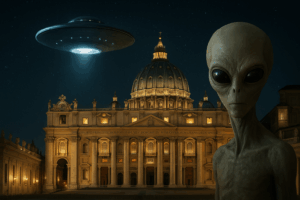
A UFO shines down over the illuminated Vatican as an alien observes, reflecting the Church’s open dialogue on life beyond Earth.
For centuries, speculation about life beyond Earth lived on the fringes of accepted thought – even brushed off as heresy in the distant past. Today, the Vatican’s tone is markedly different: church officials openly acknowledge that a universe “so big” may well harbor other life, and they see no conflict between extraterrestrial existence and Catholic faith. The director of the Vatican Observatory, Jesuit Father José Funes, famously said that if aliens exist, Christians should regard these beings as “an ‘extraterrestrial brother’” – fellow creatures of the same God. Such statements, emerging from interviews in the Vatican’s own newspaper, underscore an evolving stance at the highest levels of the Church. No longer is the notion of alien life dismissed; instead it is met with intellectual curiosity and theological openness. The Vatican has even convened scientists to discuss astrobiology and the implications of finding life on other planets, reflecting Pope Francis’s view that truth revealed by science can comfortably coexist with spiritual truth. The message is clear: the prospect of life beyond Earth is taken seriously in Rome, and it’s “not in contrast with the faith, because we cannot place limits on the creative freedom of God”.
Theology Meets the Cosmos
This open approach to extraterrestrials represents a profound shift in theology – one that aligns cosmic possibility with Catholic doctrine rather than opposing it. Church theologians and astronomers alike are exploring how traditional beliefs might expand to accommodate new discoveries. If the cosmos teems with living worlds, Vatican thinkers argue, that simply underscores God’s grandeur. “Some theologians don’t make God big enough,” one Vatican astronomer quipped in the 2016 discussion, suggesting that an overly narrow view of creation would be challenged by alien life. Indeed, Catholic teaching has gradually evolved to embrace a more universalized view of salvation and creation. Father Funes, for example, mused that an extraterrestrial civilization might not share in humanity’s fall from grace – and therefore might not need redemption through Christ. This isn’t seen as heresy but as reasonable theological speculation: if God’s mercy crafted countless worlds, some beings could remain “in full friendship with their creator” without ever experiencing original sin. At the same time, core doctrines remain intact. The Vatican emphasizes that Christ’s incarnation was a unique event for us on Earth, but as Funes noted, God’s mercy would surely “be offered to aliens, as it was to humans,” should other fallen creatures be out there. Even Pope Francis has weighed in with a bit of humor to make a serious point. In a 2014 homily he imagined a Martian asking for baptism – “Martians, right? Green, with that long nose and big ears…” – and said he wouldn’t turn them away. His message echoed the Bible’s call to openness: if God grants grace to others, “who are we to close the doors” to anyone, even an alien? It’s a striking illustration of how Catholic theology can stretch to welcome whatever – or whomever – the universe may bring.
Science, Spirituality, and Our Cosmic Future
Beyond theology, the Vatican’s candid interest in extraterrestrial life has significant scientific and cultural implications. The Church isn’t just passively accepting the idea of aliens – it’s actively engaging with the science behind it. The Vatican Observatory (one of the world’s oldest astronomical institutions) hosts conferences on astrobiology and supports research hunting for “biomarkers” on distant planets. Vatican astronomers like Brother Guy Consolmagno, SJ, stress that empirical discovery, not doctrine, should guide the conversation about alien life. In fact, the Church has no official teaching declaring extraterrestrials either real or impossible; instead, it has signaled that it will adapt its understanding based on what science reveals. This convergence of science and spirituality is striking. Roman Catholic leaders are effectively saying that discovering life beyond Earth would deepen, not diminish, humanity’s sense of wonder. Far from fearing the outcome, they frame the search for ET as part of a God-given curiosity – “a desire to understand our place in God’s Creation,” as Vatican scholars put it. This perspective resonates strongly with the themes of the Taming Gravity project, which examines how scientific exploration and spiritual evolution can go hand in hand. Just as Taming Gravity delves into advanced science and the mysteries of existence, the Vatican’s stance on alien life highlights a similar fusion of forward-thinking science with a profound spiritual framework. Both invite us to imagine a future where exploring the stars and nurturing the soul are complementary journeys. The implication is bold and hopeful: humanity’s evolution – whether technological, intellectual, or spiritual – may involve embracing a larger cosmic community, all under the same heavenly Creator.
Key Takeaways:
- Vatican Open to ET Life: The Catholic Church today acknowledges the possibility of extraterrestrial life and insists that believing in aliens “is not in contrast with the faith” – a dramatic shift from its historically cautious stance.
- Theology Without Borders: Leading Vatican theologians suggest that aliens would be part of God’s creation, even calling them “extraterrestrial brothers.” They argue that such beings might not require redemption if they haven’t fallen into sin, underscoring a theology flexible enough to include life across the cosmos.
- Science & Faith Converge: The Vatican actively bridges science and spirituality on this issue. It hosts astronomical research on exoplanets and astrobiology, indicating that the Church will let scientific discovery inform its understanding of God’s universe. This reflects a broader trend of embracing scientific insights (like evolution and the Big Bang) as compatible with faith.
“Some theologians don’t make God big enough,” observed Br. Guy Consolmagno, the Vatican’s chief astronomer, suggesting that faith must expand to embrace a universe potentially teeming with life.
Call to Action
The Vatican’s exploration of alien life is more than a curiosity – it’s a call to expand our perspective on science, faith, and the future of humanity. If we are on the verge of discovering we’re not alone, what would that mean for our understanding of God, ourselves, and our place in the cosmos? UFO 2016 – The Vatican on Alien Life challenges us to ponder these profound questions. Now it’s your turn: watch the conversation, reflect on its implications, and join the discussion. Visit TamingGravity.com to delve deeper into the converging worlds of modern science and spiritual insight, and to explore how we might all evolve as we seek to tame the great mysteries of the universe.
Read CBS article: here
~Comments always welcome…
Related Content:
References:
- Associated Press (YouTube Channel)
- CBSNews.com













Leave a Reply